
Homework Answers
Add Answer to:
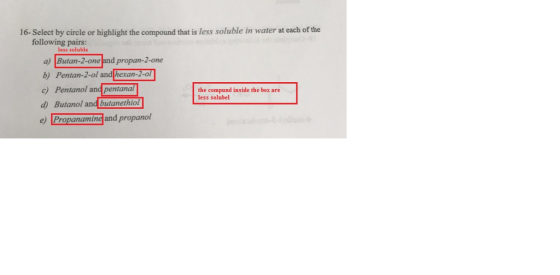
Select by circle or highlight the compound that is less soluble in water at each of...
Part 1: Predict which compound in each pair is more acidic. Explain your answers. a) cyclopentanol...
Part 1: Predict which compound in each pair is more acidic. Explain your answers. a) cyclopentanol or 3-clorophenol b) cyclohexanol or cyclohexantiol c) cyclohexanol or cyclohexanecarboxylic acid d) 2,2-dichlorobutan-1-ol or butan-1-ol Part 2: Predict which compound in each group is more soluble in water. Explain your answers. a) butan-1-ol, pentan-1-ol or propan-2-ol b) chlorocyclohexane, cyclohexanol or cyclohexane-1,2-diol c) phenol, cyclohexanol or 4-methylcyclohexanol
EXPERIMENT 4 Organic Families - Reactions and Identification of Functional Groups PART A. Reactions of Alkanes and Alkenes 1. Action of Bromine Water Observation Organic Compound cyclohexene c...
 EXPERIMENT 4 Organic Families - Reactions and Identification of Functional Groups PART A. Reactions of Alkanes and Alkenes 1. Action of Bromine Water Observation Organic Compound cyclohexene cyclohexane Equations: Write an equation for the above compounds which caused a decolourisation of bromine water. Name and draw all reactants and products. Distinguishing Test for Primary, Secondary and Tertiary Alcohols PART B. 1. Lucas Test for Alcohols Organic Compound tert-pentanol (2-methyl 2-butanol) 2-pentanol Observation 1-pentanol Equations: Write an equation for the above...
9) Select the compound that is more water soluble and a state a reason why a....
 9) Select the compound that is more water soluble and a state a reason why a. 3-pentanamine or N-ethyl-2-propanamine b. 2-heptanamine or 2-pentanamine c. pentana mide or N-methylbutanamide d. hexanamide or butanamide
Please help with equations. Report Sheet Part A-Solubility of Alcohols in Water Compound Ethanol Observations 1-Butanol...
 Please help with equations.
Report Sheet Part A-Solubility of Alcohols in Water Compound Ethanol Observations 1-Butanol هاواي ام عصاو- سعاالباحث مع 2-Butanol 2-Methyl-2-propanol more than 5 carbons Soluble - Clear soluble - Clear 1-Pentanol 1-Octanol الدوله - عاالمكحة Unknown insoluble two lagers "Summarize your observations on the solubility of alcohols. Part B-Reactivity of Alcohols Toward Sodium Compound Observations Methanol Ethanol 1-Propanol 2-Propanol 2-Methyl-2-propanol Unknown *Rank the reactivity of alcohols towards sodium. Chem 130L Equation Observations Part C- Lucas Test Compound...
Please help with equations.
Report Sheet Part A-Solubility of Alcohols in Water Compound Ethanol Observations 1-Butanol هاواي ام عصاو- سعاالباحث مع 2-Butanol 2-Methyl-2-propanol more than 5 carbons Soluble - Clear soluble - Clear 1-Pentanol 1-Octanol الدوله - عاالمكحة Unknown insoluble two lagers "Summarize your observations on the solubility of alcohols. Part B-Reactivity of Alcohols Toward Sodium Compound Observations Methanol Ethanol 1-Propanol 2-Propanol 2-Methyl-2-propanol Unknown *Rank the reactivity of alcohols towards sodium. Chem 130L Equation Observations Part C- Lucas Test Compound...
QUESTIONS 1. Select a reagent that will distinguish between each pair of compound Write equations for any reaction...
 QUESTIONS 1. Select a reagent that will distinguish between each pair of compound Write equations for any reactions that occur. The reagent should react ONLY with one compound of the pair under reaction conditions. Reagent (1) l-propanol zincill 2-propanol OH Equation(s) (2) 2-butanol 2-roethyl-2-propanol (3) 1-propanol 1-chloropropane Popu (4) 1-propanol propene - (5) 2-pentanol 3-pentanol 2. Number the alcohols below according to increasing boiling points. Recall that addition of -CH - usually increases the boiling point by anout thirty degrees...
Determine if the statements below are true or false. 1. 1-pentanol is less water soluble than...
Determine if the statements below are true or false. 1. 1-pentanol is less water soluble than 1-butanol. 2. a blue-green precipitate is produced when there is chromic acid oxidation of an alcohol. The Cr+6 ion is responsible for this blue-green color. 3. methyl alcohol will react slower with sodium metal than 2-propanol. 4. a blue-green precipitate will be produced when t-butyl is treated with chromic acid 5. in order for an alcohol to be oxidized by chromic acid, it must...
3. Classify each of the following alcohols as primary, secondary, or tertiary. a. 3-pentanol SELECT ONE...
 3. Classify each of the following alcohols as primary, secondary, or tertiary. a. 3-pentanol SELECT ONE SELECT ONE b. 2-methyl-2-butanol c. 1-propanol SELECT ONE 4. If you add chromate, an oxidizing agent, to each of the following would a green Cr solution be formed? SELECT ONE a. 3-pentanol b. 2-methyl-2-butanol SELECT ONE c. 1-propanol SELECT ONE
1)Identify the molecule below with the highest predicted boiling point. Select one: a. pentane b. butanoic...
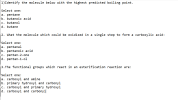 1)Identify the molecule below with the highest predicted boiling point. Select one: a. pentane b. butanoic acid c. butanol d. butane 2. What the molecule which could be oxidized in a single step to form a carboxylic acid: Select one: a. pentanal b. pentanoic acid c. pentan-2-one d. pentan-1-ol 3. The functional groups which react in an esterification reaction are: Select one: a. carboxyl and amine b. primary hydroxyl and carbonyl c. carboxyl and primary hydroxyl d. carboxyl and carbonyi
1. Of the following alcohols, _____ is likely to be least soluble in water. A. 3-pentanol...
1. Of the following alcohols, _____ is likely to be least soluble in water. A. 3-pentanol B. 1,2,3- propanetriol C. 1,2- ethanediol D. methanol E. 2-butanol
Circle the most soluble compound in n-hexane (CH3 -CH2 -CH2 -CH2 -CH2 -CH3 ) in this...
Circle the most soluble compound in n-hexane (CH3 -CH2 -CH2 -CH2 -CH2 -CH3 ) in this set: (a) ethylene glycol (b) 1-butanol (d) water (c) acetic acid Explain why
 EXPERIMENT 4 Organic Families - Reactions and Identification of Functional Groups PART A. Reactions of Alkanes and Alkenes 1. Action of Bromine Water Observation Organic Compound cyclohexene cyclohexane Equations: Write an equation for the above compounds which caused a decolourisation of bromine water. Name and draw all reactants and products. Distinguishing Test for Primary, Secondary and Tertiary Alcohols PART B. 1. Lucas Test for Alcohols Organic Compound tert-pentanol (2-methyl 2-butanol) 2-pentanol Observation 1-pentanol Equations: Write an equation for the above...
 9) Select the compound that is more water soluble and a state a reason why a. 3-pentanamine or N-ethyl-2-propanamine b. 2-heptanamine or 2-pentanamine c. pentana mide or N-methylbutanamide d. hexanamide or butanamide
 Please help with equations.
Report Sheet Part A-Solubility of Alcohols in Water Compound Ethanol Observations 1-Butanol هاواي ام عصاو- سعاالباحث مع 2-Butanol 2-Methyl-2-propanol more than 5 carbons Soluble - Clear soluble - Clear 1-Pentanol 1-Octanol الدوله - عاالمكحة Unknown insoluble two lagers "Summarize your observations on the solubility of alcohols. Part B-Reactivity of Alcohols Toward Sodium Compound Observations Methanol Ethanol 1-Propanol 2-Propanol 2-Methyl-2-propanol Unknown *Rank the reactivity of alcohols towards sodium. Chem 130L Equation Observations Part C- Lucas Test Compound...
Please help with equations.
Report Sheet Part A-Solubility of Alcohols in Water Compound Ethanol Observations 1-Butanol هاواي ام عصاو- سعاالباحث مع 2-Butanol 2-Methyl-2-propanol more than 5 carbons Soluble - Clear soluble - Clear 1-Pentanol 1-Octanol الدوله - عاالمكحة Unknown insoluble two lagers "Summarize your observations on the solubility of alcohols. Part B-Reactivity of Alcohols Toward Sodium Compound Observations Methanol Ethanol 1-Propanol 2-Propanol 2-Methyl-2-propanol Unknown *Rank the reactivity of alcohols towards sodium. Chem 130L Equation Observations Part C- Lucas Test Compound...
 QUESTIONS 1. Select a reagent that will distinguish between each pair of compound Write equations for any reactions that occur. The reagent should react ONLY with one compound of the pair under reaction conditions. Reagent (1) l-propanol zincill 2-propanol OH Equation(s) (2) 2-butanol 2-roethyl-2-propanol (3) 1-propanol 1-chloropropane Popu (4) 1-propanol propene - (5) 2-pentanol 3-pentanol 2. Number the alcohols below according to increasing boiling points. Recall that addition of -CH - usually increases the boiling point by anout thirty degrees...
 3. Classify each of the following alcohols as primary, secondary, or tertiary. a. 3-pentanol SELECT ONE SELECT ONE b. 2-methyl-2-butanol c. 1-propanol SELECT ONE 4. If you add chromate, an oxidizing agent, to each of the following would a green Cr solution be formed? SELECT ONE a. 3-pentanol b. 2-methyl-2-butanol SELECT ONE c. 1-propanol SELECT ONE
 1)Identify the molecule below with the highest predicted boiling point. Select one: a. pentane b. butanoic acid c. butanol d. butane 2. What the molecule which could be oxidized in a single step to form a carboxylic acid: Select one: a. pentanal b. pentanoic acid c. pentan-2-one d. pentan-1-ol 3. The functional groups which react in an esterification reaction are: Select one: a. carboxyl and amine b. primary hydroxyl and carbonyl c. carboxyl and primary hydroxyl d. carboxyl and carbonyi
Most questions answered within 3 hours.
-
Where is the error in this code sequence?
String s1 = "Hello";
String s2 = "ello";...
asked 10 months ago -
Financial data for Joel de Paris, Inc., for last year
follow:
Joel de Paris, Inc.
Balance...
asked 10 months ago -
Consider this reaction:
Al2(SO4)3 (aq)+ BaCl3
(aq) Al2Cl6 (aq)- +
3BaSO4(s) . What is the...
asked 10 months ago -
Suppose that Savneet is considering increasing her
recent random sample from 20 car rentals to 40...
asked 10 months ago -
Trucks arrive at an unloading terminal at an average rate of 120
per hour.
Trucks arrive...
asked 10 months ago -
Why are methanol and ethanol completely soluble in water while
octanol is not very little soluble....
asked 10 months ago -
A facilities manager at a university reads in a research report
that the mean amount of...
asked 10 months ago -
When the CuSO4 is rehydrated by adding water to the anhydrous
compound, is this an endothermic...
asked 10 months ago -
A ray of sunlight is passing from diamond into crown glass; the
angle of incidence is...
asked 10 months ago -
A block of mass 0.249 kg is placed on top of a light, vertical
spring of...
asked 10 months ago -
how do the kidneys compensate in the presences of acidosis
a) trigger hyperventilate
b) reserve acid...
asked 10 months ago -
Question 501 pts
The rental rate of capital to the firm increases. Which of the
following...
asked 10 months ago