
Homework Answers
module figures6_28 (clock, Reset, w, R1in, R1out, R2in, R2out,
R3in, R3out, Done);
input clock, Reset, w;
output reg R1in, R1out, R2in, R2out, R3in, R3out, Done;
parameter A = 2'b00, B = 2'b01, C = 2'b10;
reg [1:0] state, next_state;
always @ (posedge clock or Reset)
begin
if (Reset)
state <= A;
else
state <= next_state;
end
always @ (state or w)
begin
R1in <= 1'b0;
R1out<= 1'b0;
R2in <= 1'b0;
R2out<= 1'b0;
R3in <= 1'b0;
R3out<= 1'b0;
Done <= 1'b0;
case (state)
A: if (w) begin
next_state <= B;
R2out <=
1'b1;
R3in <= 1'b1;
end
else
next_state <= A;
B: begin
next_state <= C;
R1out <=
1'b1;
R2in <= 1'b1;
end
C: begin
next_state <= A;
R3out <=
1'b1;
R1in <=
1'b1;
Done <= 1'b1;
end
default: next_state <= A;
endcase
end
endmodule
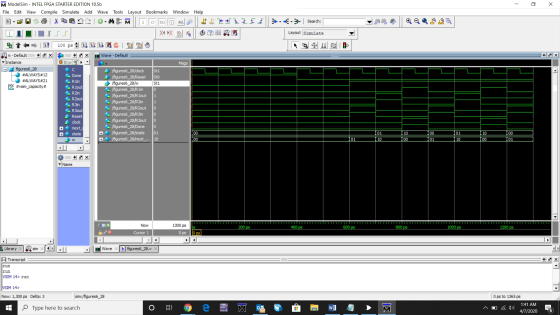
//Simulated on ModelSim
Add Answer to:
could you write a verilog code for figure 6.28 please.
CHAPTER 6 SYNCHRONOUS SEQUENTIAL CIRCUITS Reset...
please ansawer all thank you 1. Which of the following circuits are synchronous sequential circuits? Explain....
 please ansawer all thank you
1. Which of the following circuits are synchronous sequential circuits? Explain. CLK CLK CLK 2. Design an elevator controller for a building with 5 floors. This elevator only moves one floor at a time and only has inputs UP and DOWN. It produces an output indicating the floor the elevator is currently on. How many bits of state should you use? Draw the State Diagram only (do not write any Truth Tables).
please ansawer all thank you
1. Which of the following circuits are synchronous sequential circuits? Explain. CLK CLK CLK 2. Design an elevator controller for a building with 5 floors. This elevator only moves one floor at a time and only has inputs UP and DOWN. It produces an output indicating the floor the elevator is currently on. How many bits of state should you use? Draw the State Diagram only (do not write any Truth Tables).
write c++ code
 Task 1. In digital electronics and modern computer hardware, a flip-flop is a sequential digital circuit used as a basic memory element. It has two stable states and can be used to store state information. One of its states represents ‘1’ while the other represents ‘0’. The most common types of flip-flops are SR-flip-flop, JK-flip-flop, and D flip-flop. When used in a finite-state machine, the output and next state depend not only on its current input but also on its current...
how slove 4-34, 4-35, 4-36??? I dont know that! please hlep me! 306 □ CHAPTER 4/SEQUENTIAL CIRCUITS OTABLE 4-16...
 how slove 4-34, 4-35, 4-36??? I dont know that! please hlep me!
306 □ CHAPTER 4/SEQUENTIAL CIRCUITS OTABLE 4-16 State Table for Problem 4-33 Next State Input Output Present State 4-36 4-37 0 0 0 0 4-38 Design the circuit specified by Table 4-14 and use the sequence from Problen 4-31 (either yours or the one posted on the text website) to perform an automatic logic simulation-based verification of your design. 4 433. The state table for a sequential circuit...
how slove 4-34, 4-35, 4-36??? I dont know that! please hlep me!
306 □ CHAPTER 4/SEQUENTIAL CIRCUITS OTABLE 4-16 State Table for Problem 4-33 Next State Input Output Present State 4-36 4-37 0 0 0 0 4-38 Design the circuit specified by Table 4-14 and use the sequence from Problen 4-31 (either yours or the one posted on the text website) to perform an automatic logic simulation-based verification of your design. 4 433. The state table for a sequential circuit...
please provide the answers of the 4 points thanks? C Tarek Ould-Bachir, PEng,PhD. Design of Sequential Circuits ise 10. nesign the sequential circuit illustrated by Figure 11 Sequence Detector. Th...
 please provide the answers of the 4 points thanks?
C Tarek Ould-Bachir, PEng,PhD. Design of Sequential Circuits ise 10. nesign the sequential circuit illustrated by Figure 11 Sequence Detector. The cireuit has an input X and wo outputs Y and Z. The output Y goes high (1) whenever the sequence 1-0-1 has been detected on x. The output Z goes high (1) whenever the sequence 1-1 has been detected on X. Figure 11 Sequence Detector #2 1 Draw the state...
please provide the answers of the 4 points thanks?
C Tarek Ould-Bachir, PEng,PhD. Design of Sequential Circuits ise 10. nesign the sequential circuit illustrated by Figure 11 Sequence Detector. The cireuit has an input X and wo outputs Y and Z. The output Y goes high (1) whenever the sequence 1-0-1 has been detected on x. The output Z goes high (1) whenever the sequence 1-1 has been detected on X. Figure 11 Sequence Detector #2 1 Draw the state...
In this lab, you will design a finite state machine to control the tail lights of...
 In this lab, you will design a finite state machine to control the tail lights of an unsual car. There are three lights on each side that operate in sequence to indicate thedirection of a turn. Figure ! shows the tail lights and Figure 2 shows the flashing sequence for (a) left turns and (b) right rums. ZOTTAS Figure 28:8: BCECECece BCECECECes BCECECECB BCECECBCB 8888 Figure 2 Part 1 - FSM Design Start with designing the state transition diagram for...
Objective: In this lab, we will learn how we can design sequential circuits using behavioral mode...
 Just need the code for the
random counter,Thanks
Objective: In this lab, we will learn how we can design sequential circuits using behavioral modelling, and implementing the design in FPGA. Problem: Design a random counter with the following counting sequence: Counting Sequence: 04 2 9 168573 Design Description: The counter has one clock (Clock), one reset (Reset), and one move left or right control signal (L/R) as input. The counter also has one 4bit output O and one 2bit output...
Just need the code for the
random counter,Thanks
Objective: In this lab, we will learn how we can design sequential circuits using behavioral modelling, and implementing the design in FPGA. Problem: Design a random counter with the following counting sequence: Counting Sequence: 04 2 9 168573 Design Description: The counter has one clock (Clock), one reset (Reset), and one move left or right control signal (L/R) as input. The counter also has one 4bit output O and one 2bit output...
 please ansawer all thank you
1. Which of the following circuits are synchronous sequential circuits? Explain. CLK CLK CLK 2. Design an elevator controller for a building with 5 floors. This elevator only moves one floor at a time and only has inputs UP and DOWN. It produces an output indicating the floor the elevator is currently on. How many bits of state should you use? Draw the State Diagram only (do not write any Truth Tables).
please ansawer all thank you
1. Which of the following circuits are synchronous sequential circuits? Explain. CLK CLK CLK 2. Design an elevator controller for a building with 5 floors. This elevator only moves one floor at a time and only has inputs UP and DOWN. It produces an output indicating the floor the elevator is currently on. How many bits of state should you use? Draw the State Diagram only (do not write any Truth Tables).
 how slove 4-34, 4-35, 4-36??? I dont know that! please hlep me!
306 □ CHAPTER 4/SEQUENTIAL CIRCUITS OTABLE 4-16 State Table for Problem 4-33 Next State Input Output Present State 4-36 4-37 0 0 0 0 4-38 Design the circuit specified by Table 4-14 and use the sequence from Problen 4-31 (either yours or the one posted on the text website) to perform an automatic logic simulation-based verification of your design. 4 433. The state table for a sequential circuit...
how slove 4-34, 4-35, 4-36??? I dont know that! please hlep me!
306 □ CHAPTER 4/SEQUENTIAL CIRCUITS OTABLE 4-16 State Table for Problem 4-33 Next State Input Output Present State 4-36 4-37 0 0 0 0 4-38 Design the circuit specified by Table 4-14 and use the sequence from Problen 4-31 (either yours or the one posted on the text website) to perform an automatic logic simulation-based verification of your design. 4 433. The state table for a sequential circuit...
 please provide the answers of the 4 points thanks?
C Tarek Ould-Bachir, PEng,PhD. Design of Sequential Circuits ise 10. nesign the sequential circuit illustrated by Figure 11 Sequence Detector. The cireuit has an input X and wo outputs Y and Z. The output Y goes high (1) whenever the sequence 1-0-1 has been detected on x. The output Z goes high (1) whenever the sequence 1-1 has been detected on X. Figure 11 Sequence Detector #2 1 Draw the state...
please provide the answers of the 4 points thanks?
C Tarek Ould-Bachir, PEng,PhD. Design of Sequential Circuits ise 10. nesign the sequential circuit illustrated by Figure 11 Sequence Detector. The cireuit has an input X and wo outputs Y and Z. The output Y goes high (1) whenever the sequence 1-0-1 has been detected on x. The output Z goes high (1) whenever the sequence 1-1 has been detected on X. Figure 11 Sequence Detector #2 1 Draw the state...
 In this lab, you will design a finite state machine to control the tail lights of an unsual car. There are three lights on each side that operate in sequence to indicate thedirection of a turn. Figure ! shows the tail lights and Figure 2 shows the flashing sequence for (a) left turns and (b) right rums. ZOTTAS Figure 28:8: BCECECece BCECECECes BCECECECB BCECECBCB 8888 Figure 2 Part 1 - FSM Design Start with designing the state transition diagram for...
 Just need the code for the
random counter,Thanks
Objective: In this lab, we will learn how we can design sequential circuits using behavioral modelling, and implementing the design in FPGA. Problem: Design a random counter with the following counting sequence: Counting Sequence: 04 2 9 168573 Design Description: The counter has one clock (Clock), one reset (Reset), and one move left or right control signal (L/R) as input. The counter also has one 4bit output O and one 2bit output...
Just need the code for the
random counter,Thanks
Objective: In this lab, we will learn how we can design sequential circuits using behavioral modelling, and implementing the design in FPGA. Problem: Design a random counter with the following counting sequence: Counting Sequence: 04 2 9 168573 Design Description: The counter has one clock (Clock), one reset (Reset), and one move left or right control signal (L/R) as input. The counter also has one 4bit output O and one 2bit output...
Most questions answered within 3 hours.
-
Where is the error in this code sequence?
String s1 = "Hello";
String s2 = "ello";...
asked 10 months ago -
Financial data for Joel de Paris, Inc., for last year
follow:
Joel de Paris, Inc.
Balance...
asked 10 months ago -
Consider this reaction:
Al2(SO4)3 (aq)+ BaCl3
(aq) Al2Cl6 (aq)- +
3BaSO4(s) . What is the...
asked 10 months ago -
Suppose that Savneet is considering increasing her
recent random sample from 20 car rentals to 40...
asked 10 months ago -
Trucks arrive at an unloading terminal at an average rate of 120
per hour.
Trucks arrive...
asked 10 months ago -
Why are methanol and ethanol completely soluble in water while
octanol is not very little soluble....
asked 10 months ago -
A facilities manager at a university reads in a research report
that the mean amount of...
asked 10 months ago -
When the CuSO4 is rehydrated by adding water to the anhydrous
compound, is this an endothermic...
asked 10 months ago -
A ray of sunlight is passing from diamond into crown glass; the
angle of incidence is...
asked 10 months ago -
A block of mass 0.249 kg is placed on top of a light, vertical
spring of...
asked 10 months ago -
how do the kidneys compensate in the presences of acidosis
a) trigger hyperventilate
b) reserve acid...
asked 10 months ago -
Question 501 pts
The rental rate of capital to the firm increases. Which of the
following...
asked 10 months ago