python 2..fundamentals of python 1.Package Newton’s method for approximating square roots (Case Study 3.6) in a...
python 2..fundamentals of python
1.Package Newton’s method for approximating square roots (Case Study 3.6) in a function named newton. This function expects the input number as an argument and returns the estimate of its square root. The script should also include a main function that allows the user to compute square roots of inputs until she presses the enter/return key.
2.Convert Newton’s method for approximating square roots in Project 1 to a recursive function named newton. (Hint: The estimate of the square root should be passed as a second argument to the function.)
3.Elena complains that the recursive newton function in Project 2 includes an extra argument for the estimate. The function’s users should not have to provide this value, which is always the same, when they call this function. Modify the definition of the function so that it uses a keyword parameter with the appropriate default value for this argument, and call the function without a second argument to demonstrate that it solves this problem.
4.Restructure Newton’s method (Case Study 3.6) by decomposing it into three cooperating functions. The newton function can use either the recursive strategy of Project 1 or the iterative strategy of Case Study 3.6. The task of testing for the limit is assigned to a function named limitReached, whereas the task of computing a new approximation is assigned to a function named improveEstimate. Each function expects the relevant arguments and returns an appropriate value.
5.A list is sorted in ascending order if it is empty or each item except the last one is less than or equal to its successor. Define a predicate isSorted that expects a list as an argument and returns True if the list is sorted, or returns False otherwise. (Hint: For a list of length 2 or greater, loop through the list and compare pairs of items, from left to right, and return False if the first item in a pair is greater.)
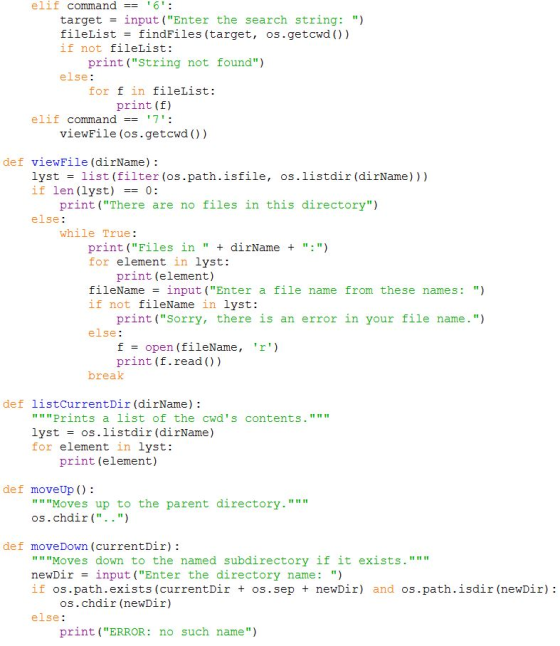
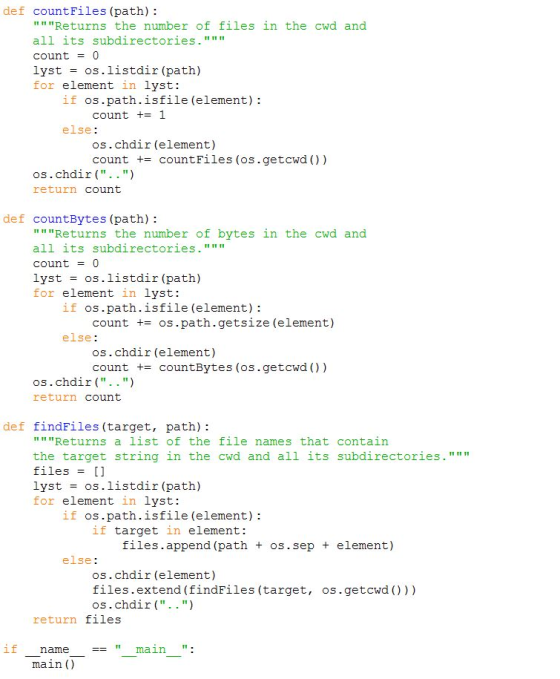
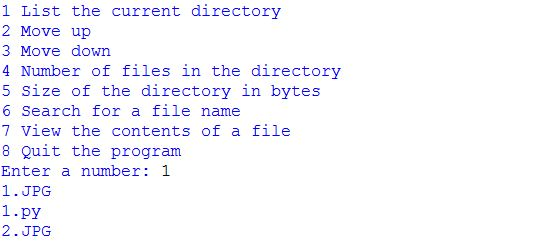
6. Add a command to this chapter’s case study program that allows the user to view the contents of a file in the current working directory. When the command is selected, the program should display a list of filenames and a prompt for the name of the file to be viewed. Be sure to include error recovery.
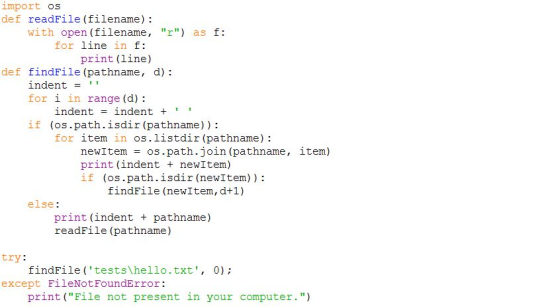
7. Write a recursive function that expects a pathname as an argument. The path- name can be either the name of a file or the name of a directory. If the pathname refers to a file, its name is displayed, followed by its contents. Otherwise, if the pathname refers to a directory, the function is applied to each name in the direc- tory. Test this function in a new program.
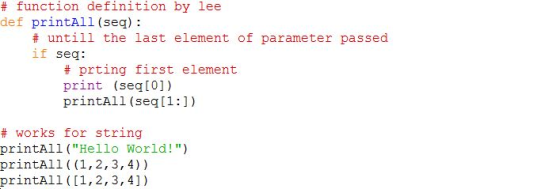
8. Lee has discovered what he thinks is a clever recursive strategy for printing the elements in a sequence (string, tuple, or list). He reasons that he can get at the first element in a sequence using the 0 index, and he can obtain a sequence of the rest of the elements by slicing from index 1. This strategy is realized in a function that expects just the sequence as an argument. If the sequence is not empty, the first element in the sequence is printed and then a recursive call is executed. On each recursive call, the sequence argument is sliced using the range 1:. Here is Lee’s function definition:
def printAll(seq):
if seq:
print(seq[0])
printAll(seq[1:])
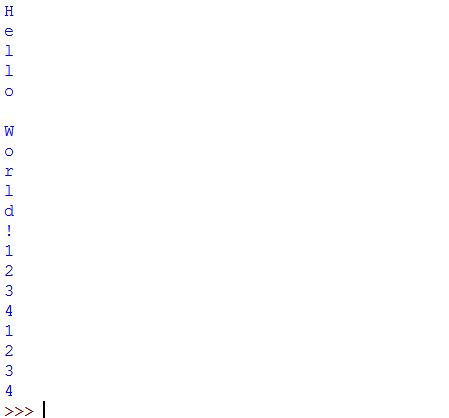
Write a script that tests this function and add code to trace the argument on each call. Does this function work as expected? If so, explain how it actually works, and describe any hidden costs in running it.
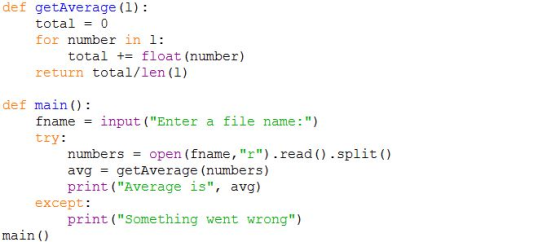
9. Write a program that computes and prints the average of the numbers in a text file. You should make use of two higher-order functions to simplify the design.
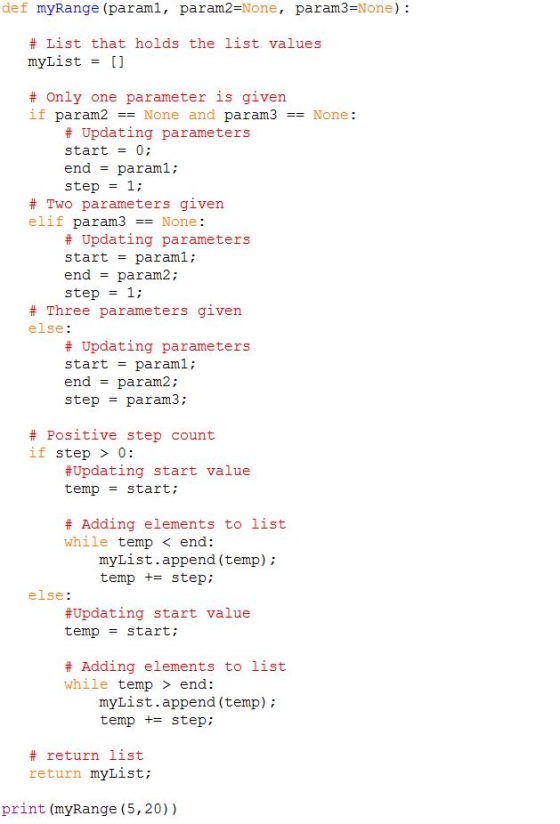
10. Define and test a function myRange. This function should behave like Python’s standard range function, with the required and optional arguments, but it should return a list. Do not use the range function in your implementation! (Hints: Study Python’s help on range to determine the names, positions, and what to do with your function’s parameters. Use a default value of None for the two optional parameters. If these parameters both equal None, then the function has been called with just the stop value. If just the third parameter equals None, then the function has been called with a start value as well. Thus, the first part of the func- tion’s code establishes what the values of the parameters are or should be. The rest of the code uses those values to build a list by counting up or down.)
Homework Answers
1.
Program screenshot:
![def newton (number): approx 0.5 * number better 0.5 *(approx number/approx) while better-approx: approx = better better = 0.5 * (approx + number/approx) return approx def main) while True: try: number=int (input (Enter the number [For exit: Press Enter] : print (The approximating square root:, newton (number)) )) except ValueError: break if name = main : main ()](http://img.homeworklib.com/questions/35af4b10-6a76-11ec-bc8e-c75d26dd9b57.png?x-oss-process=image/resize,w_560)
Sample output screenshot:
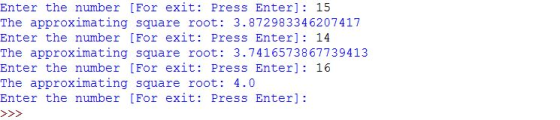
Code to copy:
def newton(number):
approx = 0.5 * number
better = 0.5 * (approx + number/approx)
while better != approx:
approx = better
better = 0.5 * (approx +
number/approx)
return approx
def main():
while True:
try:
number=int(input("Enter the number [For exit: Press Enter]:
"))
print("The approximating square root:",newton(number))
except ValueError:
break
if __name__ == '__main__':
main()
2.
Program screenshot:
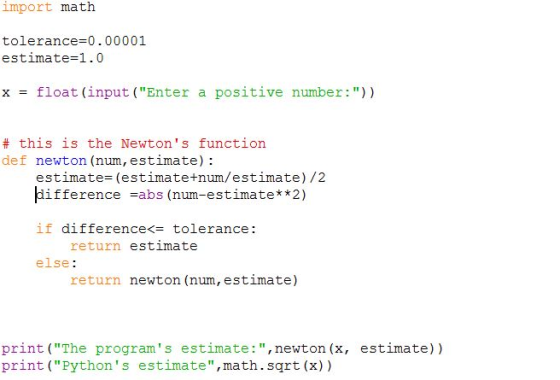
Sample output screenshot:

Code to copy:
import math
tolerance=0.00001
estimate=1.0
x = float(input("Enter a positive number:"))
# this is the Newton's function
def newton(num,estimate):
estimate=(estimate+num/estimate)/2
difference =abs(num-estimate**2)
#print(estimate)
if difference<= tolerance:
# we are returning the
value of estimate if the difference is less than the tolerance
value set
return estimate
else:
# we are calling the
newton function passing the user input and the new estimate
value,
# we are passing the
estimate value as the second argument to the function
return
newton(num,estimate)
print("The program's estimate:",newton(x, estimate))
print("Python's estimate",math.sqrt(x))
3.
Program screenshot:
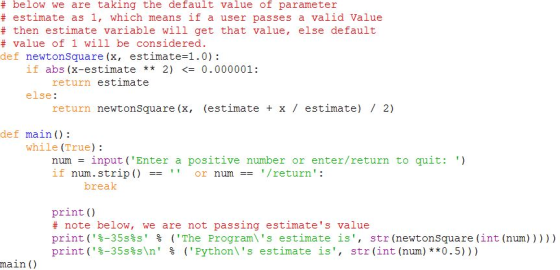
Sample output screenshot:

Code to copy:
# below we are taking the default value of parameter
# estimate as 1, which means if a user passes a valid Value
# then estimate variable will get that value, else default
# value of 1 will be considered.
def newtonSquare(x, estimate=1.0):
if abs(x-estimate ** 2) <= 0.000001:
return estimate
else:
return newtonSquare(x, (estimate + x / estimate) / 2)
def main():
while(True):
num = input('Enter a positive number or enter/return to quit: ')
if num.strip() == '' or num == '/return':
break
print()
# note below, we are not passing estimate's value
print('%-35s%s' % ('The Program\'s estimate is', str(newtonSquare(int(num)))))
print('%-35s%s\n' % ('Python\'s estimate is', str(int(num)**0.5)))
main()
4.
Program screenshot:
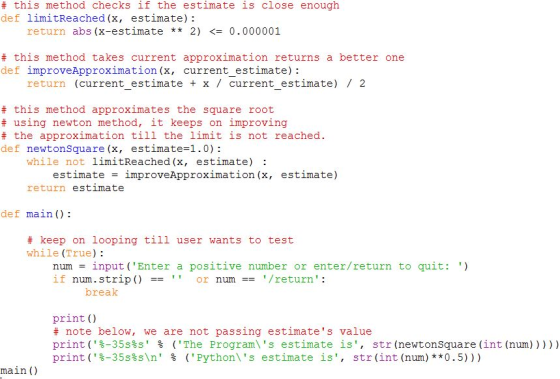
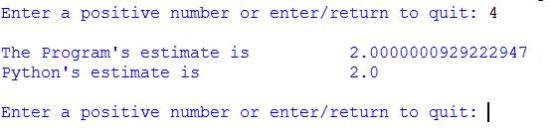
Sample output screenshot:
Code to copy:
# below we are taking the default value of parameter
# estimate as 1, which means if a user passes a valid Value
# then estimate variable will get that value, else default
# value of 1 will be considered.
def newtonSquare(x, estimate=1.0):
if abs(x-estimate ** 2) <= 0.000001:
return estimate
else:
return newtonSquare(x,
(estimate + x / estimate) / 2)
def main():
while(True):
num = input('Enter a
positive number or enter/return to quit: ')
if num.strip() == '' or
num == '/return':
break
print()
# note below, we are not
passing estimate's value
print('%-35s%s' % ('The
Program\'s estimate is', str(newtonSquare(int(num)))))
print('%-35s%s\n' %
('Python\'s estimate is', str(int(num)**0.5)))
main()
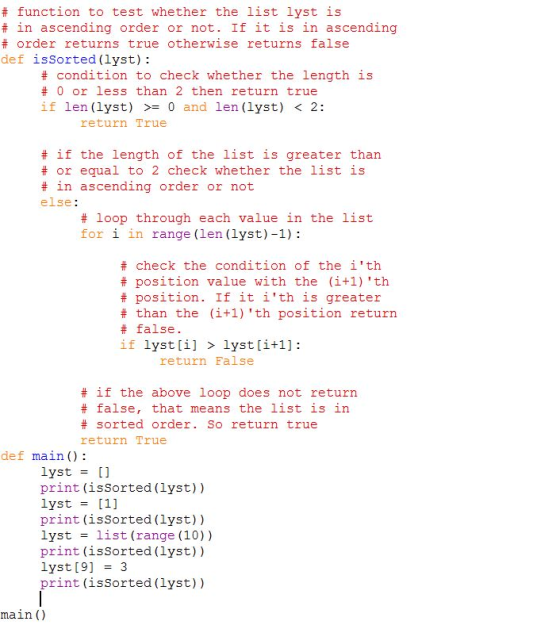
5.
Program screenshot:
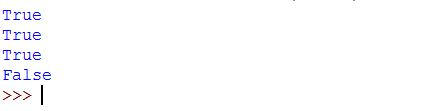
Sample output screenshot:
Code to copy:
# function to test whether the list lyst is
# in ascending order or not. If it is in ascending
# order returns true otherwise returns false
def isSorted(lyst):
# condition to check whether the length
is
# 0 or less than 2 then return true
if len(lyst) >= 0 and
len(lyst) < 2:
return
True
# if the length of the list is greater
than
# or equal to 2 check whether the list
is
# in ascending order or not
else:
# loop
through each value in the
list
for i in
range(len(lyst)-1):
# check the condition of the i'th
# position value with the (i+1)'th
# position. If it i'th is greater
# than the (i+1)'th position return
# false.
if lyst[i] > lyst[i+1]:
return False
# if the
above loop does not return
# false,
that means the list is in
# sorted
order. So return true
return
True
def main():
lyst = []
print(isSorted(lyst))
lyst = [1]
print(isSorted(lyst))
lyst =
list(range(10))
print(isSorted(lyst))
lyst[9] = 3
print(isSorted(lyst))
main()
6.
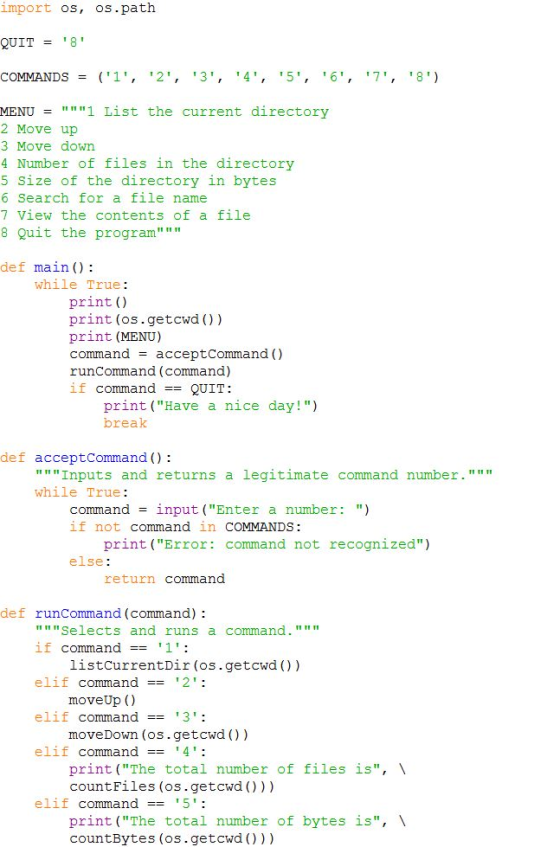
Program screenshot:
Sample output screenshot:
Code to copy:
import os, os.path
QUIT = '8'
COMMANDS = ('1', '2', '3', '4', '5', '6', '7', '8')
MENU = """1 List the current directory
2 Move up
3 Move down
4 Number of files in the directory
5 Size of the directory in bytes
6 Search for a file name
7 View the contents of a file
8 Quit the program"""
def main():
while True:
print()
print(os.getcwd())
print(MENU)
command =
acceptCommand()
runCommand(command)
if command ==
QUIT:
print("Have a nice day!")
break
def acceptCommand():
"""Inputs and returns a legitimate command
number."""
while True:
command = input("Enter a
number: ")
if not command in
COMMANDS:
print("Error: command not recognized")
else:
return command
def runCommand(command):
"""Selects and runs a command."""
if command == '1':
listCurrentDir(os.getcwd())
elif command == '2':
moveUp()
elif command == '3':
moveDown(os.getcwd())
elif command == '4':
print("The total number
of files is", \
countFiles(os.getcwd()))
elif command == '5':
print("The total number
of bytes is", \
countBytes(os.getcwd()))
elif command == '6':
target = input("Enter
the search string: ")
fileList =
findFiles(target, os.getcwd())
if not fileList:
print("String not found")
else:
for f in fileList:
print(f)
elif command == '7':
viewFile(os.getcwd())
def viewFile(dirName):
lyst = list(filter(os.path.isfile,
os.listdir(dirName)))
if len(lyst) == 0:
print("There are no
files in this directory")
else:
while True:
print("Files in " + dirName + ":")
for element in lyst:
print(element)
fileName = input("Enter a file name from these names: ")
if not fileName in lyst:
print("Sorry, there is an error in your file name.")
else:
f = open(fileName, 'r')
print(f.read())
break
def listCurrentDir(dirName):
"""Prints a list of the cwd's contents."""
lyst = os.listdir(dirName)
for element in lyst:
print(element)
def moveUp():
"""Moves up to the parent directory."""
os.chdir("..")
def moveDown(currentDir):
"""Moves down to the named subdirectory if it
exists."""
newDir = input("Enter the directory name:
")
if os.path.exists(currentDir + os.sep + newDir)
and os.path.isdir(newDir):
os.chdir(newDir)
else:
print("ERROR: no such
name")
def countFiles(path):
"""Returns the number of files in the cwd
and
all its subdirectories."""
count = 0
lyst = os.listdir(path)
for element in lyst:
if
os.path.isfile(element):
count += 1
else:
os.chdir(element)
count += countFiles(os.getcwd())
os.chdir("..")
return count
def countBytes(path):
"""Returns the number of bytes in the cwd
and
all its subdirectories."""
count = 0
lyst = os.listdir(path)
for element in lyst:
if
os.path.isfile(element):
count += os.path.getsize(element)
else:
os.chdir(element)
count += countBytes(os.getcwd())
os.chdir("..")
return count
def findFiles(target, path):
"""Returns a list of the file names that
contain
the target string in the cwd and all its
subdirectories."""
files = []
lyst = os.listdir(path)
for element in lyst:
if
os.path.isfile(element):
if target in element:
files.append(path + os.sep + element)
else:
os.chdir(element)
files.extend(findFiles(target, os.getcwd()))
os.chdir("..")
return files
if __name__ == "__main__":
main()
7.
Program screenshot:
Code to copy:
import os
def readFile(filename):
with open(filename, "r") as f:
for line in f:
print(line)
def findFile(pathname, d):
indent = ''
for i in range(d):
indent = indent + '
'
if (os.path.isdir(pathname)):
for item in
os.listdir(pathname):
newItem = os.path.join(pathname, item)
print(indent + newItem)
if (os.path.isdir(newItem)):
findFile(newItem,d+1)
else:
print(indent +
pathname)
readFile(pathname)
try:
findFile('tests\hello.txt', 0);
except FileNotFoundError:
print("File not present in your computer.")
8.
Program screenshot:
Sample output screenshot:
Code to copy:
# function definition by lee
def printAll(seq):
# untill the last element of parameter
passed
if seq:
# prting first
element
print (seq[0])
printAll(seq[1:])
# works for string
printAll("Hello World!")
printAll((1,2,3,4))
printAll([1,2,3,4])
9.
Program screenshot:
Code to copy:
def getAverage(l):
total = 0
for number in l:
total += float(number)
return total/len(l)
def main():
fname = input("Enter a file name:")
try:
numbers = open(fname,"r").read().split()
avg = getAverage(numbers)
print("Average is", avg)
except:
print("Something went wrong")
main()
10.
Program screenshot:
Sample output screenshot:

Code to copy:
def myRange(param1, param2=None, param3=None):
# List that holds the list values
myList = []
# Only one parameter is given
if param2 == None and param3 == None:
# Updating parameters
start = 0;
end = param1;
step = 1;
# Two parameters given
elif param3 == None:
# Updating parameters
start = param1;
end = param2;
step = 1;
# Three parameters given
else:
# Updating parameters
start = param1;
end = param2;
step = param3;
# Positive step count
if step > 0:
#Updating start value
temp = start;
# Adding elements to
list
while temp < end:
myList.append(temp);
temp
+= step;
else:
#Updating start value
temp = start;
# Adding elements to
list
while temp > end:
myList.append(temp);
temp
+= step;
# return list
return myList;
print(myRange(5))
print(myRange(5,20))
Add Answer to:
python 2..fundamentals of python
1.Package Newton’s method for approximating square roots (Case
Study 3.6) in a...
Restructure Newton's method (Case Study: Approximating Square Roots) by decomposing it into three...
 Restructure Newton's
method (Case Study: Approximating Square Roots) by decomposing it
into three cooperating functions.
The newton function
can use either the recursive strategy of Project 2 or the iterative
strategy of the Approximating Square Roots Case Study. The task of
testing for the limit is assigned to a function named limitReached,
whereas the task of computing a new approximation is assigned to a
function named improveEstimate. Each function expects the relevant
arguments and returns an appropriate value.
An example...
Restructure Newton's
method (Case Study: Approximating Square Roots) by decomposing it
into three cooperating functions.
The newton function
can use either the recursive strategy of Project 2 or the iterative
strategy of the Approximating Square Roots Case Study. The task of
testing for the limit is assigned to a function named limitReached,
whereas the task of computing a new approximation is assigned to a
function named improveEstimate. Each function expects the relevant
arguments and returns an appropriate value.
An example...
Python 3.6 Question 12 (2θ points) write a function named uniqueWords that counts how many different...
 Python 3.6
Question 12 (2θ points) write a function named uniqueWords that counts how many different words there are in each line of an input file and writes that count to a corresponding line of an output file. The input file already exists when uniqueWords is called. uniquewords creates the output file. Input. The function uniquewords takes two parameters: ◆ inFile, a string that is the name of text file that is to be read. The file that inFile refers...
Python 3.6
Question 12 (2θ points) write a function named uniqueWords that counts how many different words there are in each line of an input file and writes that count to a corresponding line of an output file. The input file already exists when uniqueWords is called. uniquewords creates the output file. Input. The function uniquewords takes two parameters: ◆ inFile, a string that is the name of text file that is to be read. The file that inFile refers...
Python 3 Modify the sentence-generator program of Case Study so that it inputs its vocabulary from...
Python 3 Modify the sentence-generator program of Case Study so that it inputs its vocabulary from a set of text files at startup. The filenames are nouns.txt, verbs. txt, articles.txt, and prepositions.txt. (HINT: Define a single new function, getWords. This function should expect a filename as an argument. The function should open an input file with this name, define a temporary list, read words from the file, and add them to the list. The function should then convert the list...
Roadmap To start, use the provided template file (on Blackboard): project_01_template.py. Replace the pass statements with...
 Roadmap To start, use the provided template file (on Blackboard): project_01_template.py. Replace the pass statements with your code. Notice that we included test cases under every function. If you run the project_01_template.py file at this point it should print False for each test. After you write the correct code for each function, and then run the file, it should print True for each test. 1. Write a function named gc_content that takes one argument sed and performs the following tasks:...
IT PYTHON QUESTION1 Consider the following Python code, where infile.txt and outfile.txt both exist in the current directory 'z' ) 。1d = open ( ' infile. txt ' , for line in o...
 IT PYTHON
QUESTION1 Consider the following Python code, where infile.txt and outfile.txt both exist in the current directory 'z' ) 。1d = open ( ' infile. txt ' , for line in old: new.write (line) new.write') ne«.close () old.close) Which of the following options best describes the purpose or outcome of this code? O A copy of the file infile.txt is made (except in double line spacing) and saved as outfile.txt in the current directory. O A copy of the...
IT PYTHON
QUESTION1 Consider the following Python code, where infile.txt and outfile.txt both exist in the current directory 'z' ) 。1d = open ( ' infile. txt ' , for line in old: new.write (line) new.write') ne«.close () old.close) Which of the following options best describes the purpose or outcome of this code? O A copy of the file infile.txt is made (except in double line spacing) and saved as outfile.txt in the current directory. O A copy of the...
Assignment 2 In this assignment, you will write two short programs to solve problems using recursion....
Assignment 2 In this assignment, you will write two short programs to solve problems using recursion. 1. Initial Setup Log in to Unix. Run the setup script for Assignment 2 by typing: setup 2 2. Towers of Hanoi Legend has it that in a temple in the Far East, priests are attempting to move a stack of disks from one peg to another. The initial stack had 64 disks threaded onto one peg and arranged from bottom to top by...
 Restructure Newton's
method (Case Study: Approximating Square Roots) by decomposing it
into three cooperating functions.
The newton function
can use either the recursive strategy of Project 2 or the iterative
strategy of the Approximating Square Roots Case Study. The task of
testing for the limit is assigned to a function named limitReached,
whereas the task of computing a new approximation is assigned to a
function named improveEstimate. Each function expects the relevant
arguments and returns an appropriate value.
An example...
Restructure Newton's
method (Case Study: Approximating Square Roots) by decomposing it
into three cooperating functions.
The newton function
can use either the recursive strategy of Project 2 or the iterative
strategy of the Approximating Square Roots Case Study. The task of
testing for the limit is assigned to a function named limitReached,
whereas the task of computing a new approximation is assigned to a
function named improveEstimate. Each function expects the relevant
arguments and returns an appropriate value.
An example...
 Python 3.6
Question 12 (2θ points) write a function named uniqueWords that counts how many different words there are in each line of an input file and writes that count to a corresponding line of an output file. The input file already exists when uniqueWords is called. uniquewords creates the output file. Input. The function uniquewords takes two parameters: ◆ inFile, a string that is the name of text file that is to be read. The file that inFile refers...
Python 3.6
Question 12 (2θ points) write a function named uniqueWords that counts how many different words there are in each line of an input file and writes that count to a corresponding line of an output file. The input file already exists when uniqueWords is called. uniquewords creates the output file. Input. The function uniquewords takes two parameters: ◆ inFile, a string that is the name of text file that is to be read. The file that inFile refers...
 Roadmap To start, use the provided template file (on Blackboard): project_01_template.py. Replace the pass statements with your code. Notice that we included test cases under every function. If you run the project_01_template.py file at this point it should print False for each test. After you write the correct code for each function, and then run the file, it should print True for each test. 1. Write a function named gc_content that takes one argument sed and performs the following tasks:...
 IT PYTHON
QUESTION1 Consider the following Python code, where infile.txt and outfile.txt both exist in the current directory 'z' ) 。1d = open ( ' infile. txt ' , for line in old: new.write (line) new.write') ne«.close () old.close) Which of the following options best describes the purpose or outcome of this code? O A copy of the file infile.txt is made (except in double line spacing) and saved as outfile.txt in the current directory. O A copy of the...
IT PYTHON
QUESTION1 Consider the following Python code, where infile.txt and outfile.txt both exist in the current directory 'z' ) 。1d = open ( ' infile. txt ' , for line in old: new.write (line) new.write') ne«.close () old.close) Which of the following options best describes the purpose or outcome of this code? O A copy of the file infile.txt is made (except in double line spacing) and saved as outfile.txt in the current directory. O A copy of the...
Most questions answered within 3 hours.
-
Where is the error in this code sequence?
String s1 = "Hello";
String s2 = "ello";...
asked 11 months ago -
Financial data for Joel de Paris, Inc., for last year
follow:
Joel de Paris, Inc.
Balance...
asked 11 months ago -
Consider this reaction:
Al2(SO4)3 (aq)+ BaCl3
(aq) Al2Cl6 (aq)- +
3BaSO4(s) . What is the...
asked 11 months ago -
Suppose that Savneet is considering increasing her
recent random sample from 20 car rentals to 40...
asked 11 months ago -
Trucks arrive at an unloading terminal at an average rate of 120
per hour.
Trucks arrive...
asked 11 months ago -
Why are methanol and ethanol completely soluble in water while
octanol is not very little soluble....
asked 11 months ago -
A facilities manager at a university reads in a research report
that the mean amount of...
asked 11 months ago -
When the CuSO4 is rehydrated by adding water to the anhydrous
compound, is this an endothermic...
asked 11 months ago -
A ray of sunlight is passing from diamond into crown glass; the
angle of incidence is...
asked 11 months ago -
A block of mass 0.249 kg is placed on top of a light, vertical
spring of...
asked 11 months ago -
how do the kidneys compensate in the presences of acidosis
a) trigger hyperventilate
b) reserve acid...
asked 11 months ago -
Question 501 pts
The rental rate of capital to the firm increases. Which of the
following...
asked 11 months ago