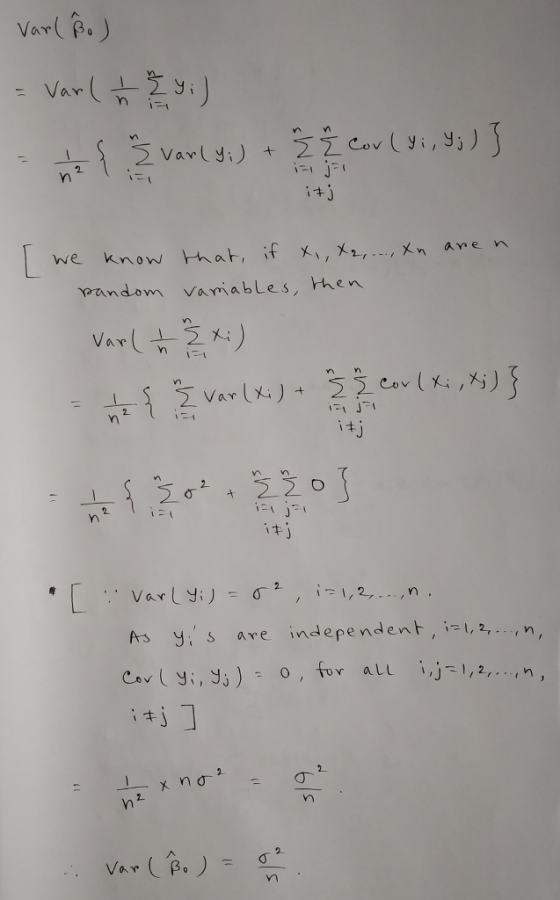
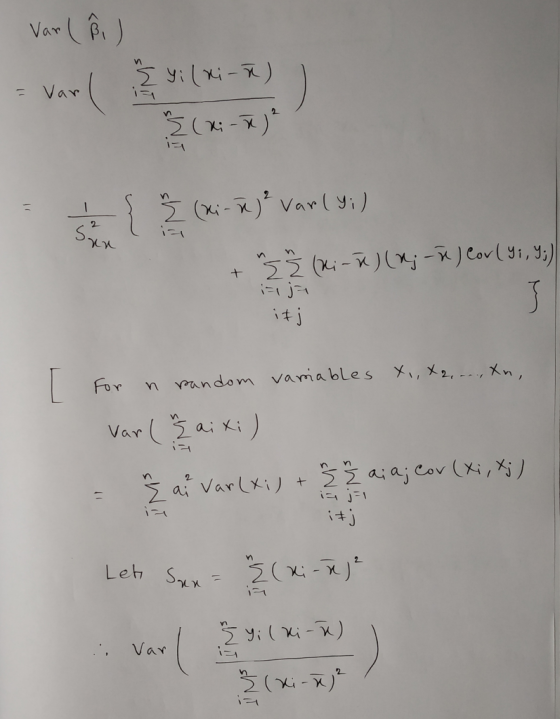
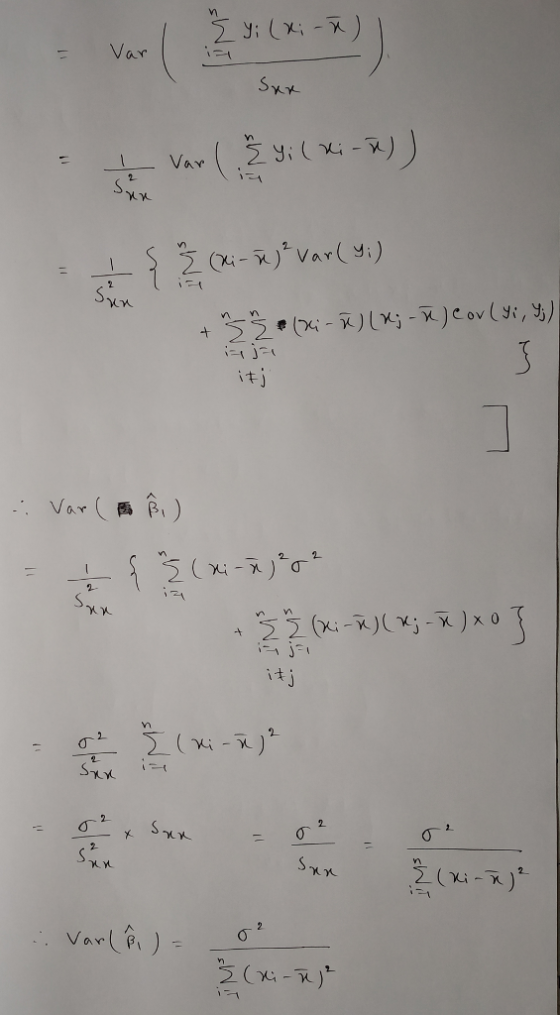
Given Derive the variance of these OLS estimators (both )
Given
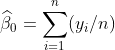

Derive the variance of these OLS estimators
(both  )
)
Homework Answers
(a) What is meant by heteroscedasticity? What are the effects of heteroscedasticity on: (i) The OLS estimators? In parti...
(a) What is meant by heteroscedasticity? What are the effects of heteroscedasticity on: (i) The OLS estimators? In particular, does heteroscedasticity create bias in the OLS estimators? (ii) The variances and standard errors of the OLS estimators. (iii) The validity of t-test and F-test of overall significance of the regression? (b) Given: Yi = β1 + β2 Xi + ui Var(ui) = σ2 Xi Show how this model can be transformed so that the disturbances have constant variance. Explain how...
What is multicollinearity and how does it affect the standard errors of OLS estimators? (b) In the context of perfect mu...
What is multicollinearity and how does it affect the standard errors of OLS estimators? (b) In the context of perfect multicollinearity between explanatory variables, explain why the OLS estimators cannot be derived. (c) With what methods can one detect multicollinearity? (d) Given relatively high variance of individual explanatory variables, explain why relatively low t-statistics but a relatively high F-statistic for the regression is an indication of multicollinearity.
Answer each question by writing TRUE or FALSE 1. For OLS estimators to be linear the...
 Answer each question by writing TRUE or FALSE 1. For OLS estimators to be linear the explanatory variables must be variable, non- stochastic and fixed in repeated samples. Under the conditions of perfect multicollinearity, the OLS estimators are not unique. The presence of heteroskedasticity causes the OLS method to overestimate the variances 2. 3. of the parameters. The Breusch-Godfrey LM test is applicable when a lagged dependent variable is used. If we include a non-influential variable in an equation the...
1. If OLS estimators satisfy asymptotic normality, it implies that a. they are approximately normally distributed...
 1. If OLS estimators satisfy asymptotic normality, it implies that a. they are approximately normally distributed in large enough sample sizes b. they are approximately normally distributed in samples with less than 10 observations c. they have a constant mean equal to zero and variance equal to a d. they have a constant mean equal to one and variance equal to a
1. If OLS estimators satisfy asymptotic normality, it implies that a. they are approximately normally distributed...
 1. If OLS estimators satisfy asymptotic normality, it implies that a. they are approximately normally distributed in large enough sample sizes b. they are approximately normally distributed in samples with less than 10 observations c. they have a constant mean equal to zero and variance equal to a d. they have a constant mean equal to one and variance equal to a
1. If OLS estimators satisfy asymptotic normality, it implies that a they are approximately normally distributed...
 1. If OLS estimators satisfy asymptotic normality, it implies that a they are approximately normally distributed in large enough sample sizes b. they are approximately normally distributed in samples with less than 10 observations c. they have a constant mean equal to zero and variance equal to a d. they have a constant mean equal to one and variance equal to o
1. If OLS estimators satisfy asymptotic normality, it implies that a they are approximately normally distributed...
 1. If OLS estimators satisfy asymptotic normality, it implies that a they are approximately normally distributed in large enough sample sizes b. they are approximately normally distributed in samples with less than 10 observations c. they have a constant mean equal to zero and variance equal to a d. they have a constant mean equal to one and variance equal to o
1. If OLS estimators satisfy asymptotic normality, it implies that a they are approximately normally distributed...
 1. If OLS estimators satisfy asymptotic normality, it implies that a they are approximately normally distributed in large enough sample sizes b. they are approximately normally distributed in samples with less than 10 observations c. they have a constant mean equal to zero and variance equal to a d. they have a constant mean equal to one and variance equal to o
1. If OLS estimators satisfy asymptotic normality, it implies that a they are approximately normally distributed in...
 1. If OLS estimators satisfy asymptotic normality, it implies that a they are approximately normally distributed in large enough sample sizes b. they are approximately normally distributed in samples with less than 10 observations c. they have a constant mean equal to zero and variance equal to a d. they have a constant mean equal to one and variance equal to o
[3] TRUE or FALSE: In the presence of autocorrelation, the OLS estimators remain unbiased but are...
 [3] TRUE or FALSE: In the presence of autocorrelation, the OLS estimators remain unbiased but are no longer efficient. [4] TRUE or FALSE: In the presence of autocorrelation, the estimated OLS variances will be unbiased estimators of the correct OLS variances. [5] TRUE or FALSE: The core time series models are the regression or static model, the autoregressive model, the distributed lag model, and the autoregressive distributed lag model.
 Answer each question by writing TRUE or FALSE 1. For OLS estimators to be linear the explanatory variables must be variable, non- stochastic and fixed in repeated samples. Under the conditions of perfect multicollinearity, the OLS estimators are not unique. The presence of heteroskedasticity causes the OLS method to overestimate the variances 2. 3. of the parameters. The Breusch-Godfrey LM test is applicable when a lagged dependent variable is used. If we include a non-influential variable in an equation the...
 1. If OLS estimators satisfy asymptotic normality, it implies that a. they are approximately normally distributed in large enough sample sizes b. they are approximately normally distributed in samples with less than 10 observations c. they have a constant mean equal to zero and variance equal to a d. they have a constant mean equal to one and variance equal to a
 1. If OLS estimators satisfy asymptotic normality, it implies that a. they are approximately normally distributed in large enough sample sizes b. they are approximately normally distributed in samples with less than 10 observations c. they have a constant mean equal to zero and variance equal to a d. they have a constant mean equal to one and variance equal to a
 1. If OLS estimators satisfy asymptotic normality, it implies that a they are approximately normally distributed in large enough sample sizes b. they are approximately normally distributed in samples with less than 10 observations c. they have a constant mean equal to zero and variance equal to a d. they have a constant mean equal to one and variance equal to o
 1. If OLS estimators satisfy asymptotic normality, it implies that a they are approximately normally distributed in large enough sample sizes b. they are approximately normally distributed in samples with less than 10 observations c. they have a constant mean equal to zero and variance equal to a d. they have a constant mean equal to one and variance equal to o
 1. If OLS estimators satisfy asymptotic normality, it implies that a they are approximately normally distributed in large enough sample sizes b. they are approximately normally distributed in samples with less than 10 observations c. they have a constant mean equal to zero and variance equal to a d. they have a constant mean equal to one and variance equal to o
 1. If OLS estimators satisfy asymptotic normality, it implies that a they are approximately normally distributed in large enough sample sizes b. they are approximately normally distributed in samples with less than 10 observations c. they have a constant mean equal to zero and variance equal to a d. they have a constant mean equal to one and variance equal to o
 [3] TRUE or FALSE: In the presence of autocorrelation, the OLS estimators remain unbiased but are no longer efficient. [4] TRUE or FALSE: In the presence of autocorrelation, the estimated OLS variances will be unbiased estimators of the correct OLS variances. [5] TRUE or FALSE: The core time series models are the regression or static model, the autoregressive model, the distributed lag model, and the autoregressive distributed lag model.
Most questions answered within 3 hours.
-
Where is the error in this code sequence?
String s1 = "Hello";
String s2 = "ello";...
asked 10 months ago -
Financial data for Joel de Paris, Inc., for last year
follow:
Joel de Paris, Inc.
Balance...
asked 10 months ago -
Consider this reaction:
Al2(SO4)3 (aq)+ BaCl3
(aq) Al2Cl6 (aq)- +
3BaSO4(s) . What is the...
asked 10 months ago -
Suppose that Savneet is considering increasing her
recent random sample from 20 car rentals to 40...
asked 10 months ago -
Trucks arrive at an unloading terminal at an average rate of 120
per hour.
Trucks arrive...
asked 10 months ago -
Why are methanol and ethanol completely soluble in water while
octanol is not very little soluble....
asked 10 months ago -
A facilities manager at a university reads in a research report
that the mean amount of...
asked 10 months ago -
When the CuSO4 is rehydrated by adding water to the anhydrous
compound, is this an endothermic...
asked 10 months ago -
A ray of sunlight is passing from diamond into crown glass; the
angle of incidence is...
asked 10 months ago -
A block of mass 0.249 kg is placed on top of a light, vertical
spring of...
asked 10 months ago -
how do the kidneys compensate in the presences of acidosis
a) trigger hyperventilate
b) reserve acid...
asked 10 months ago -
Question 501 pts
The rental rate of capital to the firm increases. Which of the
following...
asked 10 months ago