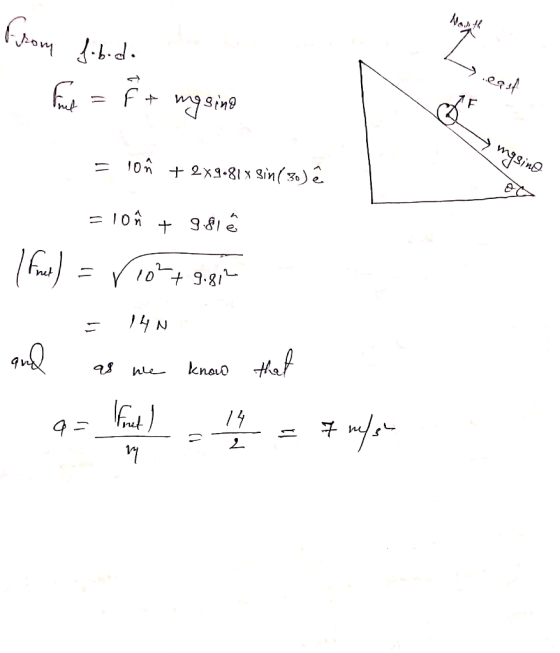
A 2 kg ball is sliding east (without friction) down a hill that makes an angle...
A 2 kg ball is sliding east (without friction) down a hill that makes an angle of 30 degrees with the horizontal. A child kicks the ball north with a force of 10 N. What is the net acceleration of the kicked ball?
Homework Answers
Add Answer to:
A 2 kg ball is sliding east (without friction) down a hill that
makes an angle...
A8.2-kg mass slides down a flat hill that makes an angle of 320 with the horizontal....
 A8.2-kg mass slides down a flat hill that makes an angle of 320 with the horizontal. If friction is negligible, what is the resultant force on the sled?
A block of mass 2.0 Kg is sliding down an inclined plane, as shown (the angle...
 A block of mass 2.0 Kg is sliding down an inclined plane, as shown (the angle is 30 degrees). If the coefficient of kinetic friction is 0.250, determine the net acceleration of the block down the plane.
A solid ball of mass 2.0 kg rolls down a hill of slope 38 degree without...
A solid ball of mass 2.0 kg rolls down a hill of slope 38 degree without slipping. Find the acceleration of the ball’s center of mass, the frictional force between ball and ground, and the minimum coefficient of static friction needed to prevent slipping.
Questions 1&2 FP 1. A sliding block of mass m 0.25 kg is subject to a...
 Questions 1&2
FP 1. A sliding block of mass m 0.25 kg is subject to a force of magnitude 4 N that makes an angle of ф-30 with the horizontal surface. If the coefficient of kinetic friction between block and surface is 0.5, what is the resulting acceleration of the block along the surface Figure 1: Block on incline. 2. A block of mass m - 5 kg is subject to a force of magnitude 20 N that makes an...
Questions 1&2
FP 1. A sliding block of mass m 0.25 kg is subject to a force of magnitude 4 N that makes an angle of ф-30 with the horizontal surface. If the coefficient of kinetic friction between block and surface is 0.5, what is the resulting acceleration of the block along the surface Figure 1: Block on incline. 2. A block of mass m - 5 kg is subject to a force of magnitude 20 N that makes an...
rope block A5 kg block is sliding on a horizontal surface while being pulled by a...
 rope block A5 kg block is sliding on a horizontal surface while being pulled by a child using a rope attached to the center of the block. The rope exerts a constant force of 26 N at an angle of 0 = 30 degrees above the horizontal on the block. Friction exists between the block and supporting surface (with Hs = 0.21 and 4x = 0.11). What is the horizontal acceleration of the block?
rope block A5 kg block is sliding on a horizontal surface while being pulled by a...
 rope block A5 kg block is sliding on a horizontal surface while being pulled by a child using a rope attached to the center of the block. The rope exerts a constant force of 28.33 N at an angle of 0 = 30 degrees above the horizontal on the block. Friction exists between the block and supporting surface (with Mg = 0.23 and Uk = 0.15). What is the horizontal acceleration of the block?
The coefficient of kinetic friction for a block of mass 45 kg sliding down an inclined...
 The coefficient of kinetic friction for a block of mass 45 kg sliding down an inclined plane having an angle of 52 degrees to the ground is .03. Calculate the acceleration of the sliding block.
A 5 kg block is sliding on a horizontal surface while being pulled by a child...
A 5 kg block is sliding on a horizontal surface while being pulled by a child using a rope attached to the center of the block. The rope exerts a constant force of 29.48 N at an angle of \theta=θ = 30 degrees above the horizontal on the block. Friction exists between the block and supporting surface (with \mu_s=\:μ s = 0.2 and \mu_k=\:μ k = 0.1 ). What is the horizontal acceleration of the block?
1) A solid ball of mass M and radius R rolls without slipping down a hill...
1) A solid ball of mass M and radius R rolls without slipping down a hill with slope tan θ. (That is θ is the angle of the hill relative to the horizontal direction.) What is the static frictional force acting on it? It is possible to solve this question in a fairly simple way using two ingredients: a) As derived in the worksheet when an object of moment of inertia I, mass M and radius R starts at rest...
A 20 kg child slides down a hill where the coefficient of friction is 0.25. Draw...
A 20 kg child slides down a hill where the coefficient of friction is 0.25. Draw and label a qualitative force diagram for the child. * On your force diagram, draw the components of gravity that are parallel and perpendicular to the hill. * On your component triangle, correctly locate the 38˚ angle. * Calculate the gravitational force. Show your work. * Calculate the component of gravity perpendicular to the hill. Show your work. * Calculate the component of gravity...
 A8.2-kg mass slides down a flat hill that makes an angle of 320 with the horizontal. If friction is negligible, what is the resultant force on the sled?
 A block of mass 2.0 Kg is sliding down an inclined plane, as shown (the angle is 30 degrees). If the coefficient of kinetic friction is 0.250, determine the net acceleration of the block down the plane.
 Questions 1&2
FP 1. A sliding block of mass m 0.25 kg is subject to a force of magnitude 4 N that makes an angle of ф-30 with the horizontal surface. If the coefficient of kinetic friction between block and surface is 0.5, what is the resulting acceleration of the block along the surface Figure 1: Block on incline. 2. A block of mass m - 5 kg is subject to a force of magnitude 20 N that makes an...
Questions 1&2
FP 1. A sliding block of mass m 0.25 kg is subject to a force of magnitude 4 N that makes an angle of ф-30 with the horizontal surface. If the coefficient of kinetic friction between block and surface is 0.5, what is the resulting acceleration of the block along the surface Figure 1: Block on incline. 2. A block of mass m - 5 kg is subject to a force of magnitude 20 N that makes an...
 rope block A5 kg block is sliding on a horizontal surface while being pulled by a child using a rope attached to the center of the block. The rope exerts a constant force of 26 N at an angle of 0 = 30 degrees above the horizontal on the block. Friction exists between the block and supporting surface (with Hs = 0.21 and 4x = 0.11). What is the horizontal acceleration of the block?
 rope block A5 kg block is sliding on a horizontal surface while being pulled by a child using a rope attached to the center of the block. The rope exerts a constant force of 28.33 N at an angle of 0 = 30 degrees above the horizontal on the block. Friction exists between the block and supporting surface (with Mg = 0.23 and Uk = 0.15). What is the horizontal acceleration of the block?
 The coefficient of kinetic friction for a block of mass 45 kg sliding down an inclined plane having an angle of 52 degrees to the ground is .03. Calculate the acceleration of the sliding block.
Most questions answered within 3 hours.
-
Where is the error in this code sequence?
String s1 = "Hello";
String s2 = "ello";...
asked 11 months ago -
Financial data for Joel de Paris, Inc., for last year
follow:
Joel de Paris, Inc.
Balance...
asked 11 months ago -
Consider this reaction:
Al2(SO4)3 (aq)+ BaCl3
(aq) Al2Cl6 (aq)- +
3BaSO4(s) . What is the...
asked 11 months ago -
Suppose that Savneet is considering increasing her
recent random sample from 20 car rentals to 40...
asked 11 months ago -
Trucks arrive at an unloading terminal at an average rate of 120
per hour.
Trucks arrive...
asked 11 months ago -
Why are methanol and ethanol completely soluble in water while
octanol is not very little soluble....
asked 11 months ago -
A facilities manager at a university reads in a research report
that the mean amount of...
asked 11 months ago -
When the CuSO4 is rehydrated by adding water to the anhydrous
compound, is this an endothermic...
asked 11 months ago -
A ray of sunlight is passing from diamond into crown glass; the
angle of incidence is...
asked 11 months ago -
A block of mass 0.249 kg is placed on top of a light, vertical
spring of...
asked 11 months ago -
how do the kidneys compensate in the presences of acidosis
a) trigger hyperventilate
b) reserve acid...
asked 11 months ago -
Question 501 pts
The rental rate of capital to the firm increases. Which of the
following...
asked 11 months ago