
Homework Answers
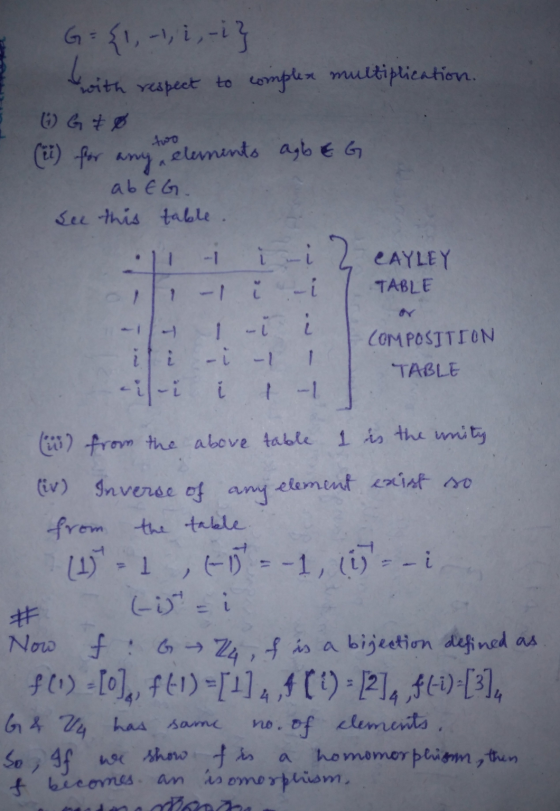
![But if we show that f is not a homomorphism then of is not isomorphism See f(-1,-1) = f(1) [214 if (-1) f(-i) = [1] + [3] [4]](http://img.homeworklib.com/questions/693a8af0-6ccb-11ec-b921-37a546ebc4ec.png?x-oss-process=image/resize,w_560) If
you have any doubt, please comment and I will try my best to
explore this to you. Thank you.
If
you have any doubt, please comment and I will try my best to
explore this to you. Thank you.
Question 4 Exercise 1. Let G be a group such that |G| is even. Show that...
 Question 4
Exercise 1. Let G be a group such that |G| is even. Show that there exists an EG,17e with x = e. Exercise 2. Let G be a group and H a subgroup of G. Define a set K by K = {z € G war- € H for all a € H}. Show that (i) K <G (ii) H <K Exercise 3. Let S be the set R\ {0,1}. Define functions from S to S by e(z)...
Question 4
Exercise 1. Let G be a group such that |G| is even. Show that there exists an EG,17e with x = e. Exercise 2. Let G be a group and H a subgroup of G. Define a set K by K = {z € G war- € H for all a € H}. Show that (i) K <G (ii) H <K Exercise 3. Let S be the set R\ {0,1}. Define functions from S to S by e(z)...
Question 2 please Exercise 1. Define an operation on Z by a b= a - b....
 Question 2 please
Exercise 1. Define an operation on Z by a b= a - b. Determine ife is associative or commutative. Find a right identity. Is there a left identity? What about inverses? Exercise 2. Write a multiplication table for the set A = {a,b,c,d,e} such that e is an identity element, the product is defined for all elements and each element has an inverse, but the product is NOT associative. Show by example that it is not associative....
Question 2 please
Exercise 1. Define an operation on Z by a b= a - b. Determine ife is associative or commutative. Find a right identity. Is there a left identity? What about inverses? Exercise 2. Write a multiplication table for the set A = {a,b,c,d,e} such that e is an identity element, the product is defined for all elements and each element has an inverse, but the product is NOT associative. Show by example that it is not associative....
QUESTION 8 Let G is an abelian group with the additive operation. Define the operation of multiplication by the rule ab...
 QUESTION 8 Let G is an abelian group with the additive operation. Define the operation of multiplication by the rule ab- a- b for all a,b of G. Is G a ring?
QUESTION 8 Let G is an abelian group with the additive operation. Define the operation of multiplication by the rule ab- a- b for all a,b of G. Is G a ring?
QUESTION 8 Let G is an abelian group with the additive operation. Define the operation of multiplication by the rule ab- a- b for all a,b of G. Is G a ring?
16. Let Z(G), the center of G, be the set of elements of G that commute...
 16. Let Z(G), the center of G, be the set of elements of G that commute with all elements of G. (a) Find the center of the quaternions, defined in Example 19.16. (b) Find the center of Z5. (c) Show that Z(G) is a subgroup of G. (d) If Z(G) G, what can you say about the group G? b 0 Example 19.16 d We now work inside M2(C), the ring of 2 x 2 matrices with complex entries. Consider...
1. Let G = {a, b, c, d, e} be a set with an associative binary...
1. Let G = {a, b, c, d, e} be a set with an associative binary operation multiplication such that ab = ba = d, ed = de = c. Prove that G under this multiplication cannot consist of a group. Hint: Assume that G under this operation does consist of a group. Try to complete the multiplication table and deduce a contradiction. 2. Let G be a group containing 4 elements a, b, c, and d. Under the group...
Solve problem 2 using the priblem 1 . Question is taken from Ring theory dealing with ideals and ...
 Solve problem 2 using the priblem 1 . Question is taken from
Ring theory dealing with ideals and generating sets for
ideals.
Problem 1. Suppose that R (R,+ Jis a commutative ring with unity, and suppose F- (a,,. , a } is a finite nonempty subset of R. Modify your proof for Problem 5 above to show that 7n j-1 Problem 2. Consider the set Zo of integer sequences introduced in Homework Problem 6 of Investigation 16. You showed that...
Solve problem 2 using the priblem 1 . Question is taken from
Ring theory dealing with ideals and generating sets for
ideals.
Problem 1. Suppose that R (R,+ Jis a commutative ring with unity, and suppose F- (a,,. , a } is a finite nonempty subset of R. Modify your proof for Problem 5 above to show that 7n j-1 Problem 2. Consider the set Zo of integer sequences introduced in Homework Problem 6 of Investigation 16. You showed that...
11. Let G = Z4 Z4, H = {0,0), (2,0), (0,2), (2,2)). Write the Cayley table...
 11. Let G = Z4 Z4, H = {0,0), (2,0), (0,2), (2,2)). Write the Cayley table for G/H. Is G/H isomorphic to Z4 or Z2 x Z ? Justify your answer. 12. Show that G = {1, 7, 17, 23, 49, 55, 65, 71} is a group under multiplication modulo 96. Then express G as an external and an internal direct product of cyclic groups.
2. Let S be the set of all functions from R to R. For f.g es,...
 2. Let S be the set of all functions from R to R. For f.g es, we define the binary operation on S by (fog)(x) = f(x) + g(x) + 3x*, VX E R. (1) Find the additive identity in S under the operation . (ii) Find the additive inverse of the function w es defined by w(x) = 5x - 8, VXER [4] under the operation .
2. Let G {g, g. . . , gn-le} be a cyclic group of order n,...
 2. Let G {g, g. . . , gn-le} be a cyclic group of order n, H a group, and h є H. Define a function φ : G → H by φ(gi-hi for all 0 < i n-1. Show that φ is a group homomor- phism if and only if o(h) divides o(g). Warning: mind your modular arithmetic! [10]
b and c please explian thx i post the question from the book Let 2 be a non-empty set. Let Fo be the collection of all subsets such that either A or AC is finite. (a) Show that Fo is a field. Def...
 b and c please explian thx
i
post the question from the book
Let 2 be a non-empty set. Let Fo be the collection of all subsets such that either A or AC is finite. (a) Show that Fo is a field. Define for E e Fo the set function P by ¡f E is finite, 0, if E is finite 1, if Ec is finite. P(h-10, (b) If is countably infinite, show P is finitely additive but not-additive. (c)...
b and c please explian thx
i
post the question from the book
Let 2 be a non-empty set. Let Fo be the collection of all subsets such that either A or AC is finite. (a) Show that Fo is a field. Define for E e Fo the set function P by ¡f E is finite, 0, if E is finite 1, if Ec is finite. P(h-10, (b) If is countably infinite, show P is finitely additive but not-additive. (c)...
 Question 4
Exercise 1. Let G be a group such that |G| is even. Show that there exists an EG,17e with x = e. Exercise 2. Let G be a group and H a subgroup of G. Define a set K by K = {z € G war- € H for all a € H}. Show that (i) K <G (ii) H <K Exercise 3. Let S be the set R\ {0,1}. Define functions from S to S by e(z)...
Question 4
Exercise 1. Let G be a group such that |G| is even. Show that there exists an EG,17e with x = e. Exercise 2. Let G be a group and H a subgroup of G. Define a set K by K = {z € G war- € H for all a € H}. Show that (i) K <G (ii) H <K Exercise 3. Let S be the set R\ {0,1}. Define functions from S to S by e(z)...
 Question 2 please
Exercise 1. Define an operation on Z by a b= a - b. Determine ife is associative or commutative. Find a right identity. Is there a left identity? What about inverses? Exercise 2. Write a multiplication table for the set A = {a,b,c,d,e} such that e is an identity element, the product is defined for all elements and each element has an inverse, but the product is NOT associative. Show by example that it is not associative....
Question 2 please
Exercise 1. Define an operation on Z by a b= a - b. Determine ife is associative or commutative. Find a right identity. Is there a left identity? What about inverses? Exercise 2. Write a multiplication table for the set A = {a,b,c,d,e} such that e is an identity element, the product is defined for all elements and each element has an inverse, but the product is NOT associative. Show by example that it is not associative....
 QUESTION 8 Let G is an abelian group with the additive operation. Define the operation of multiplication by the rule ab- a- b for all a,b of G. Is G a ring?
QUESTION 8 Let G is an abelian group with the additive operation. Define the operation of multiplication by the rule ab- a- b for all a,b of G. Is G a ring?
QUESTION 8 Let G is an abelian group with the additive operation. Define the operation of multiplication by the rule ab- a- b for all a,b of G. Is G a ring?
 16. Let Z(G), the center of G, be the set of elements of G that commute with all elements of G. (a) Find the center of the quaternions, defined in Example 19.16. (b) Find the center of Z5. (c) Show that Z(G) is a subgroup of G. (d) If Z(G) G, what can you say about the group G? b 0 Example 19.16 d We now work inside M2(C), the ring of 2 x 2 matrices with complex entries. Consider...
 Solve problem 2 using the priblem 1 . Question is taken from
Ring theory dealing with ideals and generating sets for
ideals.
Problem 1. Suppose that R (R,+ Jis a commutative ring with unity, and suppose F- (a,,. , a } is a finite nonempty subset of R. Modify your proof for Problem 5 above to show that 7n j-1 Problem 2. Consider the set Zo of integer sequences introduced in Homework Problem 6 of Investigation 16. You showed that...
Solve problem 2 using the priblem 1 . Question is taken from
Ring theory dealing with ideals and generating sets for
ideals.
Problem 1. Suppose that R (R,+ Jis a commutative ring with unity, and suppose F- (a,,. , a } is a finite nonempty subset of R. Modify your proof for Problem 5 above to show that 7n j-1 Problem 2. Consider the set Zo of integer sequences introduced in Homework Problem 6 of Investigation 16. You showed that...
 11. Let G = Z4 Z4, H = {0,0), (2,0), (0,2), (2,2)). Write the Cayley table for G/H. Is G/H isomorphic to Z4 or Z2 x Z ? Justify your answer. 12. Show that G = {1, 7, 17, 23, 49, 55, 65, 71} is a group under multiplication modulo 96. Then express G as an external and an internal direct product of cyclic groups.
 2. Let S be the set of all functions from R to R. For f.g es, we define the binary operation on S by (fog)(x) = f(x) + g(x) + 3x*, VX E R. (1) Find the additive identity in S under the operation . (ii) Find the additive inverse of the function w es defined by w(x) = 5x - 8, VXER [4] under the operation .
 2. Let G {g, g. . . , gn-le} be a cyclic group of order n, H a group, and h є H. Define a function φ : G → H by φ(gi-hi for all 0 < i n-1. Show that φ is a group homomor- phism if and only if o(h) divides o(g). Warning: mind your modular arithmetic! [10]
 b and c please explian thx
i
post the question from the book
Let 2 be a non-empty set. Let Fo be the collection of all subsets such that either A or AC is finite. (a) Show that Fo is a field. Define for E e Fo the set function P by ¡f E is finite, 0, if E is finite 1, if Ec is finite. P(h-10, (b) If is countably infinite, show P is finitely additive but not-additive. (c)...
b and c please explian thx
i
post the question from the book
Let 2 be a non-empty set. Let Fo be the collection of all subsets such that either A or AC is finite. (a) Show that Fo is a field. Define for E e Fo the set function P by ¡f E is finite, 0, if E is finite 1, if Ec is finite. P(h-10, (b) If is countably infinite, show P is finitely additive but not-additive. (c)...
Most questions answered within 3 hours.
-
Where is the error in this code sequence?
String s1 = "Hello";
String s2 = "ello";...
asked 11 months ago -
Financial data for Joel de Paris, Inc., for last year
follow:
Joel de Paris, Inc.
Balance...
asked 11 months ago -
Consider this reaction:
Al2(SO4)3 (aq)+ BaCl3
(aq) Al2Cl6 (aq)- +
3BaSO4(s) . What is the...
asked 11 months ago -
Suppose that Savneet is considering increasing her
recent random sample from 20 car rentals to 40...
asked 11 months ago -
Trucks arrive at an unloading terminal at an average rate of 120
per hour.
Trucks arrive...
asked 11 months ago -
Why are methanol and ethanol completely soluble in water while
octanol is not very little soluble....
asked 11 months ago -
A facilities manager at a university reads in a research report
that the mean amount of...
asked 11 months ago -
When the CuSO4 is rehydrated by adding water to the anhydrous
compound, is this an endothermic...
asked 11 months ago -
A ray of sunlight is passing from diamond into crown glass; the
angle of incidence is...
asked 11 months ago -
A block of mass 0.249 kg is placed on top of a light, vertical
spring of...
asked 11 months ago -
how do the kidneys compensate in the presences of acidosis
a) trigger hyperventilate
b) reserve acid...
asked 11 months ago -
Question 501 pts
The rental rate of capital to the firm increases. Which of the
following...
asked 11 months ago