
Homework Answers
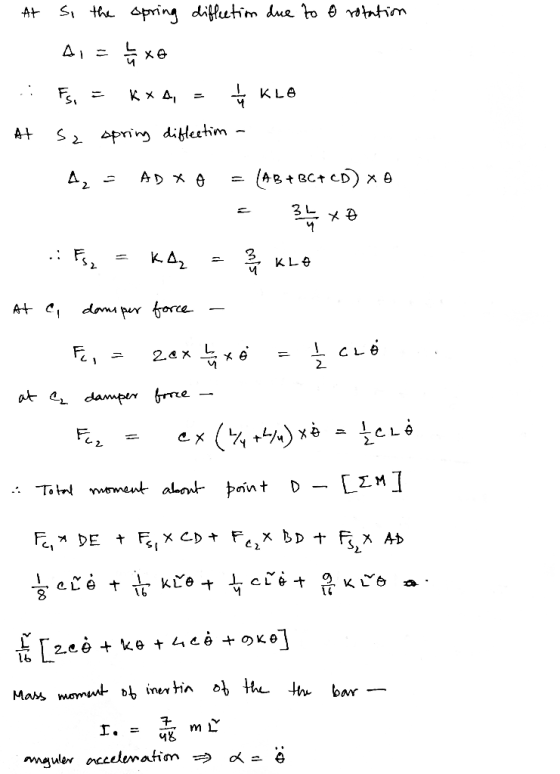
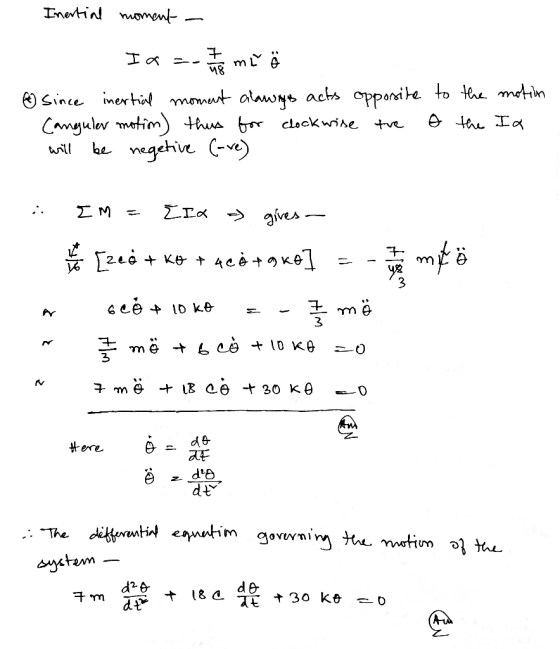
![o Newtons Law of motion for rotational systems - Sum of all moments = Inertial moment => Em = Eix (x anguler acceleration] S](http://img.homeworklib.com/questions/fc31c4b0-6d8e-11ec-99ad-93884da37179.png?x-oss-process=image/resize,w_560)
Add Answer to:
04: Derive the differential equation governing the motion of the one degree-of-freedom system by using Newton's...
solve with newton's method Q1: Use the equivalent system method to derive the differential equation governing...
 solve with newton's method
Q1: Use the equivalent system method to derive the differential equation governing the free vibrations of the system of Figure below. Use x, the displacement of the mass center of the disk from the system's equilibrium position, as the generalized coordinate. The disk rolls without slipping, no slip occurs at the pulley, and the pulley is frictionless. Include an approximation for the inertia effects of the springs. Each spring has a mass ms. Use newton's method....
solve with newton's method
Q1: Use the equivalent system method to derive the differential equation governing the free vibrations of the system of Figure below. Use x, the displacement of the mass center of the disk from the system's equilibrium position, as the generalized coordinate. The disk rolls without slipping, no slip occurs at the pulley, and the pulley is frictionless. Include an approximation for the inertia effects of the springs. Each spring has a mass ms. Use newton's method....
3) For the single degree of freedom system shown below: a) Use the equivalent system method...
 3) For the single degree of freedom system shown below: a) Use the equivalent system method to derive the differential equation governing the motion of the system, taking χ as the Slender har of mass m generalized coordinate. Rigid 1 link b) If m-6 kg, M = 10 kg, and k=500 N/m, determine the value of c that makes the system critically damped. c) For the values obtained in part (b), determine the response of the system, x(t) if x(0)=...
7. 150 points) A one-degree-of-freedom system is shown below. (a) (50 points) Derive the differential equation...
 7. 150 points) A one-degree-of-freedom system is shown below. (a) (50 points) Derive the differential equation governing the motion of the system usingq, the (b) (25 points) what are the natural frequency and damping ratto of the system? c) (25 points) Mc)-0 (d) (25 points) (e) (25 points) If M(t) =1.2 sin m N clockwise angular displacement of the disk from equilibrium as the generalized coordinate. 10° and the system is given an initial angulan released from rest what is...
Tutorial Problem Draw the free-body diagram and derive the equation of motion in terms of 0 using Newton's seco...
 Tutorial Problem Draw the free-body diagram and derive the equation of motion in terms of 0 using Newton's second law of motion of the systems shown in Figure below. Derive the equation of motion using the principle of conservation of energy Pulley, mas moment of inertia at)
Tutorial Problem Draw the free-body diagram and derive the equation of motion in terms of 0 using Newton's second law of motion of the systems shown in Figure below. Derive the equation of...
Tutorial Problem Draw the free-body diagram and derive the equation of motion in terms of 0 using Newton's second law of motion of the systems shown in Figure below. Derive the equation of motion using the principle of conservation of energy Pulley, mas moment of inertia at)
Tutorial Problem Draw the free-body diagram and derive the equation of motion in terms of 0 using Newton's second law of motion of the systems shown in Figure below. Derive the equation of...
Use Newton's method to determine the differential equation of motion, for the system shown, in terms...
 Use Newton's method to determine the differential equation of motion, for the system shown, in terms of the coordinates x and y. Jo is the moment of inertia for the pulley. Displacements x and y are zero when the system is in equilibrium. a) Show and properly label the (3) free body diagrams. b) Write and simplify to two EOMs for coordinates x and y Bonus: Write EOMs in matrix form for coordinates x and y 2r r 0 FO)
Full steps 3) (35 percent) Determine the differential equation of the system in the figure below...
 Full steps
3) (35 percent) Determine the differential equation of the system in the figure below using as the generalized coordinate using (a) Free-body diagram method by applying Newton's laws and (b) Equivalent systems method. 2k Slender bar of mass m Nie - -
Full steps
3) (35 percent) Determine the differential equation of the system in the figure below using as the generalized coordinate using (a) Free-body diagram method by applying Newton's laws and (b) Equivalent systems method. 2k Slender bar of mass m Nie - -
44. The system shown in Fig. P7 consists of a slider block of mass m2 and a uniform slender rod of mass m3, length 13, and mass moment of inertia about its center of mass J The slider block is connec...
 44. The system shown in Fig. P7 consists of a slider block of mass m2 and a uniform slender rod of mass m3, length 13, and mass moment of inertia about its center of mass J The slider block is connected to the ground by a spring that has a stiffness coefficient k. The slider block is subjected to the force F(t), while the rod is subjected to the moment M. Obtain the differential equations of motion of this two-degree-of-freedom...
Use only newtons method and make free body diagram Derive the equation of motion and find...
 Use only newtons method and make free body
diagram
Derive the equation of motion and find the natural frequency of the system shown below. Given that the moment of inertial of the bar about its centre of gravity is Jg = 1 ml? 4 Uniform rigid bar, mass m 3K @ooo k 4 4 2 Hint: the moment of inertia of the bar about O is to be found first.
Use only newtons method and make free body
diagram
Derive the equation of motion and find the natural frequency of the system shown below. Given that the moment of inertial of the bar about its centre of gravity is Jg = 1 ml? 4 Uniform rigid bar, mass m 3K @ooo k 4 4 2 Hint: the moment of inertia of the bar about O is to be found first.
Derive the governing equation of motion for the angular motion of a bar suspended using bifilar...
Derive the governing equation of motion for the angular motion of a bar suspended using bifilar suspension, and hence, derive the expression for the angular frequency.
Problem 4 Write the equation of motion of the system shown in Figure 3 using either...
 Problem 4 Write the equation of motion of the system shown in Figure 3 using either Newton's law or the principle of conservation of energy. Pulley, mass moment of inertia J. x(1) Figure 3
 solve with newton's method
Q1: Use the equivalent system method to derive the differential equation governing the free vibrations of the system of Figure below. Use x, the displacement of the mass center of the disk from the system's equilibrium position, as the generalized coordinate. The disk rolls without slipping, no slip occurs at the pulley, and the pulley is frictionless. Include an approximation for the inertia effects of the springs. Each spring has a mass ms. Use newton's method....
solve with newton's method
Q1: Use the equivalent system method to derive the differential equation governing the free vibrations of the system of Figure below. Use x, the displacement of the mass center of the disk from the system's equilibrium position, as the generalized coordinate. The disk rolls without slipping, no slip occurs at the pulley, and the pulley is frictionless. Include an approximation for the inertia effects of the springs. Each spring has a mass ms. Use newton's method....
 3) For the single degree of freedom system shown below: a) Use the equivalent system method to derive the differential equation governing the motion of the system, taking χ as the Slender har of mass m generalized coordinate. Rigid 1 link b) If m-6 kg, M = 10 kg, and k=500 N/m, determine the value of c that makes the system critically damped. c) For the values obtained in part (b), determine the response of the system, x(t) if x(0)=...
 7. 150 points) A one-degree-of-freedom system is shown below. (a) (50 points) Derive the differential equation governing the motion of the system usingq, the (b) (25 points) what are the natural frequency and damping ratto of the system? c) (25 points) Mc)-0 (d) (25 points) (e) (25 points) If M(t) =1.2 sin m N clockwise angular displacement of the disk from equilibrium as the generalized coordinate. 10° and the system is given an initial angulan released from rest what is...
 Tutorial Problem Draw the free-body diagram and derive the equation of motion in terms of 0 using Newton's second law of motion of the systems shown in Figure below. Derive the equation of motion using the principle of conservation of energy Pulley, mas moment of inertia at)
Tutorial Problem Draw the free-body diagram and derive the equation of motion in terms of 0 using Newton's second law of motion of the systems shown in Figure below. Derive the equation of...
Tutorial Problem Draw the free-body diagram and derive the equation of motion in terms of 0 using Newton's second law of motion of the systems shown in Figure below. Derive the equation of motion using the principle of conservation of energy Pulley, mas moment of inertia at)
Tutorial Problem Draw the free-body diagram and derive the equation of motion in terms of 0 using Newton's second law of motion of the systems shown in Figure below. Derive the equation of...
 Use Newton's method to determine the differential equation of motion, for the system shown, in terms of the coordinates x and y. Jo is the moment of inertia for the pulley. Displacements x and y are zero when the system is in equilibrium. a) Show and properly label the (3) free body diagrams. b) Write and simplify to two EOMs for coordinates x and y Bonus: Write EOMs in matrix form for coordinates x and y 2r r 0 FO)
 Full steps
3) (35 percent) Determine the differential equation of the system in the figure below using as the generalized coordinate using (a) Free-body diagram method by applying Newton's laws and (b) Equivalent systems method. 2k Slender bar of mass m Nie - -
Full steps
3) (35 percent) Determine the differential equation of the system in the figure below using as the generalized coordinate using (a) Free-body diagram method by applying Newton's laws and (b) Equivalent systems method. 2k Slender bar of mass m Nie - -
 44. The system shown in Fig. P7 consists of a slider block of mass m2 and a uniform slender rod of mass m3, length 13, and mass moment of inertia about its center of mass J The slider block is connected to the ground by a spring that has a stiffness coefficient k. The slider block is subjected to the force F(t), while the rod is subjected to the moment M. Obtain the differential equations of motion of this two-degree-of-freedom...
 Use only newtons method and make free body
diagram
Derive the equation of motion and find the natural frequency of the system shown below. Given that the moment of inertial of the bar about its centre of gravity is Jg = 1 ml? 4 Uniform rigid bar, mass m 3K @ooo k 4 4 2 Hint: the moment of inertia of the bar about O is to be found first.
Use only newtons method and make free body
diagram
Derive the equation of motion and find the natural frequency of the system shown below. Given that the moment of inertial of the bar about its centre of gravity is Jg = 1 ml? 4 Uniform rigid bar, mass m 3K @ooo k 4 4 2 Hint: the moment of inertia of the bar about O is to be found first.
 Problem 4 Write the equation of motion of the system shown in Figure 3 using either Newton's law or the principle of conservation of energy. Pulley, mass moment of inertia J. x(1) Figure 3
Most questions answered within 3 hours.
-
Where is the error in this code sequence?
String s1 = "Hello";
String s2 = "ello";...
asked 10 months ago -
Financial data for Joel de Paris, Inc., for last year
follow:
Joel de Paris, Inc.
Balance...
asked 10 months ago -
Consider this reaction:
Al2(SO4)3 (aq)+ BaCl3
(aq) Al2Cl6 (aq)- +
3BaSO4(s) . What is the...
asked 10 months ago -
Suppose that Savneet is considering increasing her
recent random sample from 20 car rentals to 40...
asked 10 months ago -
Trucks arrive at an unloading terminal at an average rate of 120
per hour.
Trucks arrive...
asked 10 months ago -
Why are methanol and ethanol completely soluble in water while
octanol is not very little soluble....
asked 10 months ago -
A facilities manager at a university reads in a research report
that the mean amount of...
asked 10 months ago -
When the CuSO4 is rehydrated by adding water to the anhydrous
compound, is this an endothermic...
asked 10 months ago -
A ray of sunlight is passing from diamond into crown glass; the
angle of incidence is...
asked 10 months ago -
A block of mass 0.249 kg is placed on top of a light, vertical
spring of...
asked 10 months ago -
how do the kidneys compensate in the presences of acidosis
a) trigger hyperventilate
b) reserve acid...
asked 10 months ago -
Question 501 pts
The rental rate of capital to the firm increases. Which of the
following...
asked 10 months ago