Claire Gerber wants to buy 400 shares of Google, which is selling in the market for...
Claire Gerber wants to buy 400 shares of Google, which is selling in the market for $534.14 a share. Rather than liquidate all her savings, she decides to borrow through her broker at 5 percent a year. Assume that the margin requirement on common stock is 50 percent. If the stock rises to $625 a share over the next year, calculate the dollar profit and percentage return that Claire would earn if she makes the investment with 50 percent margin. Contrast these figures to what she'd make if she uses no margin. Calculate the dollar net profit. Round the answers to the nearest dollar. Without Margin and With 50% Margin Calculate the return on investment. Round the answers to two decimal places. Without Margin and With 50% Margin
Homework Answers
Without margin:
Dollar gain=400*(625-534.14)=36344
Return on Investment=36344/(400*534.14)=17.01%
With margin:
Margin=400*534.14*50%=106828
Own Investment=400*534.14*50%=1068280
Interest to be paid=106828*5%=5341.40
Dollar gain=400*(625-534.14)-5341.4=31002.60
Return on Investment=31002.6/106828=29.02%
Add Answer to:
Claire Gerber wants to buy 400 shares of Google, which is
selling in the market for...
Financial Planning Exercise 4 Calculating profits on margined and unmargined investments Claire Gerber wants to buy...
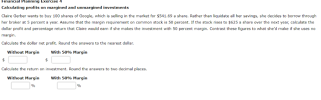 Financial Planning Exercise 4 Calculating profits on margined and unmargined investments Claire Gerber wants to buy 100 shares of Google, which is selling in the market for $541.69 a share. Rather than liquidate all her savings, she decides to borrow through her broker at 5 percent a year. Assume that the margin requirement on common stock is 50 percent. If the stock rises to $625 a share over the next year, calculate the dollar profit and percentage return that Claire...
Calculating profits on margined and unmargined investments
Claire Gerber wants to buy 300 shares of Google, which is selling in the market for $537.34 a share. Rather than liquidate all her savings, she decides to borrow through her broker at 5 percent a year. Assume that the margin requirement on common stock is 50 percent. If the stock rises to $625 a share over the next year, calculate the dollar profit and percentage return that Claire would earn if she makes the investment with 50 percent margin....
Dée Trader opens a brokerage account and purchases 400 shares of Internet Dreams at $20 per...
 Dée Trader opens a brokerage account and purchases 400 shares of Internet Dreams at $20 per share. She borrows $2,500 from her broker to help pay for the purchase. The interest rate on the loan is 7%. a. What is the margin in Dée's account when she first purchases the stock? Margin b. If the share price falls to $10 per share by the end of the year, what is the remaining margin in her account? (Round your answer to...
Dée Trader opens a brokerage account and purchases 400 shares of Internet Dreams at $24 per...
Dée Trader opens a brokerage account and purchases 400 shares of Internet Dreams at $24 per share. She borrows $3,400 from her broker to help pay for the purchase. The interest rate on the loan is 9%. a. What is the margin in Dée’s account when she first purchases the stock? b. If the share price falls to $14 per share by the end of the year, what is the remaining margin in her account? (Round your answer to 2...
You buy 100 shares of stock XYZ at $50/share on margin. Your broker makes you deposit...
 You buy 100 shares of stock XYZ at $50/share on margin. Your broker makes you deposit 50% of the cost into your margin account and you borrow the remaining 50% from your broker at 0% interest. When you close out your position, you sell all 100 shares of XYZ for $45 dollars and repay the loan. What was your return on the investment? (it's not -10%)
Lauren purchases 500 shares of Walsh Corp. at the beginning of the year when the market...
Lauren purchases 500 shares of Walsh Corp. at the beginning of the year when the market price of those shares was $77.50. During the year she receives a dividend of $2.80 per share and sells the stock at the end of the year for $82.00 per share. Calculate Lauren's total percentage return on this investment if she: (a) pays for the shares in-full with cash; and, (b) uses the 60% margin her broker offers. Ignore commissions, interest charges and taxes
Suppose you buy a round lot of Francesca Industries stock (100 shares) on 60 percent margin...
 Suppose you buy a round lot of Francesca Industries stock (100 shares) on 60 percent margin when the stock is selling at $30 a share. The broker charges a 8 percent annual interest rate, and commissions are 4 percent of the stock value on the purchase and sale. A year later you receive a $0.70 per share dividend and sell the stock for $40 a share. What is your rate of return on Francesca Industries? Do not round intermediate calculations....
Suppose you purchase 600 shares of stock at $33 per share with an initial cash investment...
 Suppose you purchase 600 shares of stock at $33 per share with an initial cash investment of $9,900. The call money rate is 5 percent and you are charged a 1.5 percent premium over this rate. Ignore dividends. a. Calculate your return on investment one year later if the share price is $41. Suppose instead you had simply purchased $9,900 of stock with no margin. What would your rate of return have been now? (Do not round intermediate calculations. Enter...
Barbara buys 130 shares of DEM at $33.00 a share and 190 shares of GOP at...
Barbara buys 130 shares of DEM at $33.00 a share and 190 shares of GOP at $37.00 a share. She buys on margin and the broker charges interest of 7 percent on the loan. If the margin requirement is 42 percent, what is the maximum amount she can borrow? Round your answer to the nearest cent. $ If she buys the stocks using the borrowed money and holds the securities for a year, how much interest must she pay? Round...
Suppose that you sell short 400 shares of Xtel, currently selling for $50 per share, and...
 Suppose that you sell short 400 shares of Xtel, currently selling for $50 per share, and give your broker $8,000 to establish your margin account. a. If you earn no interest on the funds in your margin account, what will be your rate of return after one year if Xtel stock is selling at: (i) $54; (ii) $50; (iii) $44? Assume that Xtel pays no dividends. (Leave no cells blank - be certain to enter "O" wherever required. Negative values...
 Financial Planning Exercise 4 Calculating profits on margined and unmargined investments Claire Gerber wants to buy 100 shares of Google, which is selling in the market for $541.69 a share. Rather than liquidate all her savings, she decides to borrow through her broker at 5 percent a year. Assume that the margin requirement on common stock is 50 percent. If the stock rises to $625 a share over the next year, calculate the dollar profit and percentage return that Claire...
 Dée Trader opens a brokerage account and purchases 400 shares of Internet Dreams at $20 per share. She borrows $2,500 from her broker to help pay for the purchase. The interest rate on the loan is 7%. a. What is the margin in Dée's account when she first purchases the stock? Margin b. If the share price falls to $10 per share by the end of the year, what is the remaining margin in her account? (Round your answer to...
 You buy 100 shares of stock XYZ at $50/share on margin. Your broker makes you deposit 50% of the cost into your margin account and you borrow the remaining 50% from your broker at 0% interest. When you close out your position, you sell all 100 shares of XYZ for $45 dollars and repay the loan. What was your return on the investment? (it's not -10%)
 Suppose you buy a round lot of Francesca Industries stock (100 shares) on 60 percent margin when the stock is selling at $30 a share. The broker charges a 8 percent annual interest rate, and commissions are 4 percent of the stock value on the purchase and sale. A year later you receive a $0.70 per share dividend and sell the stock for $40 a share. What is your rate of return on Francesca Industries? Do not round intermediate calculations....
 Suppose you purchase 600 shares of stock at $33 per share with an initial cash investment of $9,900. The call money rate is 5 percent and you are charged a 1.5 percent premium over this rate. Ignore dividends. a. Calculate your return on investment one year later if the share price is $41. Suppose instead you had simply purchased $9,900 of stock with no margin. What would your rate of return have been now? (Do not round intermediate calculations. Enter...
 Suppose that you sell short 400 shares of Xtel, currently selling for $50 per share, and give your broker $8,000 to establish your margin account. a. If you earn no interest on the funds in your margin account, what will be your rate of return after one year if Xtel stock is selling at: (i) $54; (ii) $50; (iii) $44? Assume that Xtel pays no dividends. (Leave no cells blank - be certain to enter "O" wherever required. Negative values...
Most questions answered within 3 hours.
-
Where is the error in this code sequence?
String s1 = "Hello";
String s2 = "ello";...
asked 11 months ago -
Financial data for Joel de Paris, Inc., for last year
follow:
Joel de Paris, Inc.
Balance...
asked 11 months ago -
Consider this reaction:
Al2(SO4)3 (aq)+ BaCl3
(aq) Al2Cl6 (aq)- +
3BaSO4(s) . What is the...
asked 11 months ago -
Suppose that Savneet is considering increasing her
recent random sample from 20 car rentals to 40...
asked 11 months ago -
Trucks arrive at an unloading terminal at an average rate of 120
per hour.
Trucks arrive...
asked 11 months ago -
Why are methanol and ethanol completely soluble in water while
octanol is not very little soluble....
asked 11 months ago -
A facilities manager at a university reads in a research report
that the mean amount of...
asked 11 months ago -
When the CuSO4 is rehydrated by adding water to the anhydrous
compound, is this an endothermic...
asked 11 months ago -
A ray of sunlight is passing from diamond into crown glass; the
angle of incidence is...
asked 11 months ago -
A block of mass 0.249 kg is placed on top of a light, vertical
spring of...
asked 11 months ago -
how do the kidneys compensate in the presences of acidosis
a) trigger hyperventilate
b) reserve acid...
asked 11 months ago -
Question 501 pts
The rental rate of capital to the firm increases. Which of the
following...
asked 11 months ago