
Homework Answers
Add Answer to:
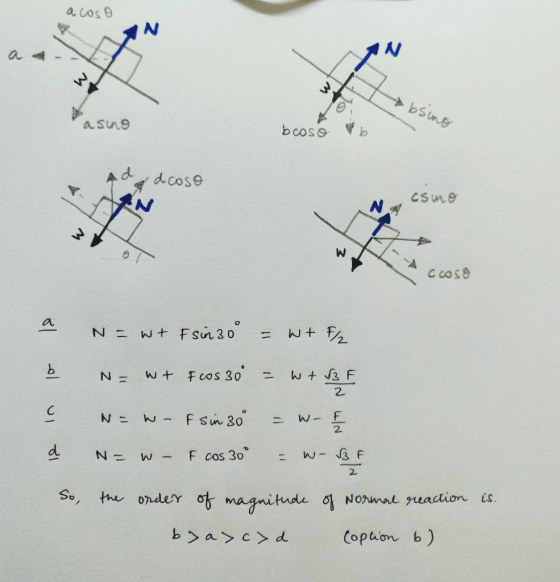
40). The figure at right shows four choices for the direction of a force of magnitude...
The figure shows three arrangements of a block attached to identical springs that are in their...
 The figure shows three arrangements of a block attached to
identical springs that are in their relaxed state when the block is
centered as shown. Rank the arrangements according to the magnitude
of the net force on the block, largest first, when the block is
displaced by distance d (a) to the right
and (b) to the left. Rank the arrangements
according to the work done on the block by the spring forces,
greatest first, when the block is displaced...
The figure shows three arrangements of a block attached to
identical springs that are in their relaxed state when the block is
centered as shown. Rank the arrangements according to the magnitude
of the net force on the block, largest first, when the block is
displaced by distance d (a) to the right
and (b) to the left. Rank the arrangements
according to the work done on the block by the spring forces,
greatest first, when the block is displaced...
A box of mass m is sliding down an inclined plane. The plane makes an angle...
A box of mass m is sliding down an inclined plane. The plane makes an angle ϴ with the horizontal ground. What is the magnitude of the component of the gravitational force that is parallel to the inclined plane? A. m g cosθ B. m g sinϴ C. 0 D. m g If you lift a 2 kg weight through a vertical distance of 1 m at constant velocity, how much work did you do on the weight? Assume the...
helpp!!! Work Done by Different Forces (No Calculator): You try F or N Normal Force perpendicular...
 helpp!!!
Work Done by Different Forces (No Calculator): You try F or N Normal Force perpendicular to the surface. Q1: The block in the figure is moving upwards along a smooth inclined plane at angle 0. A force F is pushing it upwards, parallel to the incline as shown in the figure. The block moved a distance, d. (a) Draw a FBD and (b) figure out work done by forces F.F. fand N fFriction FA Applied force. Force towards the...
helpp!!!
Work Done by Different Forces (No Calculator): You try F or N Normal Force perpendicular to the surface. Q1: The block in the figure is moving upwards along a smooth inclined plane at angle 0. A force F is pushing it upwards, parallel to the incline as shown in the figure. The block moved a distance, d. (a) Draw a FBD and (b) figure out work done by forces F.F. fand N fFriction FA Applied force. Force towards the...
A block of mass m is pulled along a rough horizontal floor by an applied force...
 A block of mass m is pulled along a rough horizontal floor by an applied force T that makes an angle with the horizontal. The vertical force exerted on the block by the floor is: a mg - Tsine b. mg + Tsine c. mg d. mg-T cose Question 10 Moving to the next question prevents changes to this answer.
The figure below shows an initially stationary block of mass m on a floor
 The figure below shows an initially stationary block of mass m on a floor. A force of magnitude F = 0.550mg is then applied at upward angle θ = 24°. (a) What is the magnitude of the acceleration of the block across the floor if the friction coefficients are μs = 0.610 and μk = 0.505? (b) What is the magnitude of the acceleration of the block across the floor if the friction coefficients are μs = 0.395 and μk...
A 9-kg block is placed on a frictionless plane inclined at an angle of 30° to...
 A 9-kg block is placed on a frictionless plane inclined at an angle of 30° to the horizontal. A horizontal force is then applied to the block to keep it stationary. Find the magnitude of this applied force A. 30 N B. 40 N C. 50 N D. 60 N E. 70N
A block weighing 10.20 N rests on a 34° inclined plane. (a) Find the normal force...
A block weighing 10.20 N rests on a 34° inclined plane. (a) Find the normal force exerted by the plane on the block. out of the plane (b) Find the frictional force exerted by the plane on the block. up the slope (c) Find the magnitude of the total force exerted by the plane on the block (d) Find the normal force and the frictional force exerted by the block on the plane. normal force into the plane frictional friction...
24. A particle is on a smooth horizontal plane. A force graph is given. Then: F...
 24. A particle is on a smooth horizontal plane. A force graph is given. Then: F is applied w hose F vs t A) at t, the acceleration is constant B) initially body must be in rest C) at t, the acceleration is constant D) initially acceleration is zero E) Both C) and D) are correct. 25. A crate rests on a horizontal surface and a woman pulls on it with a 10 N force. Rank the situations shown below...
A block of weight w = 40.0 N sits on a frictionless inclined plane, which makes...
A block of weight w = 40.0 N sits on a frictionless inclined plane, which makes an angle θ = 35.0 ∘ with respect to the horizontal, as shown in the figure. (Figure 1)A force of magnitude F = 22.9 N , applied parallel to the incline, is just sufficient to pull the block up the plane at constant speed. Part B What is Wg, the work done on the block by the force of gravity w⃗ as the block moves...
Figure 1: Block on incline. 2, A block of mass m = 5 kg is subject...
 Figure 1: Block on incline. 2, A block of mass m = 5 kg is subject to a force of magnitude 20 N that makes an angle of p20 with the (frictionless) inclined plane of contact. The plane itself is inclined θ = 300 with the horizontal. (a) What is the acceleration of the block along the incline? (b) If the block begins at rest, in what direction will it move subsequently (i.e., up or down the incline)? (c) If...
 The figure shows three arrangements of a block attached to
identical springs that are in their relaxed state when the block is
centered as shown. Rank the arrangements according to the magnitude
of the net force on the block, largest first, when the block is
displaced by distance d (a) to the right
and (b) to the left. Rank the arrangements
according to the work done on the block by the spring forces,
greatest first, when the block is displaced...
The figure shows three arrangements of a block attached to
identical springs that are in their relaxed state when the block is
centered as shown. Rank the arrangements according to the magnitude
of the net force on the block, largest first, when the block is
displaced by distance d (a) to the right
and (b) to the left. Rank the arrangements
according to the work done on the block by the spring forces,
greatest first, when the block is displaced...
 helpp!!!
Work Done by Different Forces (No Calculator): You try F or N Normal Force perpendicular to the surface. Q1: The block in the figure is moving upwards along a smooth inclined plane at angle 0. A force F is pushing it upwards, parallel to the incline as shown in the figure. The block moved a distance, d. (a) Draw a FBD and (b) figure out work done by forces F.F. fand N fFriction FA Applied force. Force towards the...
helpp!!!
Work Done by Different Forces (No Calculator): You try F or N Normal Force perpendicular to the surface. Q1: The block in the figure is moving upwards along a smooth inclined plane at angle 0. A force F is pushing it upwards, parallel to the incline as shown in the figure. The block moved a distance, d. (a) Draw a FBD and (b) figure out work done by forces F.F. fand N fFriction FA Applied force. Force towards the...
 A block of mass m is pulled along a rough horizontal floor by an applied force T that makes an angle with the horizontal. The vertical force exerted on the block by the floor is: a mg - Tsine b. mg + Tsine c. mg d. mg-T cose Question 10 Moving to the next question prevents changes to this answer.
 A 9-kg block is placed on a frictionless plane inclined at an angle of 30° to the horizontal. A horizontal force is then applied to the block to keep it stationary. Find the magnitude of this applied force A. 30 N B. 40 N C. 50 N D. 60 N E. 70N
 24. A particle is on a smooth horizontal plane. A force graph is given. Then: F is applied w hose F vs t A) at t, the acceleration is constant B) initially body must be in rest C) at t, the acceleration is constant D) initially acceleration is zero E) Both C) and D) are correct. 25. A crate rests on a horizontal surface and a woman pulls on it with a 10 N force. Rank the situations shown below...
 Figure 1: Block on incline. 2, A block of mass m = 5 kg is subject to a force of magnitude 20 N that makes an angle of p20 with the (frictionless) inclined plane of contact. The plane itself is inclined θ = 300 with the horizontal. (a) What is the acceleration of the block along the incline? (b) If the block begins at rest, in what direction will it move subsequently (i.e., up or down the incline)? (c) If...
Most questions answered within 3 hours.
-
Where is the error in this code sequence?
String s1 = "Hello";
String s2 = "ello";...
asked 11 months ago -
Financial data for Joel de Paris, Inc., for last year
follow:
Joel de Paris, Inc.
Balance...
asked 11 months ago -
Consider this reaction:
Al2(SO4)3 (aq)+ BaCl3
(aq) Al2Cl6 (aq)- +
3BaSO4(s) . What is the...
asked 11 months ago -
Suppose that Savneet is considering increasing her
recent random sample from 20 car rentals to 40...
asked 11 months ago -
Trucks arrive at an unloading terminal at an average rate of 120
per hour.
Trucks arrive...
asked 11 months ago -
Why are methanol and ethanol completely soluble in water while
octanol is not very little soluble....
asked 11 months ago -
A facilities manager at a university reads in a research report
that the mean amount of...
asked 11 months ago -
When the CuSO4 is rehydrated by adding water to the anhydrous
compound, is this an endothermic...
asked 11 months ago -
A ray of sunlight is passing from diamond into crown glass; the
angle of incidence is...
asked 11 months ago -
A block of mass 0.249 kg is placed on top of a light, vertical
spring of...
asked 11 months ago -
how do the kidneys compensate in the presences of acidosis
a) trigger hyperventilate
b) reserve acid...
asked 11 months ago -
Question 501 pts
The rental rate of capital to the firm increases. Which of the
following...
asked 11 months ago