
Homework Answers
Add Answer to:
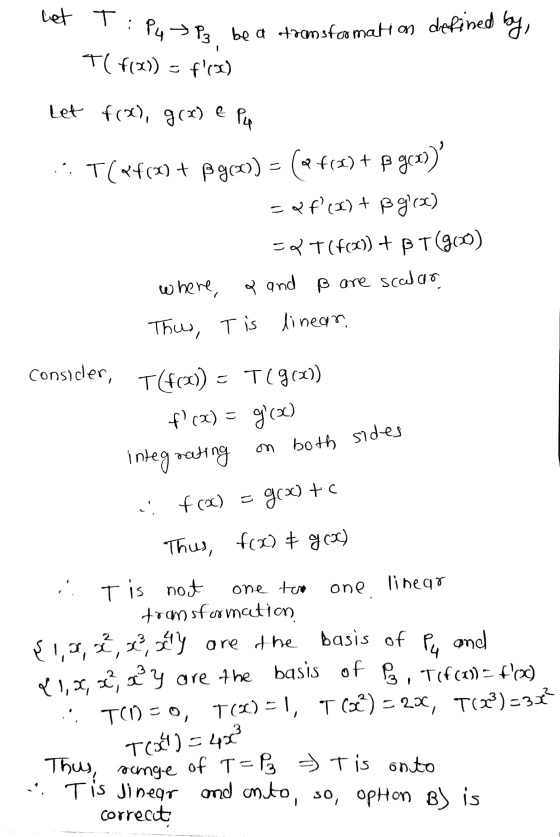
16. Let T:P4 → P3 be a transformation defined by T(f(x)) = f'(x). This transformation is...
6. (16 points) For the two linear transformations defined as T: Pz → P3, T1(p) =...
 6. (16 points) For the two linear transformations defined as T: Pz → P3, T1(p) = xp' T2 :P3 → P1, T2(p) = 3p". a) Determine whether Ti is an isomorphism? (Clearly show your work and explain.) b) Show how to find the image of p(x) = 3 - 4x + 2x² – 5x’ through the T2 transformation. c) Show how to find the standard matrix for the linear transformation that is T =T, •T,. d) Show how to find...
(1 point) Let T : P3-> P3 be the linear transformation such that Find T(1). T(x)....
 (1 point) Let T : P3-> P3 be the linear transformation such that Find T(1). T(x). T(r2), and T(az2 + bz+ c), where a, b, and c are arbitrary real numbers. T(1) = T(z) = T(r2) Note: You can earn partial credit on this problem.
could u help me for this question?thanku!! 21. Let T be a linear transformation from P2 into P3 over R defined by T(p(x)) xp(x). (a) Find [T]B.A the matrix of T relative to the bases A = {1-x, l-x...
 could u help me for this question?thanku!!
21. Let T be a linear transformation from P2 into P3 over R defined by T(p(x)) xp(x). (a) Find [T]B.A the matrix of T relative to the bases A = {1-x, l-x2,x) and B={1,1+x, 1 +x+12, 1-x3}. (b) Use [TlB. A to find a basis for the range of T. (c) Use TB.A to find a basis for the kernel of T. (d) State the rank and nullity of T.
21. Let T...
could u help me for this question?thanku!!
21. Let T be a linear transformation from P2 into P3 over R defined by T(p(x)) xp(x). (a) Find [T]B.A the matrix of T relative to the bases A = {1-x, l-x2,x) and B={1,1+x, 1 +x+12, 1-x3}. (b) Use [TlB. A to find a basis for the range of T. (c) Use TB.A to find a basis for the kernel of T. (d) State the rank and nullity of T.
21. Let T...
Let T: R4 → R3 be the linear transformation represented by T(x) = Ax, where 1...
 Let T: R4 → R3 be the linear transformation represented by T(x) = Ax, where 1 A = 0 -2 1 0 1 2 3 . 0 0 1 0 (a) Find the dimension of the domain. (b) Find the dimension of the range. (C) Find the dimension of the kernel. (d) Is T one-to-one? Explain. O T is one-to-one since the ker(T) = {0}. O T is one-to-one since the ker(T) = {0}. O T is not one-to-one since...
Let T: P1 → P2 be a linear transformation defined by T(a + bx) = 3a...
 Let T: P1 → P2 be a linear transformation defined by T(a + bx) = 3a – 2bx + (a + b)x². (a) Find range(T) and give a basis for range(T). (b) Find ker(T) and give a basis for ker(T). (c) By justifying your answer determine whether T is onto. (d) By justifying your answer determine whether T is one-to-one. (e) Find [T(7 + x)]], where B = {-1, -2x, 4x2}.
Determine whether or not the following transformation T :V + W is a linear transformation. If...
 Determine whether or not the following transformation T :V + W is a linear transformation. If T is not a linear transformation, provide a counter example. If it is, then: (i) find the nullspace N(T) and nullity of T, (ii) find the range R(T) and rank of T, (iii) determine if T is one-to-one, (iv) determine if T is onto. : (a) T: R3 + R2 defined by T(x, y, z) = (2x, y, z) (b) T: R2 + R2...
Q22 A` = AP, B` = BQ 5.4 Composition of Linear Transformations229 Let T be the linear transformation from P3 over R t...
 Q22 A` = AP, B` = BQ
5.4 Composition of Linear Transformations229 Let T be the linear transformation from P3 over R to R2x2 defined by ao T (ao+ ax azx a3x) ao t a3 a3 Find bases A' of Pa and B' of R22 that satisfy the conditions given in Theorem 5.19. 23. Let T be the linear transformation from R2x2 to P2 0ver R defined by a12 a22 +(a1-a22)x +(a12 -a21)x T a22 Find bases A' of R2x2...
Q22 A` = AP, B` = BQ
5.4 Composition of Linear Transformations229 Let T be the linear transformation from P3 over R to R2x2 defined by ao T (ao+ ax azx a3x) ao t a3 a3 Find bases A' of Pa and B' of R22 that satisfy the conditions given in Theorem 5.19. 23. Let T be the linear transformation from R2x2 to P2 0ver R defined by a12 a22 +(a1-a22)x +(a12 -a21)x T a22 Find bases A' of R2x2...
1. (a) Let T:R' R'be defined by T(x) = 5 -2. Is T a linear transformation?...
 1. (a) Let T:R' R'be defined by T(x) = 5 -2. Is T a linear transformation? If so, prove that it is. If not, explain why not. (b) More generally than part (a), suppose that T:R → R is defined by T(x) = ax +b, where a and b are constants. What must be true about a and b in order for T to be a linear transformation? Explain your answer.
2) Let T be a linear transformation from P3(R) to M22(R). Let B= (1+2x + 4x2...
 2) Let T be a linear transformation from P3(R) to M22(R). Let B= (1+2x + 4x2 + 8x3), (1 + 3x + 5x2 + 10x3), (1 + 4x + 7x2 + 13r%),(1 + 4x + 7x2 + 14x²). Let C= [] [ 1];[1 ] [ ] 0 17 40 Let M= 13 31 36 124 22 52 -61 -209 23 55 -64 -220 be the matrix transformation of T from basis B to C. -47 -161 The closed form of...
Let F :P3 + R2 be a linear transformation with three values given below. F(22) =...
 Let F :P3 + R2 be a linear transformation with three values given below. F(22) = 11 F(x) = 1 f(1) = 1 Find F((x – 2)2) B. Find an element of ker(F)| A.
 6. (16 points) For the two linear transformations defined as T: Pz → P3, T1(p) = xp' T2 :P3 → P1, T2(p) = 3p". a) Determine whether Ti is an isomorphism? (Clearly show your work and explain.) b) Show how to find the image of p(x) = 3 - 4x + 2x² – 5x’ through the T2 transformation. c) Show how to find the standard matrix for the linear transformation that is T =T, •T,. d) Show how to find...
 (1 point) Let T : P3-> P3 be the linear transformation such that Find T(1). T(x). T(r2), and T(az2 + bz+ c), where a, b, and c are arbitrary real numbers. T(1) = T(z) = T(r2) Note: You can earn partial credit on this problem.
 could u help me for this question?thanku!!
21. Let T be a linear transformation from P2 into P3 over R defined by T(p(x)) xp(x). (a) Find [T]B.A the matrix of T relative to the bases A = {1-x, l-x2,x) and B={1,1+x, 1 +x+12, 1-x3}. (b) Use [TlB. A to find a basis for the range of T. (c) Use TB.A to find a basis for the kernel of T. (d) State the rank and nullity of T.
21. Let T...
could u help me for this question?thanku!!
21. Let T be a linear transformation from P2 into P3 over R defined by T(p(x)) xp(x). (a) Find [T]B.A the matrix of T relative to the bases A = {1-x, l-x2,x) and B={1,1+x, 1 +x+12, 1-x3}. (b) Use [TlB. A to find a basis for the range of T. (c) Use TB.A to find a basis for the kernel of T. (d) State the rank and nullity of T.
21. Let T...
 Let T: R4 → R3 be the linear transformation represented by T(x) = Ax, where 1 A = 0 -2 1 0 1 2 3 . 0 0 1 0 (a) Find the dimension of the domain. (b) Find the dimension of the range. (C) Find the dimension of the kernel. (d) Is T one-to-one? Explain. O T is one-to-one since the ker(T) = {0}. O T is one-to-one since the ker(T) = {0}. O T is not one-to-one since...
 Let T: P1 → P2 be a linear transformation defined by T(a + bx) = 3a – 2bx + (a + b)x². (a) Find range(T) and give a basis for range(T). (b) Find ker(T) and give a basis for ker(T). (c) By justifying your answer determine whether T is onto. (d) By justifying your answer determine whether T is one-to-one. (e) Find [T(7 + x)]], where B = {-1, -2x, 4x2}.
 Determine whether or not the following transformation T :V + W is a linear transformation. If T is not a linear transformation, provide a counter example. If it is, then: (i) find the nullspace N(T) and nullity of T, (ii) find the range R(T) and rank of T, (iii) determine if T is one-to-one, (iv) determine if T is onto. : (a) T: R3 + R2 defined by T(x, y, z) = (2x, y, z) (b) T: R2 + R2...
 Q22 A` = AP, B` = BQ
5.4 Composition of Linear Transformations229 Let T be the linear transformation from P3 over R to R2x2 defined by ao T (ao+ ax azx a3x) ao t a3 a3 Find bases A' of Pa and B' of R22 that satisfy the conditions given in Theorem 5.19. 23. Let T be the linear transformation from R2x2 to P2 0ver R defined by a12 a22 +(a1-a22)x +(a12 -a21)x T a22 Find bases A' of R2x2...
Q22 A` = AP, B` = BQ
5.4 Composition of Linear Transformations229 Let T be the linear transformation from P3 over R to R2x2 defined by ao T (ao+ ax azx a3x) ao t a3 a3 Find bases A' of Pa and B' of R22 that satisfy the conditions given in Theorem 5.19. 23. Let T be the linear transformation from R2x2 to P2 0ver R defined by a12 a22 +(a1-a22)x +(a12 -a21)x T a22 Find bases A' of R2x2...
 1. (a) Let T:R' R'be defined by T(x) = 5 -2. Is T a linear transformation? If so, prove that it is. If not, explain why not. (b) More generally than part (a), suppose that T:R → R is defined by T(x) = ax +b, where a and b are constants. What must be true about a and b in order for T to be a linear transformation? Explain your answer.
 2) Let T be a linear transformation from P3(R) to M22(R). Let B= (1+2x + 4x2 + 8x3), (1 + 3x + 5x2 + 10x3), (1 + 4x + 7x2 + 13r%),(1 + 4x + 7x2 + 14x²). Let C= [] [ 1];[1 ] [ ] 0 17 40 Let M= 13 31 36 124 22 52 -61 -209 23 55 -64 -220 be the matrix transformation of T from basis B to C. -47 -161 The closed form of...
 Let F :P3 + R2 be a linear transformation with three values given below. F(22) = 11 F(x) = 1 f(1) = 1 Find F((x – 2)2) B. Find an element of ker(F)| A.
Most questions answered within 3 hours.
-
Where is the error in this code sequence?
String s1 = "Hello";
String s2 = "ello";...
asked 10 months ago -
Financial data for Joel de Paris, Inc., for last year
follow:
Joel de Paris, Inc.
Balance...
asked 10 months ago -
Consider this reaction:
Al2(SO4)3 (aq)+ BaCl3
(aq) Al2Cl6 (aq)- +
3BaSO4(s) . What is the...
asked 10 months ago -
Suppose that Savneet is considering increasing her
recent random sample from 20 car rentals to 40...
asked 10 months ago -
Trucks arrive at an unloading terminal at an average rate of 120
per hour.
Trucks arrive...
asked 10 months ago -
Why are methanol and ethanol completely soluble in water while
octanol is not very little soluble....
asked 10 months ago -
A facilities manager at a university reads in a research report
that the mean amount of...
asked 10 months ago -
When the CuSO4 is rehydrated by adding water to the anhydrous
compound, is this an endothermic...
asked 10 months ago -
A ray of sunlight is passing from diamond into crown glass; the
angle of incidence is...
asked 10 months ago -
A block of mass 0.249 kg is placed on top of a light, vertical
spring of...
asked 10 months ago -
how do the kidneys compensate in the presences of acidosis
a) trigger hyperventilate
b) reserve acid...
asked 10 months ago -
Question 501 pts
The rental rate of capital to the firm increases. Which of the
following...
asked 10 months ago