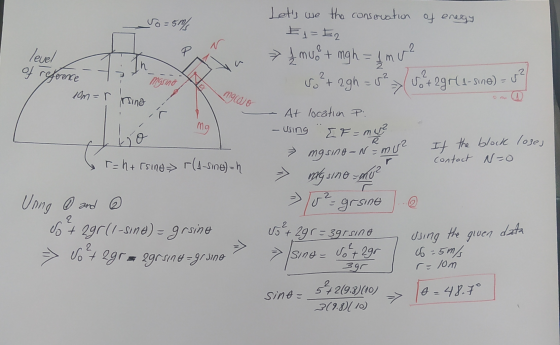
An object rests at the top of a smooth frictionless hemispherical surface of radius r =...
An object rests at the top of a smooth frictionless hemispherical surface of radius r = 10m. After the object is pushed horizontally with an initial velocity of v0 = 5m/s, it slides down and slips off the hemisphere. Find the angle at which the object loses contact with the surface.
Could you please type in the numbers that are suppose to go to each variable in the formulas thank you!

Homework Answers
Add Answer to:
An object rests at the top of a smooth frictionless
hemispherical surface of radius r =...
An object of mass 0.04kg is released from rest at the lip of a smooth hemispherical...
An object of mass 0.04kg is released from rest at the lip of a smooth hemispherical bowl of radius R. The object slips down the side and collides with another object of mass 0.1 kg sitting at the bottom of the bowl. You can ignore friction between the masses and the surface of the bowl. If they stick together when they collide, how high above the bottom of the bowl will the masses go after colliding?
A 1.00 kg block is at rest at the top of a smooth hemispherical surface of radius R = 2.00 m. It is attached to anunstre...
 A 1.00 kg block is at rest at the top of a smooth hemispherical
surface of radius R = 2.00 m. It is attached to anunstretched cord
with stiffness of 5.00 N/m as shown on the left. It is given a
slight nudge to the right, and it slides along the surface. When
the block has moved to the position shown on the right what
is:
a) the stretch in the cord as an exact multiple of R?
b) the...
A 1.00 kg block is at rest at the top of a smooth hemispherical
surface of radius R = 2.00 m. It is attached to anunstretched cord
with stiffness of 5.00 N/m as shown on the left. It is given a
slight nudge to the right, and it slides along the surface. When
the block has moved to the position shown on the right what
is:
a) the stretch in the cord as an exact multiple of R?
b) the...
A smooth sphere of radius R rests on a horizontal plane. A small mass is placed...
A smooth sphere of radius R rests on a horizontal plane. A small mass is placed on top of the sphere and slides without friction down it. Find a) the angle and speed at which the small mass leaves the surface of the sphere and b) the angle and speed with which the mass strikes the ground.
An object of 3 kg mass is at rest on a smooth frictionless surface. It is...
An object of 3 kg mass is at rest on a smooth frictionless surface. It is struck by a bullet travelling horizontally at 370 m/s. The bullet is embedded in the object and they move off together at 4.27 m/s. Assuming motion in a straight line, find the mass of the bullet. (Could you include a drawing aswell)
Object A of mass M is initially at rest on a flat, smooth frictionless surface. Object...
 Object A of mass M is initially at rest on a flat, smooth
frictionless surface. Object B, which has twice the mass of A, is
traveling with speed V before it collides elastically with A.
Immediately after the collision, both objects move off at angles
(theta)>0 with respect to the original direction of B. Calculate
the value of the angle.
[Hint: Note that the collision is elastic.] .
Object A of mass M is initially at rest on a flat,...
Object A of mass M is initially at rest on a flat, smooth
frictionless surface. Object B, which has twice the mass of A, is
traveling with speed V before it collides elastically with A.
Immediately after the collision, both objects move off at angles
(theta)>0 with respect to the original direction of B. Calculate
the value of the angle.
[Hint: Note that the collision is elastic.] .
Object A of mass M is initially at rest on a flat,...
A small block of mass m slides along the frictionless loop the loop track shown below....
 A small block of mass m slides along the frictionless loop the loop track shown below. If it starts from rest at point A, what is the speed of the block at point B? (v = squareroot (10 g R)) What is the net force acting on the block at point C? (Don't forget the gravitational force. (F = -mg (8i + j) At what height above the bottom should the block be released so that the normal force exerted...
released from rest in a smooth hemispherical bowl of radius R from the positions shown in...
 released from rest in a smooth hemispherical bowl of radius R from the positions shown in the figure below. You can ignore friction between the masses and the surface of the bowl. If they stick together when they collide, how high above the bottom of the bowl will the masses go after colliding? Two identical masses are
Two identical masses are released from rest in a smooth hemispherical bowl of radius R, from...
Two identical masses are released from rest in a smooth hemispherical bowl of radius R, from the positions shown in the figure . You can ignore friction between the masses and the surface of the bowl. If they stick together when they collide, how high above the bottom of the bowl will the masses go after colliding?
Two identical masses are released from rest in a smooth hemispherical bowl of radius R, from...
Two identical masses are released from rest in a smooth hemispherical bowl of radius R, from the positions shown in the figure (Figure 1) . You can ignore friction between the masses and the surface of the bowl.If they stick together when they collide, how high above the bottom of the bowl will the masses go after colliding? y= ?? R
A spool rests on a horizontal, frictionless surface and you are looking at it from the top view (...
 A spool rests on a horizontal, frictionless surface and you are looking at it from the top view (appears as a circle) In the following questions, the spool is pulled by tension forces that are applied at various locations, directions, and radii To solve each problem, draw the spool as a circle on a piece of paper and then draw the given tension vectors REMEMBER that the direction UPWARD points to the TOP of the page and DOWNWARD points to...
 A 1.00 kg block is at rest at the top of a smooth hemispherical
surface of radius R = 2.00 m. It is attached to anunstretched cord
with stiffness of 5.00 N/m as shown on the left. It is given a
slight nudge to the right, and it slides along the surface. When
the block has moved to the position shown on the right what
is:
a) the stretch in the cord as an exact multiple of R?
b) the...
A 1.00 kg block is at rest at the top of a smooth hemispherical
surface of radius R = 2.00 m. It is attached to anunstretched cord
with stiffness of 5.00 N/m as shown on the left. It is given a
slight nudge to the right, and it slides along the surface. When
the block has moved to the position shown on the right what
is:
a) the stretch in the cord as an exact multiple of R?
b) the...
 Object A of mass M is initially at rest on a flat, smooth
frictionless surface. Object B, which has twice the mass of A, is
traveling with speed V before it collides elastically with A.
Immediately after the collision, both objects move off at angles
(theta)>0 with respect to the original direction of B. Calculate
the value of the angle.
[Hint: Note that the collision is elastic.] .
Object A of mass M is initially at rest on a flat,...
Object A of mass M is initially at rest on a flat, smooth
frictionless surface. Object B, which has twice the mass of A, is
traveling with speed V before it collides elastically with A.
Immediately after the collision, both objects move off at angles
(theta)>0 with respect to the original direction of B. Calculate
the value of the angle.
[Hint: Note that the collision is elastic.] .
Object A of mass M is initially at rest on a flat,...
 A small block of mass m slides along the frictionless loop the loop track shown below. If it starts from rest at point A, what is the speed of the block at point B? (v = squareroot (10 g R)) What is the net force acting on the block at point C? (Don't forget the gravitational force. (F = -mg (8i + j) At what height above the bottom should the block be released so that the normal force exerted...
 released from rest in a smooth hemispherical bowl of radius R from the positions shown in the figure below. You can ignore friction between the masses and the surface of the bowl. If they stick together when they collide, how high above the bottom of the bowl will the masses go after colliding? Two identical masses are
 A spool rests on a horizontal, frictionless surface and you are looking at it from the top view (appears as a circle) In the following questions, the spool is pulled by tension forces that are applied at various locations, directions, and radii To solve each problem, draw the spool as a circle on a piece of paper and then draw the given tension vectors REMEMBER that the direction UPWARD points to the TOP of the page and DOWNWARD points to...
Most questions answered within 3 hours.
-
Where is the error in this code sequence?
String s1 = "Hello";
String s2 = "ello";...
asked 11 months ago -
Financial data for Joel de Paris, Inc., for last year
follow:
Joel de Paris, Inc.
Balance...
asked 11 months ago -
Consider this reaction:
Al2(SO4)3 (aq)+ BaCl3
(aq) Al2Cl6 (aq)- +
3BaSO4(s) . What is the...
asked 11 months ago -
Suppose that Savneet is considering increasing her
recent random sample from 20 car rentals to 40...
asked 11 months ago -
Trucks arrive at an unloading terminal at an average rate of 120
per hour.
Trucks arrive...
asked 11 months ago -
Why are methanol and ethanol completely soluble in water while
octanol is not very little soluble....
asked 11 months ago -
A facilities manager at a university reads in a research report
that the mean amount of...
asked 11 months ago -
When the CuSO4 is rehydrated by adding water to the anhydrous
compound, is this an endothermic...
asked 11 months ago -
A ray of sunlight is passing from diamond into crown glass; the
angle of incidence is...
asked 11 months ago -
A block of mass 0.249 kg is placed on top of a light, vertical
spring of...
asked 11 months ago -
how do the kidneys compensate in the presences of acidosis
a) trigger hyperventilate
b) reserve acid...
asked 11 months ago -
Question 501 pts
The rental rate of capital to the firm increases. Which of the
following...
asked 11 months ago