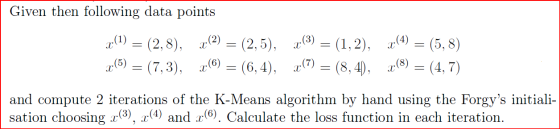
Given then following data points x(1) = (2, 8); x(2) = (2, 5); x(3) = (1, 2); x(4) = (5, 8) x(5) = (7, 3); x(6) = (6, 4); x(7) = (8, 4); x(8) = (4, 7) Compute 2 iterations of the K-Means algorithm by hand using the Forgy’s initialisation choosing x(3),
Given then following data points
x(1) = (2, 8); x(2) = (2, 5); x(3) = (1, 2); x(4) = (5, 8)
x(5) = (7, 3); x(6) = (6, 4); x(7) = (8, 4); x(8) = (4, 7)
Compute 2 iterations of the K-Means algorithm by hand using the Forgy’s initialisation choosing x(3), x(4) and x(6). Calculate the loss function in each iteration.
Homework Answers
Here the data points are given as x(1)=(2,8) , x(2)= (2,5) , x(3)= (1,2) ,x(4)=(5,8) , x(5)=(7,3), x(6)=(6,4) , x(7)=(8,4) , x(8)=(4,7)
the initialized points are x(3)= (1,2) ,x(4)=(5,8) and x(6)=(6,4)
the distance or the loss can be calculated by the formula
L = 
| Distance from x(3) | Distance from x(4) | Distance from x(5) | Nearest point | |
| (2,8) | 6.08 | 3 | 5.65 | x(4) |
| (2,5) | 3.16 | 4.24 | 4.12 | x(3) |
| (1,2) | 0 | 7.12 | 5.38 | x(3) |
| (5,8) | 7.21 | 0 | 4.12 | x(4) |
| (7,3) | 6.08 | 5.38 | 1.41 | x(6) |
| (6,4) | 5.38 | 4.12 | 0 | x(6) |
| (8,4) | 7.28 | 5 | 2 | x(6) |
| (4,7) | 5.83 | 1.41 | 3.61 | x(4) |
x(3) contains x(2) and x(3), so
the new center of x(3) is =  = (1.5 , 3.5)
x(4) contains x(1) , x(4) and
x(8) so the new center of x(3) is =  = (3.67 , 8)
x(6) contains x(5) , x(6) and
x(7) so the new center of x(3) is =  = (7 , 3.67)
| Distance from (1.5,3.5) | Distance from (3.67, 8) | Distance from (7, 3.67) | Nearest point | |
| (2,8) | 4.52 | 1.67 | 6.61 | (3.67, 8) = x(4) |
| (2,5) | 1.58 | 3.43 | 5.17 | (1.5,3.5) = x(3) |
| (1,2) | 1.58 | 6.56 | 6.22 | (1.5,3.5) = x(3) |
| (5,8) | 5.7 | 1.33 | 4.77 | (3.67, 8) = x(4) |
| (7,3) | 5.52 | 6.01 | 0.67 | (7, 3.67) = x(6) |
| (6,4) | 4.52 | 4.63 | 1.05 | (7, 3.67) = x(6) |
| (8,4) | 6.51 | 5.89 | 1.05 | (7, 3.67) = x(6) |
| (4,7) | 4.30 | 1.05 | 4.48 | (3.67, 8) = x(4) |
so , the clusters
x(3) contains x(2) and x(3) points
x(4) contains x(1) , x(4) and x(8) points
x(6) contains x(5) , x(6) and x(7) points
Add Answer to:
Given then following data points x(1) = (2, 8); x(2) = (2, 5); x(3) = (1, 2); x(4) = (5, 8) x(5) = (7, 3); x(6) = (6, 4); x(7) = (8, 4); x(8) = (4, 7) Compute 2 iterations of the K-Means algorithm by hand using the Forgy’s initialisation choosing x(3),
Question 4 1 pts Which of the following reasons is not the reason why the K-means...
 Question 4 1 pts Which of the following reasons is not the reason why the K-means algorithm will likely end up with sub-optimal clustering? (Select all that apply.) Bad choices for the initial cluster centers. Choosing a k that corresponds to the number of natural clusters in the dataset. Fast convergence of the K-means algorithm. Existence of closely located data samples in the dataset. Question 5 1 pts Which of the following is a step in K-means algorithm implementation? (Select...
Given the following data points, use the K-Means algorithm to cluster them into 2 clusters. Use...
Given the following data points, use the K-Means algorithm to cluster them into 2 clusters. Use (31,32) as the centroid of the first cluster and (34,24) as the centroid of the second cluster. Show your calculations and the final clusters. 1 2 3 4 5 6 7 8 9 10 x 11 11 15 20 25 26 31 34 40 43 y 6 38 18 40 24 8 32 24 41 47
Question Given the following data points, use the K-Means algorithm to cluster them into 2 clusters. Use (31,32) as the centroid of the first cluster and (34,24) as the centroid of the second cluster....
Question Given the following data points, use the K-Means algorithm to cluster them into 2 clusters. Use (31,32) as the centroid of the first cluster and (34,24) as the centroid of the second cluster. Show your calculations and the final clusters. 1 2 3 4 5 6 7 8 9 10 x 11 11 15 20 25 26 31 34 40 43 y 6 38 18 40 24 8 32 24 41 47
Given these data: x 1 2 3 5 7 8 f(x) 3 6 19 99 291...
Given these data: x 1 2 3 5 7 8 f(x) 3 6 19 99 291 444 a) Calculate f(4) using Newton's interpolating polynomials of order 1 through 4. Choose your base points to attain good accuracy. What do your results indicate regarding the order of the polynomial used to generate the data in the table?
Problem 3. (15 points) Given the following data: 3, 2, 3, 4, 5, 3, 4, 6,...
 Problem 3. (15 points) Given the following data: 3, 2, 3, 4, 5, 3, 4, 6, 4, 10, 7, 11 () (2 points) Calculate the sample mean by hand using its definition. Round your in results to two decimal places and your final answer to one decimal place. Same for the remai questions. (2) (2 points) Calculate the median of the data. (3) (3 points) Calculate the sample variance by hand using its definition. 4) (3 poi ning ints) Calculate...
Data clustering and the k means algorithm. However, I'm not able to list all of the...
 Data clustering and the k means algorithm. However, I'm
not able to list all of the data sets but they include: ecoli.txt,
glass.txt, ionoshpere.txt, iris_bezdek.txt, landsat.txt,
letter_recognition.txt, segmentation.txt vehicle.txt, wine.txt and
yeast.txt.
Input: Your program should be non-interactive (that is, the program should not interact with the user by asking him/her explicit questions) and take the following command-line arguments: <F<K><I><T> <R>, where F: name of the data file K: number of clusters (positive integer greater than one) I: maximum number...
Data clustering and the k means algorithm. However, I'm
not able to list all of the data sets but they include: ecoli.txt,
glass.txt, ionoshpere.txt, iris_bezdek.txt, landsat.txt,
letter_recognition.txt, segmentation.txt vehicle.txt, wine.txt and
yeast.txt.
Input: Your program should be non-interactive (that is, the program should not interact with the user by asking him/her explicit questions) and take the following command-line arguments: <F<K><I><T> <R>, where F: name of the data file K: number of clusters (positive integer greater than one) I: maximum number...
Question 1 (10 marks) For a linear system Ax- b with 1 0 -1 A-1 2-1 2 -1 3 b=14 18 and compute by...
 Please do question 5 for me. Thanks
Question 1 (10 marks) For a linear system Ax- b with 1 0 -1 A-1 2-1 2 -1 3 b=14 18 and compute by hand the first four iterations with the Jacobi method, using x()0 Hint: for the ease of calculation, keep to rational fractions rather than decimals Question 2 For the same linear system as in Question 1, compute by hand the first three iterations (10 marks) with the Gauss Seidel method,...
Please do question 5 for me. Thanks
Question 1 (10 marks) For a linear system Ax- b with 1 0 -1 A-1 2-1 2 -1 3 b=14 18 and compute by hand the first four iterations with the Jacobi method, using x()0 Hint: for the ease of calculation, keep to rational fractions rather than decimals Question 2 For the same linear system as in Question 1, compute by hand the first three iterations (10 marks) with the Gauss Seidel method,...
Use a calculator or program to compute the first 10 iterations of Newton's method for the...
 Use a calculator or program to compute the first 10 iterations of Newton's method for the given function and initial approximation. f(x)= 5 sinx- 4x-1, Xo = 1.9 Complete the table. (Do not round until the final answer. Then round to six decimal places as needed.) k хк XK 1 K 6 2 7 3 8 4 9 5 10
Use a calculator or program to compute the first 10 iterations of Newton's method for the...
 Use a calculator or program to compute the first 10 iterations of Newton's method for the given function and initial approximation. f(x) = 2 sinx-5x - 1, Xo = 1.3 Complete the table. (Do not round until the final answer. Then round to six decimal places as needed.) K хк k XK 1 6 2 7 3 8 4 9 5 10
Question 1 (10 marks) For a linear system Ax b with 1 0-1 A-1 2-1 2-13 and b4 18 compute by hand ...
 Question 1 (10 marks) For a linear system Ax b with 1 0-1 A-1 2-1 2-13 and b4 18 compute by hand the first four iterations with the Jacobi method, usg0 Hint: for the ease of calculation, keep to rational fractions rather than decimals. (10 marks) Question 2 For the same linear svstem as in Question 1. compute by hand the first three iterations with the Gauss Seidel method, us0 Hint: for the ease of calculation, keep to rational fractions...
 Question 4 1 pts Which of the following reasons is not the reason why the K-means algorithm will likely end up with sub-optimal clustering? (Select all that apply.) Bad choices for the initial cluster centers. Choosing a k that corresponds to the number of natural clusters in the dataset. Fast convergence of the K-means algorithm. Existence of closely located data samples in the dataset. Question 5 1 pts Which of the following is a step in K-means algorithm implementation? (Select...
 Problem 3. (15 points) Given the following data: 3, 2, 3, 4, 5, 3, 4, 6, 4, 10, 7, 11 () (2 points) Calculate the sample mean by hand using its definition. Round your in results to two decimal places and your final answer to one decimal place. Same for the remai questions. (2) (2 points) Calculate the median of the data. (3) (3 points) Calculate the sample variance by hand using its definition. 4) (3 poi ning ints) Calculate...
 Data clustering and the k means algorithm. However, I'm
not able to list all of the data sets but they include: ecoli.txt,
glass.txt, ionoshpere.txt, iris_bezdek.txt, landsat.txt,
letter_recognition.txt, segmentation.txt vehicle.txt, wine.txt and
yeast.txt.
Input: Your program should be non-interactive (that is, the program should not interact with the user by asking him/her explicit questions) and take the following command-line arguments: <F<K><I><T> <R>, where F: name of the data file K: number of clusters (positive integer greater than one) I: maximum number...
Data clustering and the k means algorithm. However, I'm
not able to list all of the data sets but they include: ecoli.txt,
glass.txt, ionoshpere.txt, iris_bezdek.txt, landsat.txt,
letter_recognition.txt, segmentation.txt vehicle.txt, wine.txt and
yeast.txt.
Input: Your program should be non-interactive (that is, the program should not interact with the user by asking him/her explicit questions) and take the following command-line arguments: <F<K><I><T> <R>, where F: name of the data file K: number of clusters (positive integer greater than one) I: maximum number...
 Please do question 5 for me. Thanks
Question 1 (10 marks) For a linear system Ax- b with 1 0 -1 A-1 2-1 2 -1 3 b=14 18 and compute by hand the first four iterations with the Jacobi method, using x()0 Hint: for the ease of calculation, keep to rational fractions rather than decimals Question 2 For the same linear system as in Question 1, compute by hand the first three iterations (10 marks) with the Gauss Seidel method,...
Please do question 5 for me. Thanks
Question 1 (10 marks) For a linear system Ax- b with 1 0 -1 A-1 2-1 2 -1 3 b=14 18 and compute by hand the first four iterations with the Jacobi method, using x()0 Hint: for the ease of calculation, keep to rational fractions rather than decimals Question 2 For the same linear system as in Question 1, compute by hand the first three iterations (10 marks) with the Gauss Seidel method,...
 Use a calculator or program to compute the first 10 iterations of Newton's method for the given function and initial approximation. f(x)= 5 sinx- 4x-1, Xo = 1.9 Complete the table. (Do not round until the final answer. Then round to six decimal places as needed.) k хк XK 1 K 6 2 7 3 8 4 9 5 10
 Use a calculator or program to compute the first 10 iterations of Newton's method for the given function and initial approximation. f(x) = 2 sinx-5x - 1, Xo = 1.3 Complete the table. (Do not round until the final answer. Then round to six decimal places as needed.) K хк k XK 1 6 2 7 3 8 4 9 5 10
 Question 1 (10 marks) For a linear system Ax b with 1 0-1 A-1 2-1 2-13 and b4 18 compute by hand the first four iterations with the Jacobi method, usg0 Hint: for the ease of calculation, keep to rational fractions rather than decimals. (10 marks) Question 2 For the same linear svstem as in Question 1. compute by hand the first three iterations with the Gauss Seidel method, us0 Hint: for the ease of calculation, keep to rational fractions...
Most questions answered within 3 hours.
-
Where is the error in this code sequence?
String s1 = "Hello";
String s2 = "ello";...
asked 10 months ago -
Financial data for Joel de Paris, Inc., for last year
follow:
Joel de Paris, Inc.
Balance...
asked 10 months ago -
Consider this reaction:
Al2(SO4)3 (aq)+ BaCl3
(aq) Al2Cl6 (aq)- +
3BaSO4(s) . What is the...
asked 10 months ago -
Suppose that Savneet is considering increasing her
recent random sample from 20 car rentals to 40...
asked 10 months ago -
Trucks arrive at an unloading terminal at an average rate of 120
per hour.
Trucks arrive...
asked 10 months ago -
Why are methanol and ethanol completely soluble in water while
octanol is not very little soluble....
asked 10 months ago -
A facilities manager at a university reads in a research report
that the mean amount of...
asked 10 months ago -
When the CuSO4 is rehydrated by adding water to the anhydrous
compound, is this an endothermic...
asked 10 months ago -
A ray of sunlight is passing from diamond into crown glass; the
angle of incidence is...
asked 10 months ago -
A block of mass 0.249 kg is placed on top of a light, vertical
spring of...
asked 10 months ago -
how do the kidneys compensate in the presences of acidosis
a) trigger hyperventilate
b) reserve acid...
asked 10 months ago -
Question 501 pts
The rental rate of capital to the firm increases. Which of the
following...
asked 10 months ago