Assume that the graphs in this problem are simple undirected graphs A. The minimum possible vertex...
Assume that the graphs in this problem are simple undirected graphs
A. The minimum possible vertex degree in a connected undirected graph of N vertices is:
B. The maximum possible vertex degree in a connected undirected graph of N vertices is:
C. The minimum possible vertex degree in a connected undirected graph of N vertices with all vertex degree being equal is:
D. The number of edges in a completely connected undirected graph of N vertices is:
E. Minimum possible number of vertices of maximum possible vertex degree in a connected undirected graph of N vertices is:
Homework Answers
A -
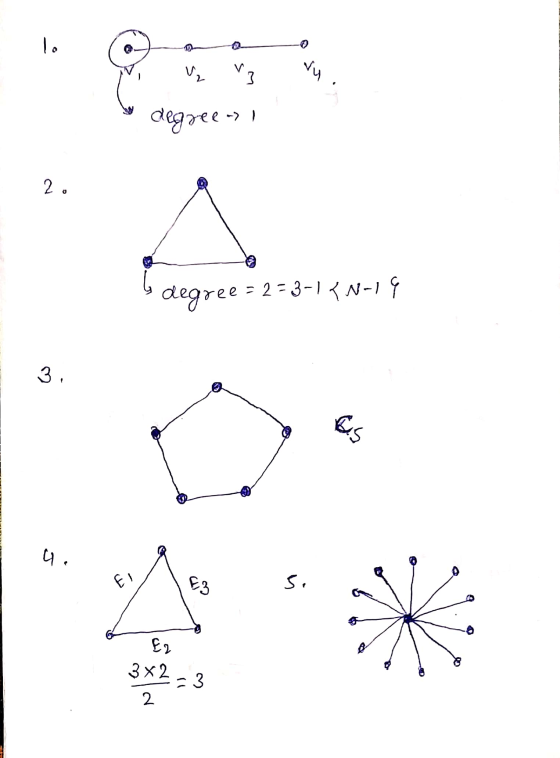
FOR ANY CONNECTED GRAPH EVERY VERTICE MUST BE CONNECTED TO ATLEAST ONE OTHER VERTICE.
SO THE MINIMUM POSSIBLE VERTEX DEGREE CAN BE 1
THINK IT OF AS A PATH WITH THE CORNER VERTEX ARE CONNECTED TO ONLY ONE ADJACENT VERTEX, SO THEIR DEGREE IS 1
B. -
THE MAXIMUM DEGREE IS POSSIBLE IN A CONNECTED GRAPH THAT IS N-1 WHEN THE EDGE IS CONNECTED TO ALL OTHER VERTEX , MEANING THERE IS AN EDGE GOING TO ALL OTHER N-1 VERTICES .
SO MAXIMUM DEGREE IS N-1
C. -
THE MINIMUM POSSIBLE DEGREE WILL BE WHEN THE ALL VERTICES FORM A RING
JUST IMAGINE THEM AS HOLDING HANDS TO EACH OTHER AND FORMING A BIG CIRCLE JUST.
SO THE MINIMUM POSSIBLE DEGREE WILL BE 2{
HEY THIS IS NOT VALID IN A SPECIAL CASE WHEN THERE ARE ONLY 2 VERTICES THEN THERE THE ANSWER WILL BE 1 }
D. -
FOR ANY CONNECTED GRAPH THERE WILL BE ALWAYS
N COMINATION 2 WAYS
SO NUMBER OF EDGES = N(N-1)/2
E-
JUST IMAGINE A VERTEX WITH ALL THE EDGES GOING OUTWARDS , LIKE HAVE YOU JUST LIKE THE DIAGRAM AS SHOWN SO
ANSWER =
1
ASK NY DOUBTS IN THE COMMENTS.
Add Answer to:
Assume that the graphs in this problem are simple undirected
graphs
A. The minimum possible vertex...
8. For each of the following, either draw a undirected graph satisfying the given criteria or explain why it cannot be done. Your graphs should be simple, i.e. not having any multiple edges (more tha...
 8. For each of the following, either draw a undirected graph satisfying the given criteria or explain why it cannot be done. Your graphs should be simple, i.e. not having any multiple edges (more than one edge between the same pair of vertices) or self-loops (edges with both ends at the same vertex). [10 points] a. A graph with 3 connected components, 11 vertices, and 10 edges. b. A graph with 4 connected components, 10 vertices, and 30 edges. c....
Long paths in undirected graphs In this question m is the number of edges in an...
Long paths in undirected graphs In this question m is the number of edges in an undirected graph. 1. Show that if the degree of every vertex is at least k, then the graph has a simple path of length at least k. Hint: consider the longest simple path in the graph say from x to y. Show that the endpoints x and y do not have edges to vertices outside the path. Thus all the neighbors of x, y...
1- Give an example (by drawing or by describing) of the following undirected graphs (a) A...
1- Give an example (by drawing or by describing) of the following undirected graphs (a) A graph where the degree in each vertex is even and the total number of edges is odd (b) A graph that does not have an eulerian cycle. An eulerian cycle is a cycle where every edge of the graph is visited exactly once. (c) A graph that does not have any cycles and the maximum degree of a node is 2 (minimum degree can...
7. Graphs u, u2, u3, u4, u5, u6} and the (a) Consider the undirected graph G...
 7. Graphs u, u2, u3, u4, u5, u6} and the (a) Consider the undirected graph G (V, E), with vertex set V set of edges E ((ul,u2), (u2,u3), (u3, u4), (u4, u5), (u5, u6). (u6, ul)} i. Draw a graphical representation of G. ii. Write the adjacency matrix of the graph G ii. Is the graph G isomorphic to any member of K, C, Wn or Q? Justify your answer. a. (1 Mark) (2 Marks) (2 Marks) b. Consider an...
8. For each of the following, either draw a undirected graph satisfying the given criteria or...
 8. For each of the following, either draw a undirected graph satisfying the given criteria or explain why it cannot be done. Your graphs should be simple, i.e. not having any multiple edges (more than one edge between the same pair of vertices) or self-loops (edges with both ends at the same vertex). [10 points] a. A graph with 3 connected components, 11 vertices, and 10 edges. b. A graph with 4 connected components, 10 vertices, and 30 edges. c....
Bounds on the number of edges in a graph. (a) Let G be an undirected graph...
Bounds on the number of edges in a graph. (a) Let G be an undirected graph with n vertices. Let Δ(G) be the maximum degree of any vertex in G, δ(G) be the minimum degree of any vertex in G, and m be the number of edges in G. Prove that δ(G)n2≤m≤Δ(G)n2
An undirected bipartite graph has n vertices and m edges. a) If the graph is connected,...
An undirected bipartite graph has n vertices and m edges. a) If the graph is connected, what is the minimum number of edges? b) If the graph is disconnected, what is the maximum number of edges? c) What is the longest single path? d) If the path can pass through a vertex and not any edges more than once, What is the longest path? Kindly provide me with an example for me to relate
Problem 5. (12 marks) Connectivity in undirected graphs vs. directed graphs. a. (8 marks) Prove that...
 Problem 5. (12 marks) Connectivity in undirected graphs vs. directed graphs. a. (8 marks) Prove that in any connected undirected graph G- (V, E) with VI > 2, there are at least two vertices u, u є V whose removal (along with all the edges that touch them) leaves G still connected. Propose an efficient algorithm to find two such vertices. (Hint: The algorithm should be based on the proof or the proof should be based on the algorithm.) b....
Recall the definition of the degree of a vertex in a graph. a) Suppose a graph has 7 vertices, each of degree 2 or 3. Is the graph necessarily connected ? b) Now the graph has 7 vertices, each degree...
 Recall the definition of the degree of a vertex in a graph. a)
Suppose a graph has 7 vertices, each of degree 2 or 3. Is the graph
necessarily connected ?
b) Now the graph has 7 vertices, each degree 3 or 4. Is it
necessarily connected?
My professor gave an example in class. He said triangle and a
square are graph which are not connected yet each vertex has degree
2.
(Paul Zeitz, The Art and Craft of Problem...
Recall the definition of the degree of a vertex in a graph. a)
Suppose a graph has 7 vertices, each of degree 2 or 3. Is the graph
necessarily connected ?
b) Now the graph has 7 vertices, each degree 3 or 4. Is it
necessarily connected?
My professor gave an example in class. He said triangle and a
square are graph which are not connected yet each vertex has degree
2.
(Paul Zeitz, The Art and Craft of Problem...
Question 1: Given an undirected connected graph so that every edge belongs to at least one...
Question 1: Given an undirected connected graph so that every edge belongs to at least one simple cycle (a cycle is simple if be vertex appears more than once). Show that we can give a direction to every edge so that the graph will be strongly connected. Question 2: Given a graph G(V, E) a set I is an independent set if for every uv el, u #v, uv & E. A Matching is a collection of edges {ei} so...
 8. For each of the following, either draw a undirected graph satisfying the given criteria or explain why it cannot be done. Your graphs should be simple, i.e. not having any multiple edges (more than one edge between the same pair of vertices) or self-loops (edges with both ends at the same vertex). [10 points] a. A graph with 3 connected components, 11 vertices, and 10 edges. b. A graph with 4 connected components, 10 vertices, and 30 edges. c....
 7. Graphs u, u2, u3, u4, u5, u6} and the (a) Consider the undirected graph G (V, E), with vertex set V set of edges E ((ul,u2), (u2,u3), (u3, u4), (u4, u5), (u5, u6). (u6, ul)} i. Draw a graphical representation of G. ii. Write the adjacency matrix of the graph G ii. Is the graph G isomorphic to any member of K, C, Wn or Q? Justify your answer. a. (1 Mark) (2 Marks) (2 Marks) b. Consider an...
 8. For each of the following, either draw a undirected graph satisfying the given criteria or explain why it cannot be done. Your graphs should be simple, i.e. not having any multiple edges (more than one edge between the same pair of vertices) or self-loops (edges with both ends at the same vertex). [10 points] a. A graph with 3 connected components, 11 vertices, and 10 edges. b. A graph with 4 connected components, 10 vertices, and 30 edges. c....
 Problem 5. (12 marks) Connectivity in undirected graphs vs. directed graphs. a. (8 marks) Prove that in any connected undirected graph G- (V, E) with VI > 2, there are at least two vertices u, u є V whose removal (along with all the edges that touch them) leaves G still connected. Propose an efficient algorithm to find two such vertices. (Hint: The algorithm should be based on the proof or the proof should be based on the algorithm.) b....
 Recall the definition of the degree of a vertex in a graph. a)
Suppose a graph has 7 vertices, each of degree 2 or 3. Is the graph
necessarily connected ?
b) Now the graph has 7 vertices, each degree 3 or 4. Is it
necessarily connected?
My professor gave an example in class. He said triangle and a
square are graph which are not connected yet each vertex has degree
2.
(Paul Zeitz, The Art and Craft of Problem...
Recall the definition of the degree of a vertex in a graph. a)
Suppose a graph has 7 vertices, each of degree 2 or 3. Is the graph
necessarily connected ?
b) Now the graph has 7 vertices, each degree 3 or 4. Is it
necessarily connected?
My professor gave an example in class. He said triangle and a
square are graph which are not connected yet each vertex has degree
2.
(Paul Zeitz, The Art and Craft of Problem...
Most questions answered within 3 hours.
-
Where is the error in this code sequence?
String s1 = "Hello";
String s2 = "ello";...
asked 11 months ago -
Financial data for Joel de Paris, Inc., for last year
follow:
Joel de Paris, Inc.
Balance...
asked 11 months ago -
Consider this reaction:
Al2(SO4)3 (aq)+ BaCl3
(aq) Al2Cl6 (aq)- +
3BaSO4(s) . What is the...
asked 11 months ago -
Suppose that Savneet is considering increasing her
recent random sample from 20 car rentals to 40...
asked 11 months ago -
Trucks arrive at an unloading terminal at an average rate of 120
per hour.
Trucks arrive...
asked 11 months ago -
Why are methanol and ethanol completely soluble in water while
octanol is not very little soluble....
asked 11 months ago -
A facilities manager at a university reads in a research report
that the mean amount of...
asked 11 months ago -
When the CuSO4 is rehydrated by adding water to the anhydrous
compound, is this an endothermic...
asked 11 months ago -
A ray of sunlight is passing from diamond into crown glass; the
angle of incidence is...
asked 11 months ago -
A block of mass 0.249 kg is placed on top of a light, vertical
spring of...
asked 11 months ago -
how do the kidneys compensate in the presences of acidosis
a) trigger hyperventilate
b) reserve acid...
asked 11 months ago -
Question 501 pts
The rental rate of capital to the firm increases. Which of the
following...
asked 11 months ago