
Homework Answers
Add Answer to:
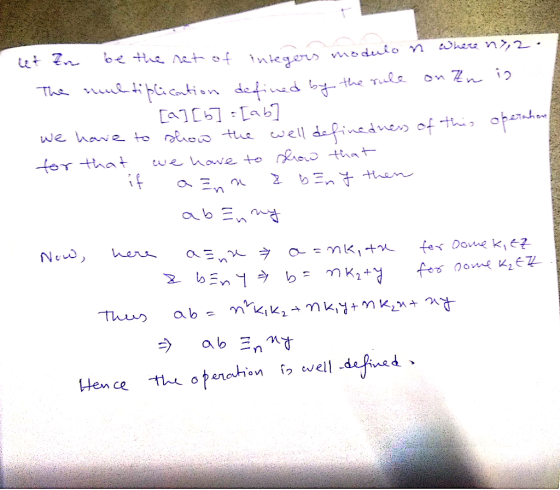
rove that the multiplication in Z,n 2 2 defined by a babis wel defined.
Let ne N. Show that Zn forn > 2 is not a group under multiplication as...
 Let ne N. Show that Zn forn > 2 is not a group under multiplication as defined above. What happens for n = 1?
there is no more info rove that the loop To: 2 = e2nit, 0 < t...
 there is no more info
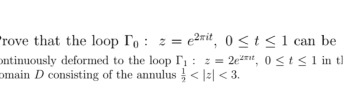
rove that the loop To: 2 = e2nit, 0 < t < 1 can be ontinuously deformed to the loop 11 : 2e2tit, 0 <t < 1 in t] omain D consisting of the annulus < < |z|<3. z =
there is no more info
rove that the loop To: 2 = e2nit, 0 < t < 1 can be ontinuously deformed to the loop 11 : 2e2tit, 0 <t < 1 in t] omain D consisting of the annulus < < |z|<3. z =
8. Let n be a positive integer. The n-th cyclotomic polynomial Ф,a(z) E Z[2] is defined recursively in the following way: 1. Ф1(x)-x-1. 2. If n > 1, then Фп(x)- , (where in the product in the...
 8. Let n be a positive integer. The n-th cyclotomic polynomial Ф,a(z) E Z[2] is defined recursively in the following way: 1. Ф1(x)-x-1. 2. If n > 1, then Фп(x)- , (where in the product in the denomina- tor, d runs through all divisors of n less than n). . A. Calculate Ф2(x), Ф4(x) and Ф8(z): . B. n(x) is the minimal polynomial for the primitive n-th root of unity over Q. Let f(x) = "8-1 E Q[a] and ω...
Please help with #6 'rove: Given a sequence of n2 +1 distinct integers, either there is an increasing subsequence of n+1 terms or a decreasing subsequence of n +1 terms. 'rove: Given...
 Please help with #6
'rove: Given a sequence of n2 +1 distinct integers, either there is an increasing subsequence of n+1 terms or a decreasing subsequence of n +1 terms.
'rove: Given a sequence of n2 +1 distinct integers, either there is an increasing subsequence of n+1 terms or a decreasing subsequence of n +1 terms.
Please help with #6
'rove: Given a sequence of n2 +1 distinct integers, either there is an increasing subsequence of n+1 terms or a decreasing subsequence of n +1 terms.
'rove: Given a sequence of n2 +1 distinct integers, either there is an increasing subsequence of n+1 terms or a decreasing subsequence of n +1 terms.
The Russian Multiplication problem can be defined as follows: Say you want to multiply x with...
The Russian Multiplication problem can be defined as follows: Say you want to multiply x with y giving z. The problem is solved using the following iterative loop: With each iteration, x gets the value x/2 and y gets the value y*2. If x is even, the y-entry is ignored. If x is odd, y is added to a running total. The loop terminates when x = 0. For example: Calculate z = 24 * 52. Write a Prolog program...
rove that a rectangular chocolate bar with n squares takes n-1 "breaks" to break it into...
 rove that a rectangular chocolate bar with n squares takes n-1 "breaks" to break it into individual uares.
2. Consider the relation E on Z defined by E n, m) n+ m is even} equivalence relation (a) Prove that E is an (b) Let n...
 2. Consider the relation E on Z defined by E n, m) n+ m is even} equivalence relation (a) Prove that E is an (b) Let n E Z. Find [n]. equivalence relation in [N, the equivalence class of 3. We defined a relation on sets A B. Prove that this relation is an (In this view, countable sets the natural numbers under this equivalence relation). exactly those that are are
2. Consider the relation E on Z defined by...
2. Consider the relation E on Z defined by E n, m) n+ m is even} equivalence relation (a) Prove that E is an (b) Let n E Z. Find [n]. equivalence relation in [N, the equivalence class of 3. We defined a relation on sets A B. Prove that this relation is an (In this view, countable sets the natural numbers under this equivalence relation). exactly those that are are
2. Consider the relation E on Z defined by...
infinite Demonstrate that for a particle trapped in an wel 12 2 where n is the...
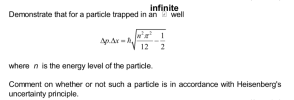 infinite Demonstrate that for a particle trapped in an wel 12 2 where n is the energy level of the particle. Comment on whether or not such a particle is in accordance with Heisenberg's uncertainty principle.
= a (mod n) is a ring homomorphism. (10) Suppose that o Z Z defined by...
 = a (mod n) is a ring homomorphism. (10) Suppose that o Z Z defined by ¢(a) (a) (5 Pts) Prove that o is injective. Answer (b) (5 Pts) Prove that o is surjective onto its image. Answer
= a (mod n) is a ring homomorphism. (10) Suppose that o Z Z defined by ¢(a) (a) (5 Pts) Prove that o is injective. Answer
(b) (5 Pts) Prove that o is surjective onto its image. Answer
= a (mod n) is a ring homomorphism. (10) Suppose that o Z Z defined by ¢(a) (a) (5 Pts) Prove that o is injective. Answer (b) (5 Pts) Prove that o is surjective onto its image. Answer
= a (mod n) is a ring homomorphism. (10) Suppose that o Z Z defined by ¢(a) (a) (5 Pts) Prove that o is injective. Answer
(b) (5 Pts) Prove that o is surjective onto its image. Answer
3. Let {Sn, n > 0} be a symmetric Random Walk on Z. Defined To inf(n...
 3. Let {Sn, n > 0} be a symmetric Random Walk on Z. Defined To inf(n > 1 : Sn-0} the time of first passage to state 0, prove that 2n - 1 for any n 2 1
 Let ne N. Show that Zn forn > 2 is not a group under multiplication as defined above. What happens for n = 1?
 there is no more info
rove that the loop To: 2 = e2nit, 0 < t < 1 can be ontinuously deformed to the loop 11 : 2e2tit, 0 <t < 1 in t] omain D consisting of the annulus < < |z|<3. z =
there is no more info
rove that the loop To: 2 = e2nit, 0 < t < 1 can be ontinuously deformed to the loop 11 : 2e2tit, 0 <t < 1 in t] omain D consisting of the annulus < < |z|<3. z =
 8. Let n be a positive integer. The n-th cyclotomic polynomial Ф,a(z) E Z[2] is defined recursively in the following way: 1. Ф1(x)-x-1. 2. If n > 1, then Фп(x)- , (where in the product in the denomina- tor, d runs through all divisors of n less than n). . A. Calculate Ф2(x), Ф4(x) and Ф8(z): . B. n(x) is the minimal polynomial for the primitive n-th root of unity over Q. Let f(x) = "8-1 E Q[a] and ω...
 Please help with #6
'rove: Given a sequence of n2 +1 distinct integers, either there is an increasing subsequence of n+1 terms or a decreasing subsequence of n +1 terms.
'rove: Given a sequence of n2 +1 distinct integers, either there is an increasing subsequence of n+1 terms or a decreasing subsequence of n +1 terms.
Please help with #6
'rove: Given a sequence of n2 +1 distinct integers, either there is an increasing subsequence of n+1 terms or a decreasing subsequence of n +1 terms.
'rove: Given a sequence of n2 +1 distinct integers, either there is an increasing subsequence of n+1 terms or a decreasing subsequence of n +1 terms.
 rove that a rectangular chocolate bar with n squares takes n-1 "breaks" to break it into individual uares.
 2. Consider the relation E on Z defined by E n, m) n+ m is even} equivalence relation (a) Prove that E is an (b) Let n E Z. Find [n]. equivalence relation in [N, the equivalence class of 3. We defined a relation on sets A B. Prove that this relation is an (In this view, countable sets the natural numbers under this equivalence relation). exactly those that are are
2. Consider the relation E on Z defined by...
2. Consider the relation E on Z defined by E n, m) n+ m is even} equivalence relation (a) Prove that E is an (b) Let n E Z. Find [n]. equivalence relation in [N, the equivalence class of 3. We defined a relation on sets A B. Prove that this relation is an (In this view, countable sets the natural numbers under this equivalence relation). exactly those that are are
2. Consider the relation E on Z defined by...
 infinite Demonstrate that for a particle trapped in an wel 12 2 where n is the energy level of the particle. Comment on whether or not such a particle is in accordance with Heisenberg's uncertainty principle.
 = a (mod n) is a ring homomorphism. (10) Suppose that o Z Z defined by ¢(a) (a) (5 Pts) Prove that o is injective. Answer (b) (5 Pts) Prove that o is surjective onto its image. Answer
= a (mod n) is a ring homomorphism. (10) Suppose that o Z Z defined by ¢(a) (a) (5 Pts) Prove that o is injective. Answer
(b) (5 Pts) Prove that o is surjective onto its image. Answer
= a (mod n) is a ring homomorphism. (10) Suppose that o Z Z defined by ¢(a) (a) (5 Pts) Prove that o is injective. Answer (b) (5 Pts) Prove that o is surjective onto its image. Answer
= a (mod n) is a ring homomorphism. (10) Suppose that o Z Z defined by ¢(a) (a) (5 Pts) Prove that o is injective. Answer
(b) (5 Pts) Prove that o is surjective onto its image. Answer
 3. Let {Sn, n > 0} be a symmetric Random Walk on Z. Defined To inf(n > 1 : Sn-0} the time of first passage to state 0, prove that 2n - 1 for any n 2 1
Most questions answered within 3 hours.
-
Where is the error in this code sequence?
String s1 = "Hello";
String s2 = "ello";...
asked 10 months ago -
Financial data for Joel de Paris, Inc., for last year
follow:
Joel de Paris, Inc.
Balance...
asked 10 months ago -
Consider this reaction:
Al2(SO4)3 (aq)+ BaCl3
(aq) Al2Cl6 (aq)- +
3BaSO4(s) . What is the...
asked 10 months ago -
Suppose that Savneet is considering increasing her
recent random sample from 20 car rentals to 40...
asked 10 months ago -
Trucks arrive at an unloading terminal at an average rate of 120
per hour.
Trucks arrive...
asked 10 months ago -
Why are methanol and ethanol completely soluble in water while
octanol is not very little soluble....
asked 10 months ago -
A facilities manager at a university reads in a research report
that the mean amount of...
asked 10 months ago -
When the CuSO4 is rehydrated by adding water to the anhydrous
compound, is this an endothermic...
asked 10 months ago -
A ray of sunlight is passing from diamond into crown glass; the
angle of incidence is...
asked 10 months ago -
A block of mass 0.249 kg is placed on top of a light, vertical
spring of...
asked 10 months ago -
how do the kidneys compensate in the presences of acidosis
a) trigger hyperventilate
b) reserve acid...
asked 10 months ago -
Question 501 pts
The rental rate of capital to the firm increases. Which of the
following...
asked 10 months ago