Light wavelegth strikes a pane of glass of thickness T and refractive index N, as showin in the figure. Part of the beam is reflected off the uppers surface of the glass, and part is transmitted and then reflected off the lower surface of the glass
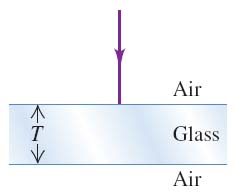
T=Wavelthgn/2
2T=Wavelentgh/2
T=Wavelenth/2N
2T=wavelength/2N
Homework Answers
T = wavelength/(2n)
The reason: The top reflection produces a phase reversal since n(air) < n(glass). The bottom reflection does not produce a phase reversal since n(glass) > n(air). Thus the extra path length 2T must provide a 1-wavelength, or lambda(glass), phase shift for destructive interference with the 1/2-wavelength shift of the top reflection. Lambda(glass) = lambda(air)/n.
Thus 2T = lambda(glass) = lambda(air)/n = lambda/n, so T = wavelength/(2n)
Add Answer to:
Light wavelegth strikes a pane of glass of thickness T and refractive index N, as showin...
In your research lab, a very thin, flat piece of glass with refractive index 2.40 and...
In your research lab, a very thin, flat piece of glass with refractive index 2.40 and uniform thickness covers the opening of a chamber that holds a gas sample. The refractive indexes of the gases on either side of the glass are very close to unity. To determine the thickness of the glass, you shine coherent light of wavelength λ0 in vacuum at normal incidence onto the surface of the glass. When λ0= 496 nm, constructive interference occurs for light...
Find the thickness of soap film of refractive index 1.33 on a glass slab of refractive...
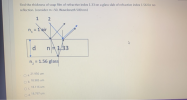 Find the thickness of soap film of refractive index 1.33 on a glass slab of refractive index 1.56 for no reflection. (consider m -50, Wavelength 500 nm) 1 2 n = 1 air d n = 1/33 n = 1.56 glass 21.956 um O a. Ob. 18.985 um 18.116 um Oc O d. 18.797 um
A 1m thick glass window with a refractive index of n=1.50 in the North Pole is...
A 1m thick glass window with a refractive index of n=1.50 in the North Pole is covered by a 0.5m thick layer of transparent ice with a refractive index of n=1.31 on the outside. A security guard on the inside shines a flashlight at an angle of 30 degrees from the normal at the window. The n of air n=1.0003. Part #1: Make a drawing of the system. Include the path of the light inside the room from the flashlight...
1. A light beam with frequency 560 THz in air strikes a sheet of glass (n...
 1. A light beam with frequency 560 THz in air strikes a sheet of glass (n 1.8) at an angle of 50° from the surface of the glass. The glass has thickness 4 cm. What is the wavelength of the light in air and in the glass? What angle does the light beam refract upon entering and exiting the glass? How long does it take the light beam to travel through the glass?
A ray of light strikes a flat block of glass (n = 1.53) of thickness 3.00...
A ray of light strikes a flat block of glass (n = 1.53) of thickness 3.00 cm at an angle of 29.0° with the normal. Trace the light beam through the glass, and find the angles of incidence and refraction at each surface. If the angle of incidence at first surface is 29.0° (all angles are measured from the normal), determine the following angles. angle of refraction at first surface ° angle of incidence at second surface ° angle of...
A ray of light strikes a flat block of glass (n = 1.52) of thickness 2.50...
A ray of light strikes a flat block of glass (n = 1.52) of thickness 2.50 cm at an angle of 22.0° with the normal. Trace the light beam through the glass, and find the angles of incidence and refraction at each surface. If the angle of incidence at first surface is 22.0° (all angles are measured from the normal), determine the following angles. angle of refraction at first surface ______ ° angle of incidence at second surface ______° angle...
Light that is traveling through water (index of refraction is n=1.33) strikes a glass surface (index...
 Light that is traveling through water (index of refraction is
n=1.33) strikes a glass surface (index of refraction n=1.50) at an
incident angle of θi=48.1°.
What is the the angle of refraction, θr, of the light in
the glass?
Light that is traveling through glass (index of refraction is
n=1.50) strikes an air surface (index of refraction n=1.00) at an
incident angle of θi=27.9°.
What is the the angle of refraction, θr, of the light
in the air?
Water Glass
Light that is traveling through water (index of refraction is
n=1.33) strikes a glass surface (index of refraction n=1.50) at an
incident angle of θi=48.1°.
What is the the angle of refraction, θr, of the light in
the glass?
Light that is traveling through glass (index of refraction is
n=1.50) strikes an air surface (index of refraction n=1.00) at an
incident angle of θi=27.9°.
What is the the angle of refraction, θr, of the light
in the air?
Water Glass
A flashlight beam strikes the surface of a pane of glass (n = 1.56) at an...
A flashlight beam strikes the surface of a pane of glass (n = 1.56) at an angle of 63 o to the normal. What is the angle of refraction in glass? Assume n air = 1.00. a) 48 b) 35 c) Can't be determined d) 63
N-1.00 n-1.33 n=1 50 3. A thin film of thickness t and index of refraction 1.33 coats a glass wit...
 I dont understand thin film interference. Thanks in
advance
n-1.00 n-1.33 n=1 50 3. A thin film of thickness t and index of refraction 1.33 coats a glass with index of refraction 1.50 as shown above. Which of the following thicknesses t will not reflect light with wavelength 640 nm in air? (A) 160 nm (8) 240 nm (C) 360 nm (D) 480 nm 4. Lenses in fine quality cameras are coated to reduce the reflection from the lenses. If...
I dont understand thin film interference. Thanks in
advance
n-1.00 n-1.33 n=1 50 3. A thin film of thickness t and index of refraction 1.33 coats a glass with index of refraction 1.50 as shown above. Which of the following thicknesses t will not reflect light with wavelength 640 nm in air? (A) 160 nm (8) 240 nm (C) 360 nm (D) 480 nm 4. Lenses in fine quality cameras are coated to reduce the reflection from the lenses. If...
Light in air strikes a glass pane with n = 1.51, making a 40 ∘ angle...
Light in air strikes a glass pane with n = 1.51, making a 40 ∘ angle with respect to the normal. Part A What angle does the light make with the normal in the glass? Express your answer to two significant figures and include the appropriate units. Part B The glass is 2.1 mm thick. As you know, the ray emerging from the glass is parallel to the ray that entered the glass. Find the perpendicular distance between those parallel...
 Find the thickness of soap film of refractive index 1.33 on a glass slab of refractive index 1.56 for no reflection. (consider m -50, Wavelength 500 nm) 1 2 n = 1 air d n = 1/33 n = 1.56 glass 21.956 um O a. Ob. 18.985 um 18.116 um Oc O d. 18.797 um
 1. A light beam with frequency 560 THz in air strikes a sheet of glass (n 1.8) at an angle of 50° from the surface of the glass. The glass has thickness 4 cm. What is the wavelength of the light in air and in the glass? What angle does the light beam refract upon entering and exiting the glass? How long does it take the light beam to travel through the glass?
 Light that is traveling through water (index of refraction is
n=1.33) strikes a glass surface (index of refraction n=1.50) at an
incident angle of θi=48.1°.
What is the the angle of refraction, θr, of the light in
the glass?
Light that is traveling through glass (index of refraction is
n=1.50) strikes an air surface (index of refraction n=1.00) at an
incident angle of θi=27.9°.
What is the the angle of refraction, θr, of the light
in the air?
Water Glass
Light that is traveling through water (index of refraction is
n=1.33) strikes a glass surface (index of refraction n=1.50) at an
incident angle of θi=48.1°.
What is the the angle of refraction, θr, of the light in
the glass?
Light that is traveling through glass (index of refraction is
n=1.50) strikes an air surface (index of refraction n=1.00) at an
incident angle of θi=27.9°.
What is the the angle of refraction, θr, of the light
in the air?
Water Glass
 I dont understand thin film interference. Thanks in
advance
n-1.00 n-1.33 n=1 50 3. A thin film of thickness t and index of refraction 1.33 coats a glass with index of refraction 1.50 as shown above. Which of the following thicknesses t will not reflect light with wavelength 640 nm in air? (A) 160 nm (8) 240 nm (C) 360 nm (D) 480 nm 4. Lenses in fine quality cameras are coated to reduce the reflection from the lenses. If...
I dont understand thin film interference. Thanks in
advance
n-1.00 n-1.33 n=1 50 3. A thin film of thickness t and index of refraction 1.33 coats a glass with index of refraction 1.50 as shown above. Which of the following thicknesses t will not reflect light with wavelength 640 nm in air? (A) 160 nm (8) 240 nm (C) 360 nm (D) 480 nm 4. Lenses in fine quality cameras are coated to reduce the reflection from the lenses. If...
Most questions answered within 3 hours.
-
Where is the error in this code sequence?
String s1 = "Hello";
String s2 = "ello";...
asked 10 months ago -
Financial data for Joel de Paris, Inc., for last year
follow:
Joel de Paris, Inc.
Balance...
asked 10 months ago -
Consider this reaction:
Al2(SO4)3 (aq)+ BaCl3
(aq) Al2Cl6 (aq)- +
3BaSO4(s) . What is the...
asked 10 months ago -
Suppose that Savneet is considering increasing her
recent random sample from 20 car rentals to 40...
asked 10 months ago -
Trucks arrive at an unloading terminal at an average rate of 120
per hour.
Trucks arrive...
asked 10 months ago -
Why are methanol and ethanol completely soluble in water while
octanol is not very little soluble....
asked 10 months ago -
A facilities manager at a university reads in a research report
that the mean amount of...
asked 10 months ago -
When the CuSO4 is rehydrated by adding water to the anhydrous
compound, is this an endothermic...
asked 10 months ago -
A ray of sunlight is passing from diamond into crown glass; the
angle of incidence is...
asked 10 months ago -
A block of mass 0.249 kg is placed on top of a light, vertical
spring of...
asked 10 months ago -
how do the kidneys compensate in the presences of acidosis
a) trigger hyperventilate
b) reserve acid...
asked 10 months ago -
Question 501 pts
The rental rate of capital to the firm increases. Which of the
following...
asked 10 months ago