A scientist notices that an oil slick floating on water when viewed from above has many...
Part A: The index of refraction of the oil is 1.20. What is the minimum thickness of the oil slick at that spot? t= 313nm
Part B: Suppose the oil had an index of refraction of 1.50. What would the minimum thickness be now? t=125nm
I only need help with part c. I put this in incase you need the information.
Part C: Now assume that the oil had a thickness of 200 nm and an index of refraction of 1.5. A diver swimming underneath the oil slick is looking at the same spot as the scientist with the spectromenter. What is the longest wavelength of the light in water that is transmitted most easily to the diver?
Homework Answers
The given problem can be solved by using the condition for constructive interference.
To find the thickness of the oil slick, use the condition for constructive interference. Use the expression for the wavelength of ray in air medium and oil medium relation. The expression for the wavelength of ray in air medium and water medium relation can be used to solve the problem.
The condition for constructive interference can be expressed as,
Here, is the refractive index, is the order and is the wavelength of the radiation.
The light from air-oil interface has a phase reversal of . The light from oil-water interface has phase reversal of .
The interference between these two rays gives zero or two phases reversal.
For minimum thickness,
The expression for the minimum thickness can be expressed as,
The light from the oil water gives no phase reversal. The light from air-oil interface has a phase reversal of . The light from oil-water interface has no phase reversal.
The interference between these two rays gives phase reversal. The condition for constructive interference is given as,
Here, is the refractive index, is the order and is the wavelength of the radiation.
For minimum thickness,
The expression for minimum thickness can be expressed as,
The wavelength of ray in air medium and oil medium are related as follows as,
Here, is the refractive index of air and is the refractive index of oil.
(A)
The minimum thickness of the slick of the oil can be calculated as,
Substitute for and for in the expression for the minimum thickness of the slick of the slick of the oil.
(B)
The minimum thickness of the oil slick at the spot can be calculated as,
Substitute for and for in the expression for the minimum thickness of the slick of the slick of the oil.
(C)
The wavelength of light in the air can be calculated as,
The expression for wavelength of light in oil can be expressed as,
For longest wavelength ,
Substitute for in the thickness and wavelength relation.
Rearrange the equation to get the value of .
Substitute for , for , for in the expression of .
The wavelength of light in the water can be calculated as,
Rearrange the equation to get the value of wavelength of light in water.
Substitute for , for , for in the expression of .
Ans: Part A
The minimum thickness of the oil slick at the spot is .
Part BThe minimum thickness of the oil slick at the spot is .
Part CThe longest wavelength of light in water is .
Add Answer to:
A scientist notices that an oil slick floating on water when viewed from above has many...
A diver is swimming underneath an oil slick with a thickness of 200nm and an index...
A diver is swimming underneath an oil slick with a thickness of 200nm and an index of refraction of 1.50. A white light shines straight down towards the diver from above the oil slick. The index of refraction of water is 1.33. What is the longest wavelength of the light in the water that is transmitted most easily to the diver?
Calculate the minimum thickness (in nm) of an oil slick on water that appears blue when...
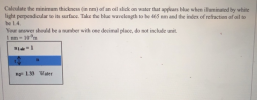 Calculate the minimum thickness (in nm) of an oil slick on water that appears blue when illuminated by white light perpendicular to its surface. Take the blue wavelength to be 465 nm and the index of refraction of oil to be 1.4. Your answer should be a number with one decimal place, do not include unit. 1 nm = 10m na = 1 ng 1.33 Water
Problem 7: An oil slick on water is 120 nm thick and illuminated by white light...
 Problem 7: An oil slick on water is 120 nm thick and illuminated by white light incident perpendicular to its surface. What is the longest wavelength (in nm) which is constructively reflected, given its index of refraction is 1.40? Numeric : A numeric value is expected and not an expression.
(17 %) Problem 3: A thin layer of oil with index of refraction no-l .47 is floating above the water. The index of refraction of water is nw 13. The index of refraction of air is na-1. A light wit...
 (17 %) Problem 3: A thin layer of oil with index of refraction no-l .47 is floating above the water. The index of refraction of water is nw 13. The index of refraction of air is na-1. A light with wavelength λ = 625 nm goes in from the air to oil and water. 25% Part (a) Express the wavelength of the light in the oil, λο, in terms of λ and no. 쇼 25% Part (b) Express the minimum...
A thin layer of oil with index of refraction no = 1.47 is floating above the...
 A thin layer of oil with index of refraction no = 1.47 is floating above the water. The index of refraction of water is nw = 1.3. The index of refraction of air is na = 1. A light with wavelength 1 = 750 nm goes in from the air to oil and water. n n (a) Express the wavelength of the light in the oil. 1o, in terms of 1 and no- (b) Express the minimum thickness of the...
An oil tanker has collided with a smaller vessel, resulting in an oil spill in a...
An oil tanker has collided with a smaller vessel, resulting in an oil spill in a large, calm-water bay of the ocean. You are investigating the environmental effects of the accident and need to know the area of the spill. The tanker captain informs you that 26000 liters of oil have escaped and that the oil has an index of refraction of n = 1.1. The index of refraction of the ocean water is 1.33. From the deck of your...
a) An oil slick on water is 108 nm thick and illuminated by white light incident...
a) An oil slick on water is 108 nm thick and illuminated by white light incident perpendicular to its surface. What color does the oil appear (what is the most constructively reflected wavelength, in nanometers), given its index of refraction is 1.41? (Assume the index of refraction of water is 1.33.) wavelength________ nm b)A ruby laser beam is reflected from the surface of a CD onto a wall. The brightest spot is the reflected beam at an angle equal to...
Problem 6: A thin layer of oil with index of refraction n. - 1.47 is floating...
 Problem 6: A thin layer of oil with index of refraction n. - 1.47 is floating above the water. The index of refraction of water is ry - 1.3. The index of refraction of air is na 1. A light with wavelength 1 - 575 nm goes in from the air to oil and water. Part (a) Express the wavelength of the light in the oil, 1o, in terms of land og Expression: Select from the variables below to write...
 Calculate the minimum thickness (in nm) of an oil slick on water that appears blue when illuminated by white light perpendicular to its surface. Take the blue wavelength to be 465 nm and the index of refraction of oil to be 1.4. Your answer should be a number with one decimal place, do not include unit. 1 nm = 10m na = 1 ng 1.33 Water
 Problem 7: An oil slick on water is 120 nm thick and illuminated by white light incident perpendicular to its surface. What is the longest wavelength (in nm) which is constructively reflected, given its index of refraction is 1.40? Numeric : A numeric value is expected and not an expression.
 (17 %) Problem 3: A thin layer of oil with index of refraction no-l .47 is floating above the water. The index of refraction of water is nw 13. The index of refraction of air is na-1. A light with wavelength λ = 625 nm goes in from the air to oil and water. 25% Part (a) Express the wavelength of the light in the oil, λο, in terms of λ and no. 쇼 25% Part (b) Express the minimum...
 A thin layer of oil with index of refraction no = 1.47 is floating above the water. The index of refraction of water is nw = 1.3. The index of refraction of air is na = 1. A light with wavelength 1 = 750 nm goes in from the air to oil and water. n n (a) Express the wavelength of the light in the oil. 1o, in terms of 1 and no- (b) Express the minimum thickness of the...
 Problem 6: A thin layer of oil with index of refraction n. - 1.47 is floating above the water. The index of refraction of water is ry - 1.3. The index of refraction of air is na 1. A light with wavelength 1 - 575 nm goes in from the air to oil and water. Part (a) Express the wavelength of the light in the oil, 1o, in terms of land og Expression: Select from the variables below to write...
Most questions answered within 3 hours.
-
Where is the error in this code sequence?
String s1 = "Hello";
String s2 = "ello";...
asked 10 months ago -
Financial data for Joel de Paris, Inc., for last year
follow:
Joel de Paris, Inc.
Balance...
asked 10 months ago -
Consider this reaction:
Al2(SO4)3 (aq)+ BaCl3
(aq) Al2Cl6 (aq)- +
3BaSO4(s) . What is the...
asked 10 months ago -
Suppose that Savneet is considering increasing her
recent random sample from 20 car rentals to 40...
asked 10 months ago -
Trucks arrive at an unloading terminal at an average rate of 120
per hour.
Trucks arrive...
asked 10 months ago -
Why are methanol and ethanol completely soluble in water while
octanol is not very little soluble....
asked 10 months ago -
A facilities manager at a university reads in a research report
that the mean amount of...
asked 10 months ago -
When the CuSO4 is rehydrated by adding water to the anhydrous
compound, is this an endothermic...
asked 10 months ago -
A ray of sunlight is passing from diamond into crown glass; the
angle of incidence is...
asked 10 months ago -
A block of mass 0.249 kg is placed on top of a light, vertical
spring of...
asked 10 months ago -
how do the kidneys compensate in the presences of acidosis
a) trigger hyperventilate
b) reserve acid...
asked 10 months ago -
Question 501 pts
The rental rate of capital to the firm increases. Which of the
following...
asked 10 months ago