
Homework Answers
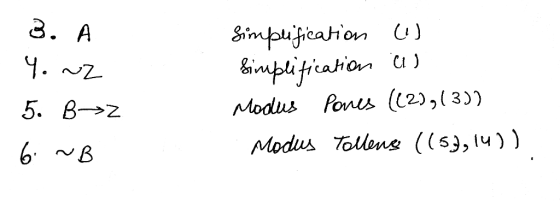
If you need any further clarification regarding this problem feel
free to comment below
Add Answer to:
Part H. Direct Proof. Construct a direct proof for the following argument. Use no assumptions. The...
Question 3 Not yet answered Mariked out of 4,00000 Flag question Please write a natural deduction proof for the following deductive, valid argument. Be sure to construct the natural deduction pro...
 Question 3 Not yet answered Mariked out of 4,00000 Flag question Please write a natural deduction proof for the following deductive, valid argument. Be sure to construct the natural deduction proof in the way indicated in the Hurley textbook, the videos, and lecture material. Please use the typewriter SL symbols; number each derived line with the appropriate Arabic numeral; provide a correct justification on the right-hand side of the proof using the standard abbreviations for the Rules of Inference/Implication and...
Question 17 6 pts For the following argument, construct a proof of the conclusion from the...
 Question 17 6 pts For the following argument, construct a proof of the conclusion from the given premises. -(3x) (Px Mx), (3x) (Mx · Sx) /: ~(x) (Sx > Px) HTML Editora Question 18 6 pts For the following argument, construct a proof of the conclusion from the given premises. (3x) Ax = (x)(Cx 3 Bx), (x)(Bx > «Ax) 1: (3x)Ax -(x)Cx HTML Editon. Question 19 Prove the following theorem. 1: (x)(Ax » Bx) = ((x)Ax = (x)Bx) HTML Edi
Create a proof for the following argument. 2. (KVFM 3. K 4. /H 1 Delete VD A BC DE FGHIJKLMNOPQR ST U V W XY Z 1 item attempt remaining Create a proof for the following argument. 2. (KVFM 3. K 4...
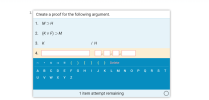 Create a proof for the following argument. 2. (KVFM 3. K 4. /H 1 Delete VD A BC DE FGHIJKLMNOPQR ST U V W XY Z 1 item attempt remaining
Create a proof for the following argument. 2. (KVFM 3. K 4. /H 1 Delete VD A BC DE FGHIJKLMNOPQR ST U V W XY Z 1 item attempt remaining
Create a proof for the following argument. 2. (KVFM 3. K 4. /H 1 Delete VD A BC DE FGHIJKLMNOPQR ST U V W XY Z 1 item attempt remaining
8. Write the argument in symbolic form using the indicated letters and construct a formal proof...
 8. Write the argument in symbolic form using the indicated letters and construct a formal proof of the validity of the argument. (a) If Emery studies (S), Emery will graduate (G). If Emery graduates, Emery will travel (T) or Emery will work for his uncle (U). Emery studies, but Emery does not work for his uncle. Therefore, Emery will travel. (b) If Robin goes to the state park (P), Robin hikes (H) and Robin fishes (F). Robin did not hike...
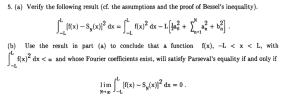
5. (a) Verify the following result (cf. the assumptions and the proof of Bessel's inequality) 2.1...
 ONLY DO PART (B)
5. (a) Verify the following result (cf. the assumptions and the proof of Bessel's inequality) 2.12 (b) Use the result in part (a) to conclude that a function f(x),-L < x < L, with f(x)2 dx and whose Fourier coefficients exist, will satisfy Parseval's equality if and only if
5. (a) Verify the following result (cf. the assumptions and the proof of Bessel's inequality) 2.12 (b) Use the result in part (a) to conclude that a...
ONLY DO PART (B)
5. (a) Verify the following result (cf. the assumptions and the proof of Bessel's inequality) 2.12 (b) Use the result in part (a) to conclude that a function f(x),-L < x < L, with f(x)2 dx and whose Fourier coefficients exist, will satisfy Parseval's equality if and only if
5. (a) Verify the following result (cf. the assumptions and the proof of Bessel's inequality) 2.12 (b) Use the result in part (a) to conclude that a...
Use the diagram of the regular pentagon to help you construct a careful proof demonstrating that:...
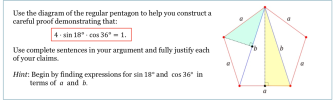 Use the diagram of the regular pentagon to help you construct a careful proof demonstrating that: 4.sin 18º. cos 36° = 1. Use complete sentences in your argument and fully justify each of your claims. Hint: Begin by finding expressions for sin 18° and cos 36° in terms of a and b.
(2) x + 1 is even -> x^2 is odd (hint: use a direct proof) (a)...
(2) x + 1 is even -> x^2 is odd (hint: use a direct proof) (a) (0.5 points) What are you assuming is true: (b) (0.5 points) What are you proving is true: (c) (1 point) Complete the proof:
1. Please provide a natural deduction proof for the following valid, deductive argument: Premise 1: ~ ( F & A ) Premise 2: ~ ( L v ~ A ) Premise 3: D > ( F v L ) / ~ D 2. Answer the following q...
1. Please provide a natural deduction proof for the following valid, deductive argument: Premise 1: ~ ( F & A ) Premise 2: ~ ( L v ~ A ) Premise 3: D > ( F v L ) / ~ D 2. Answer the following question: can one prove invalidity with the natural deduction proof method? Why or why not? 3. Answer the following question: can one construct a natural deduction proof for an invalid argument in SL? Why...
Use the method of direct proof to prove the following statement: For integers a and b,...
Use the method of direct proof to prove the following statement: For integers a and b, if a is odd or b is odd, then (a + 7)(b 5) is even.
use 18 rules of inference to solve the following problem. Do not use conditional proof, indirect proof, or assumed premises.for each proof you must write the premises in that proof. 1. X v Y ...
use 18 rules of inference to solve the following problem. Do not use conditional proof, indirect proof, or assumed premises.for each proof you must write the premises in that proof. 1. X v Y prove /S v Y 2. z 3.( x•z)---> s
 Question 3 Not yet answered Mariked out of 4,00000 Flag question Please write a natural deduction proof for the following deductive, valid argument. Be sure to construct the natural deduction proof in the way indicated in the Hurley textbook, the videos, and lecture material. Please use the typewriter SL symbols; number each derived line with the appropriate Arabic numeral; provide a correct justification on the right-hand side of the proof using the standard abbreviations for the Rules of Inference/Implication and...
 Question 17 6 pts For the following argument, construct a proof of the conclusion from the given premises. -(3x) (Px Mx), (3x) (Mx · Sx) /: ~(x) (Sx > Px) HTML Editora Question 18 6 pts For the following argument, construct a proof of the conclusion from the given premises. (3x) Ax = (x)(Cx 3 Bx), (x)(Bx > «Ax) 1: (3x)Ax -(x)Cx HTML Editon. Question 19 Prove the following theorem. 1: (x)(Ax » Bx) = ((x)Ax = (x)Bx) HTML Edi
 Create a proof for the following argument. 2. (KVFM 3. K 4. /H 1 Delete VD A BC DE FGHIJKLMNOPQR ST U V W XY Z 1 item attempt remaining
Create a proof for the following argument. 2. (KVFM 3. K 4. /H 1 Delete VD A BC DE FGHIJKLMNOPQR ST U V W XY Z 1 item attempt remaining
Create a proof for the following argument. 2. (KVFM 3. K 4. /H 1 Delete VD A BC DE FGHIJKLMNOPQR ST U V W XY Z 1 item attempt remaining
 8. Write the argument in symbolic form using the indicated letters and construct a formal proof of the validity of the argument. (a) If Emery studies (S), Emery will graduate (G). If Emery graduates, Emery will travel (T) or Emery will work for his uncle (U). Emery studies, but Emery does not work for his uncle. Therefore, Emery will travel. (b) If Robin goes to the state park (P), Robin hikes (H) and Robin fishes (F). Robin did not hike...
 ONLY DO PART (B)
5. (a) Verify the following result (cf. the assumptions and the proof of Bessel's inequality) 2.12 (b) Use the result in part (a) to conclude that a function f(x),-L < x < L, with f(x)2 dx and whose Fourier coefficients exist, will satisfy Parseval's equality if and only if
5. (a) Verify the following result (cf. the assumptions and the proof of Bessel's inequality) 2.12 (b) Use the result in part (a) to conclude that a...
ONLY DO PART (B)
5. (a) Verify the following result (cf. the assumptions and the proof of Bessel's inequality) 2.12 (b) Use the result in part (a) to conclude that a function f(x),-L < x < L, with f(x)2 dx and whose Fourier coefficients exist, will satisfy Parseval's equality if and only if
5. (a) Verify the following result (cf. the assumptions and the proof of Bessel's inequality) 2.12 (b) Use the result in part (a) to conclude that a...
 Use the diagram of the regular pentagon to help you construct a careful proof demonstrating that: 4.sin 18º. cos 36° = 1. Use complete sentences in your argument and fully justify each of your claims. Hint: Begin by finding expressions for sin 18° and cos 36° in terms of a and b.
Most questions answered within 3 hours.
-
Where is the error in this code sequence?
String s1 = "Hello";
String s2 = "ello";...
asked 10 months ago -
Financial data for Joel de Paris, Inc., for last year
follow:
Joel de Paris, Inc.
Balance...
asked 10 months ago -
Consider this reaction:
Al2(SO4)3 (aq)+ BaCl3
(aq) Al2Cl6 (aq)- +
3BaSO4(s) . What is the...
asked 10 months ago -
Suppose that Savneet is considering increasing her
recent random sample from 20 car rentals to 40...
asked 10 months ago -
Trucks arrive at an unloading terminal at an average rate of 120
per hour.
Trucks arrive...
asked 10 months ago -
Why are methanol and ethanol completely soluble in water while
octanol is not very little soluble....
asked 10 months ago -
A facilities manager at a university reads in a research report
that the mean amount of...
asked 10 months ago -
When the CuSO4 is rehydrated by adding water to the anhydrous
compound, is this an endothermic...
asked 10 months ago -
A ray of sunlight is passing from diamond into crown glass; the
angle of incidence is...
asked 10 months ago -
A block of mass 0.249 kg is placed on top of a light, vertical
spring of...
asked 10 months ago -
how do the kidneys compensate in the presences of acidosis
a) trigger hyperventilate
b) reserve acid...
asked 10 months ago -
Question 501 pts
The rental rate of capital to the firm increases. Which of the
following...
asked 10 months ago