A satellite of mass m (where m ≪ Me) is initially in a circular orbit around...
A satellite of mass m (where m ≪ Me) is initially in a circular orbit around the Earth at a height of 410 km above the Earth’s equator. Its operators would like to move it into a geosynchronous orbit using a Hohmann transfer orbit. Assume a spherical Earth with radius 6371 km.
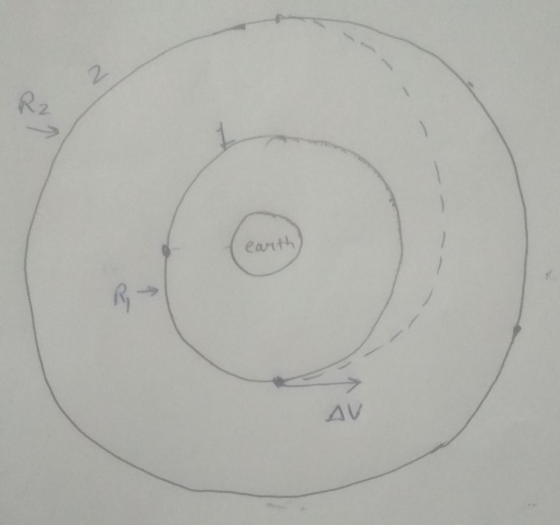
(a) Sketch the satellite’s Hohmann transfer orbit.
(b) Find the satellite’s initial (circular) orbital speed according to an inertial observer.
(c) Find the maximum height of the satellite above the Earth’s surface when it is on its Hohmann transfer orbit.
(d) How much does the satellite’s initial speed need to be increased to place it on its Hohmann transfer orbit?
Homework Answers
PART A
the initial speed can be calvulated with the hep of the formula
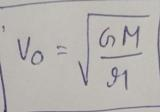
Vo = orbital velocity
G = universal gravitational constant = 6.67 x 10 -11 Nm2kg-2
M = mass of earth (standarded value approximate 6.0 x 10 24 kg)
r = radius of orbit from the center on the earth
for the question it is given that the
radius of earth 6371 km
height or orbit from earth surface = 410 km
so radius of orbit r = 6371+410 = 6781 km
for part B initial orbital velocity Voi = 
Voi = 7682.30 m/s
part c the maximum height = ?
maximum height is equal to the height or radius of geosynchronous orbit
for identifing the maximum height
as per the defination of geosynchonous orbit the angular velocity of geosynchronous is equal to the angular velocity of earth on its axis.
the angular velocity of eath is equal to angular velocity = 2π / T
T = 24 hrs
angular velocity of earth = 7.3 x 10⁻⁵ rad/sec
so the velocity of geosynchronous Vgy = radius x angular velocity(ω)
velocity formula of a orbit =
Vgy =
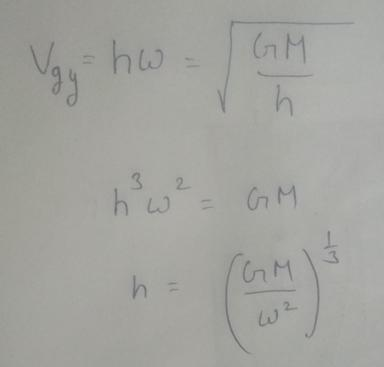
by putting all value of G, M and angular velocity we will get =42549 km (approx)
so the maximum height of the satallite from the surface of earth is = 42549-6371= 36178 km
for part D we have to known the preigee and apogee
as the shown in figure we gave to calculate the velocity at pregee and apogee

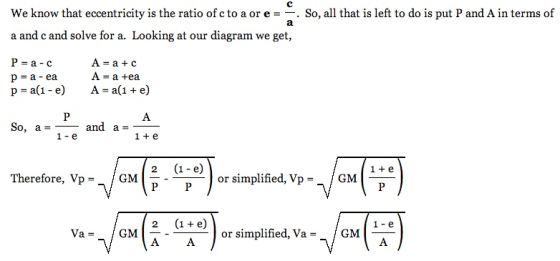
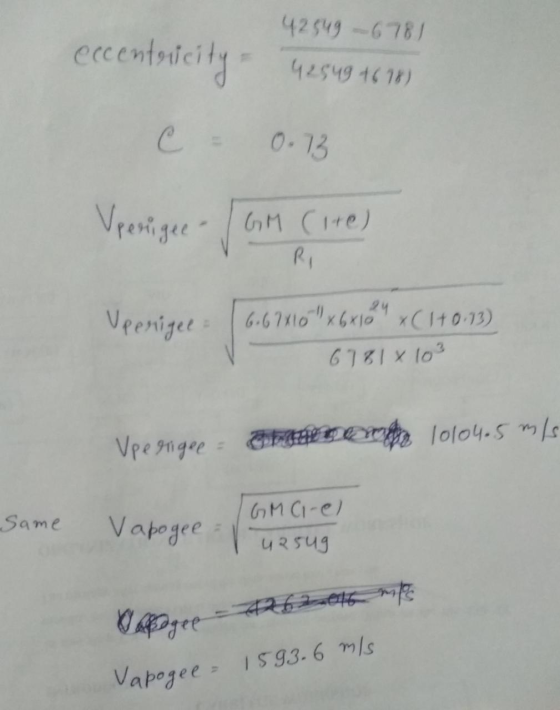
The satellite travels at a speed of 7682m/s (part A) around the small circle. We need to speed the satellite up to 10104.5m/s (pregee) when it reaches the perigee so it will transfer onto the ellipse. We then need to slow the satellite down to 1593.6m/s at the apogee, and then speed it up again to 3100m/s (Vgy) to transfer it to the higher circle that orbits at 42549 km above the Earth’s surface.
Add Answer to:
A satellite of mass m (where m ≪ Me) is initially in a circular
orbit around...
For communications purposes, satellites are typically placed in a circular geosynchronous orbit. If the orbit is...
For communications purposes, satellites are typically placed in a circular geosynchronous orbit. If the orbit is in the equatorial plane of the Earth, it is called geostationary. A satellite’s orbital speed in a geostationary orbit is set to match the angular velocity Ωe of the rotating Earth (with mass M), so that as seen from the Earth the satellite is stationary above a fixed point on the Equator. For a satellite of mass m in a geostationary circular orbit then...
A satellite is in orbit around Earth at a height of 120 km above Earth’s surface....
A satellite is in orbit around Earth at a height of 120 km above Earth’s surface. Find the orbital speed of the satellite. (Mass of the earth is 6*1024 kg and the radius of Earth is 6371 km)
Two satellites are in circular orbits around the earth. The orbit for satellite A is at...
Two satellites are in circular orbits around the earth. The orbit for satellite A is at a height of 502 km above the earth’s surface, while that for satellite B is at a height of 747 km. Find the orbital speed for (a) satellite A and (b) satellite B.
Two satellites are in circular orbits around the earth. The orbit for satellite A is at...
Two satellites are in circular orbits around the earth. The orbit for satellite A is at a height of 460 km above the earth’s surface, while that for satellite B is at a height of 774 km. Find the orbital speed for (a) satellite A and (b) satellite B.
A satellite travels around Earth in uniform circular motion at an altitude of 35,850 km above...
A satellite travels around Earth in uniform circular motion at an altitude of 35,850 km above Earth’s surface. The satellite is in geosynchronous orbit. In the below figure, the satellite moves counterclockwise (ABCDA). (State directions in terms of the x- and y-axes.) The radius of Earth is 6371 km. What is the direction of the satellite’s average velocity for one quarter of an orbit, starting at A and ending at B? Enter the answer in degrees where negative indicates an...
10-3. A 639-kg satellite is in a circular orbit about Earth at a height h =...
10-3. A 639-kg satellite is in a circular orbit about Earth at a height h = 1.16 x 10^7 m above the Earth’s surface. Find (a) the gravitational force (N) acting on the satellite, (b) the satellite’s speed (m/s) (magnitude of its velocity, not its angular velocity), and (c) the period (h) of its revolution. Caution: The radius of the satellite’s orbit is not just its height above the Earth’s surface. It also includes the radius of the Earth. The...
Consider a 435 satellite in a circular orbit at a distance of 3.19X10^4 above the Earth’s...
Consider a 435 satellite in a circular orbit at a distance of 3.19X10^4 above the Earth’s surface. What is the minimum amount of work W the satellite’s thrusters must do to raise the satellite to a geosynchronous orbit? Geosynchronous orbits occur at approximately 3.6X10^4 above the Earth’s surface. The radius of the Earth and the mass of the Earth are RE=6.37X10^3 and 5.97X10^24 respectively. The gravitational constant is G = 6.67X10^-11 Assume the change in mass of the satellite is...
Two satellites are in circular orbits around the earth. The orbit for satellite A is at...
Two satellites are in circular orbits around the earth. The orbit for satellite A is at a height of 364 km above the earth's surface, while that for satellite B is at a height of 880. km. Find the orbital speed for satellite A and satellite B. (a) VA = (b) VB =
A satellite of mass 350 kg is launched from a site on the Equator into an...
A satellite of mass 350 kg is launched from a site on the Equator into an orbit at 317 km above Earth’s surface. If the orbit is circular, what is the satellite’s speed in orbit? The gravitational constant is 6.67259 × 10⁻¹¹ N · m2 /kg2 , the mass of the earth is 5.98 × 1024 kg and its radius is 6.37 × 10⁶ m . Answer in units of m/s. 018 (part 2 of 3) 10.0 points What is...
Find the orbital speed of a satellite in a geosynchronous circular orbit 3.45×10⁷ m above the...
Find the orbital speed of a satellite in a geosynchronous circular orbit 3.45×10⁷ m above the surface of the Earth.
Most questions answered within 3 hours.
-
Where is the error in this code sequence?
String s1 = "Hello";
String s2 = "ello";...
asked 11 months ago -
Financial data for Joel de Paris, Inc., for last year
follow:
Joel de Paris, Inc.
Balance...
asked 11 months ago -
Consider this reaction:
Al2(SO4)3 (aq)+ BaCl3
(aq) Al2Cl6 (aq)- +
3BaSO4(s) . What is the...
asked 11 months ago -
Suppose that Savneet is considering increasing her
recent random sample from 20 car rentals to 40...
asked 11 months ago -
Trucks arrive at an unloading terminal at an average rate of 120
per hour.
Trucks arrive...
asked 11 months ago -
Why are methanol and ethanol completely soluble in water while
octanol is not very little soluble....
asked 11 months ago -
A facilities manager at a university reads in a research report
that the mean amount of...
asked 11 months ago -
When the CuSO4 is rehydrated by adding water to the anhydrous
compound, is this an endothermic...
asked 11 months ago -
A ray of sunlight is passing from diamond into crown glass; the
angle of incidence is...
asked 11 months ago -
A block of mass 0.249 kg is placed on top of a light, vertical
spring of...
asked 11 months ago -
how do the kidneys compensate in the presences of acidosis
a) trigger hyperventilate
b) reserve acid...
asked 11 months ago -
Question 501 pts
The rental rate of capital to the firm increases. Which of the
following...
asked 11 months ago