A discrete time waveform x(n) is composed of three sinusoidal components:
A discrete time waveform x(n) is composed of three sinusoidal components:
30 Hz with magnitude 2.0
50 Hz with magnitude 3.0
80 Hz with magnitude 1.0
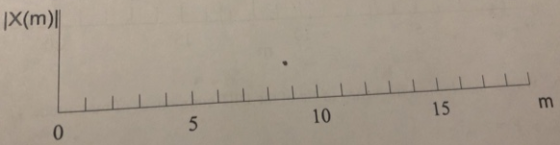
The time between samples is ts= 0.005 sec. (fs= 200 samples/sec .). Sketch the magnitude of the N point DFT X(m)|= |DFT{x(n)} | versus m over the entire range shown, assuming that the DFT is performed on 20 consecutive samples of x(n) (i.e. N = 20). (By the way, the magnitude of a DFT element corresponding to a sinusoidal input of magnitude A, is A*N/2)
Homework Answers
From the given information we can compose time varying signal x(t) as some of three sinusoidal signals whose frequencies and magnituds are given below
30Hz magnitude 2
50Hz magnitude 3
80Hz magnitude 1
x(t)=2sin(60 t)+3sin(100
 t)+sin(160t)
................(1)
t)+sin(160t)
................(1)
now to obtian the descrete time signal we need to keep t=nts where ts is sampling time period given as 0.005sec whereas n is descrete time variable
so x(n)= 2sin(60*n*0.005)+3sin(100*n*0.005)+sin(160*n*0.005)
x(n)=2sin(0.3n)+3sin(0.5n)+sin(0.8n)
....................(2)
now we have to obtain 20 point DFT of the above expression hence we need to find
x(0),x(1),x(2),x(3),x(4), .........................upto x(19) .
so by keeping n=1,2,3,4,5,6,7,8,9, .........................19 we will get below values
x(0)= 0 x(10)=0
x(1)=5.2058 x(11)=-4.03
x(2)=0.95 x(12)=-2.853
x(3)=-1.43 x(13)=3.333
x(4)=-1.763 x(14)=0.5877
x(5)=1 x(15)=-1
x(6)=-0.587 x(16)=1.7633
x(7)=-3.333 x(17)=1.4309
x(8)=2.8531 x(18)=-0.951
x(9)=4.0302 x(19)=-5.205
for finding N point DFT we have the formula as given below
X(m)=  .............................(3)
where  =
= =
=
so by keeping value of N=20 and m=0, 1, 2, 3, ...................19 in equation (3) we get
DFT of x(n)
X(0)= =75.49*10-16
X(1)= =84.89*10-16
X(2)= =35.544*10-16
similarly
X(3)= =20
=20
X(4)= =8.01*10-16
X(5)= =30
=30
X(6)= =119*10-16
X(7)= =69.12*10-16
X(8)= =10
=10
X(9)= =116*10-16
X(10)= =595*10-16
X(11)= =173*10-16
X(12)= =10
=10
X(13)= =243*10-16
X(14)= =442.52*10-16
X(15)= =30
=30
X(16)= =147.74*10-16
X(17)= =20
=20
X(18)= =615*10-16
X(19)= =572.111*10-16
from the above results considering the magnitude of those whose value is in powers of -16 is equel to zero
we have
magnitudes of
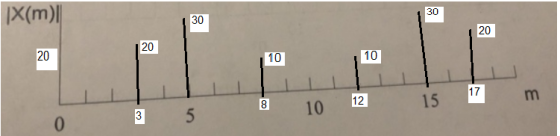
X(3)=X(17)=20
X(5)=X(15)=30
X(8)=X(12)=10 and remaining all others are zeros
by drawing the magnitude spectrum of the above values we will get below figure
Add Answer to:
A discrete time waveform x(n) is composed of three sinusoidal components:
ASSIGNMENT 2 (C4,_CO2, PO1) 1. Calculate DFT of the following discrete-time sequence, x(n) using DFT technique...
 ASSIGNMENT 2 (C4,_CO2, PO1) 1. Calculate DFT of the following discrete-time sequence, x(n) using DFT technique x(n) = {72,-56, 159) (C4, CO2,PO1) 2. Calculate the 8-point DFT of the following discrete-time sequence, x(n) using Decimation In Time Fast Fourier transform (DIT-FFT) algorithm. Show the sketch and label all parameters on a signal flow graph/butterfly diagram structure in your answer. (1-3<ns3 x(n) = 0 elsewhere
Consider the signal x(n-õn-4] + 2õn-5] + õn_6]. (a) Find X(el the discrete-time Fourier transform of...
 Consider the signal x(n-õn-4] + 2õn-5] + õn_6]. (a) Find X(el the discrete-time Fourier transform of xin]. Write expressions for the magnitude and phase of X(elu), and sketch these functions (b) Find all values of N for which the N-point DFT is a set of real numbers (c) Can you find a three-point causal signal x1n i.e., x1In] 0 for n <0 and n > 2) for which the three-point DFT of x (n] is: xn[nl (ie, xiin] O for...
Question 4 (a) Find the DFT of the series x[n)-(0.2,1,1,0.2), and sketch the magnitude of the resulting spectral components [10 marks] (b) For a discrete impulse response, h[n], that is symmetric...
 Question 4 (a) Find the DFT of the series x[n)-(0.2,1,1,0.2), and sketch the magnitude of the resulting spectral components [10 marks] (b) For a discrete impulse response, h[n], that is symmetric about the origin, the spectral coefficients of the signal, H(k), can be obtained by use of the DFT He- H(k)- H-(N-1)/2 Conversely, if the spectral coefficients, H(k), are known (and are even and symmetrical about k-0), the original signal, h[n], can be reconstituted using the inverse DFT 1 (N-D/2...
(a) Consider a discrete-time signal v[n] satisfying vn0 except if n is a multiple of some fixed integer N. i.e oln] -0, otherwise where m is an integer. Denote its discrete-time Fourier transform by...
 (a) Consider a discrete-time signal v[n] satisfying vn0 except if n is a multiple of some fixed integer N. i.e oln] -0, otherwise where m is an integer. Denote its discrete-time Fourier transform by V(eJ"). Define y[nl-v[Nn] Express Y(e) as a function of V(e). Hint : If confused, start with N-2 (b) Consider the discrete-time signal r[n] with discrete-time Fourier transform X(e). Now, let z[n] be formed by inserting two zeroes between any two samples of x[n]. Give a formula...
The question was let x(t)=7sin(11*pi*t). in each of the following parts, the discrete time signal x[n]...
The question was let x(t)=7sin(11*pi*t). in each of the following parts, the discrete time signal x[n] is obtained by sampling x(t) at a rate fs, and the resultant x[n] can be written as x[n]=Acos(wo*n+phi). (d) What is the continuous-time period of x(t)? What is the discrete-time period after x(t) has been sampled at fs = 15 samples/s?
12. Let X(e") be the DTFT of the discrete-time signal z[n] = (0.5)"u[n]. Let gin] be the length-5...
 12. Let X(e") be the DTFT of the discrete-time signal z[n] = (0.5)"u[n]. Let gin] be the length-5 sequence whose 5-point DFT, Gk], is made from uniform samples from X(eu): g[n] CH 0 for n<0and n > 4 = x(e,2 ) for k = 0, 1, 2,3,4 = Find g(0] and gl1].
12. Let X(e") be the DTFT of the discrete-time signal z[n] = (0.5)"u[n]. Let gin] be the length-5 sequence whose 5-point DFT, Gk], is made from uniform samples...
12. Let X(e") be the DTFT of the discrete-time signal z[n] = (0.5)"u[n]. Let gin] be the length-5 sequence whose 5-point DFT, Gk], is made from uniform samples from X(eu): g[n] CH 0 for n<0and n > 4 = x(e,2 ) for k = 0, 1, 2,3,4 = Find g(0] and gl1].
12. Let X(e") be the DTFT of the discrete-time signal z[n] = (0.5)"u[n]. Let gin] be the length-5 sequence whose 5-point DFT, Gk], is made from uniform samples...
Signal xo(t) 5 cos (200π1+ 품 ) + 4 sin (300π) is sampled at a rate of Fs = 1 kHz to obtain the discrete-time signal x[n]. (a) Determine the spectrum X(ej ) of x[n] and plot its magnitude as a functi...
 Signal xo(t) 5 cos (200π1+ 품 ) + 4 sin (300π) is sampled at a rate of Fs = 1 kHz to obtain the discrete-time signal x[n]. (a) Determine the spectrum X(ej ) of x[n] and plot its magnitude as a function of ω rad sam in tad and as a function of F in Hz. Explain whether the original signal xe(t) can be recovered from xln]. (b) Repeat part (a) for 500 Hz. (c) Repeat part (a) for 100...
Consider a sampler which samples the continuous-time input signal x(t) at a sampling frequency fs =...
 Consider a sampler which samples the continuous-time input signal x(t) at a sampling frequency fs = 8000 Hz and produces at its output a sampled discrete-time signal x$(t) = x(nTs), where To = 1/fs is the sampling period. If the sampled signal is passed through a unity-gain lowpass filter with cutoff frequency of fs/2, sketch the magnitude spectrum of the resulting signal for the following input signals: (a) x(t) = cos(6000nt). (b) x(t) = cos(12000nt). (c) x(t) = cos(18000nt).
(5%) The following signals r t) is sanpled periodically to obtained the discrete-time signal [n. ...
 Please explain why. Thank you.
(5%) The following signals r t) is sanpled periodically to obtained the discrete-time signal [n. For each of the given sampling rates in F, Hz or in T period, (i) determine the spectrum x(eM) of x[n]; (ii) plot its magnitude and phase as a function of w in and as a function of sampling frequency Fs in HZ; and (iii explain whether e(t) can be recovered from rn] (a) re(t) 8 +12e-3207e-j0(+), with sampling rate...
Please explain why. Thank you.
(5%) The following signals r t) is sanpled periodically to obtained the discrete-time signal [n. For each of the given sampling rates in F, Hz or in T period, (i) determine the spectrum x(eM) of x[n]; (ii) plot its magnitude and phase as a function of w in and as a function of sampling frequency Fs in HZ; and (iii explain whether e(t) can be recovered from rn] (a) re(t) 8 +12e-3207e-j0(+), with sampling rate...
The power versus time for a point on a string (μ = 0.06 kg/m) in which a sinusoidal traveling wave is induced is shown...
 The power versus time for a point on a string (μ = 0.06
kg/m) in which a sinusoidal traveling wave is induced is
shown in the following figure. The wave is modeled with the wave
equation y(x, t) = A sin[(25.43 m−1)x − ωt]. What are
the frequency (in Hz) and amplitude (in m) of the wave?
The power versus time or a point on a string μ 0.06 kg/m n which a sinusoidal traveling wave sind ce s snow...
The power versus time for a point on a string (μ = 0.06
kg/m) in which a sinusoidal traveling wave is induced is
shown in the following figure. The wave is modeled with the wave
equation y(x, t) = A sin[(25.43 m−1)x − ωt]. What are
the frequency (in Hz) and amplitude (in m) of the wave?
The power versus time or a point on a string μ 0.06 kg/m n which a sinusoidal traveling wave sind ce s snow...
 ASSIGNMENT 2 (C4,_CO2, PO1) 1. Calculate DFT of the following discrete-time sequence, x(n) using DFT technique x(n) = {72,-56, 159) (C4, CO2,PO1) 2. Calculate the 8-point DFT of the following discrete-time sequence, x(n) using Decimation In Time Fast Fourier transform (DIT-FFT) algorithm. Show the sketch and label all parameters on a signal flow graph/butterfly diagram structure in your answer. (1-3<ns3 x(n) = 0 elsewhere
 Consider the signal x(n-õn-4] + 2õn-5] + õn_6]. (a) Find X(el the discrete-time Fourier transform of xin]. Write expressions for the magnitude and phase of X(elu), and sketch these functions (b) Find all values of N for which the N-point DFT is a set of real numbers (c) Can you find a three-point causal signal x1n i.e., x1In] 0 for n <0 and n > 2) for which the three-point DFT of x (n] is: xn[nl (ie, xiin] O for...
 Question 4 (a) Find the DFT of the series x[n)-(0.2,1,1,0.2), and sketch the magnitude of the resulting spectral components [10 marks] (b) For a discrete impulse response, h[n], that is symmetric about the origin, the spectral coefficients of the signal, H(k), can be obtained by use of the DFT He- H(k)- H-(N-1)/2 Conversely, if the spectral coefficients, H(k), are known (and are even and symmetrical about k-0), the original signal, h[n], can be reconstituted using the inverse DFT 1 (N-D/2...
 (a) Consider a discrete-time signal v[n] satisfying vn0 except if n is a multiple of some fixed integer N. i.e oln] -0, otherwise where m is an integer. Denote its discrete-time Fourier transform by V(eJ"). Define y[nl-v[Nn] Express Y(e) as a function of V(e). Hint : If confused, start with N-2 (b) Consider the discrete-time signal r[n] with discrete-time Fourier transform X(e). Now, let z[n] be formed by inserting two zeroes between any two samples of x[n]. Give a formula...
 12. Let X(e") be the DTFT of the discrete-time signal z[n] = (0.5)"u[n]. Let gin] be the length-5 sequence whose 5-point DFT, Gk], is made from uniform samples from X(eu): g[n] CH 0 for n<0and n > 4 = x(e,2 ) for k = 0, 1, 2,3,4 = Find g(0] and gl1].
12. Let X(e") be the DTFT of the discrete-time signal z[n] = (0.5)"u[n]. Let gin] be the length-5 sequence whose 5-point DFT, Gk], is made from uniform samples...
12. Let X(e") be the DTFT of the discrete-time signal z[n] = (0.5)"u[n]. Let gin] be the length-5 sequence whose 5-point DFT, Gk], is made from uniform samples from X(eu): g[n] CH 0 for n<0and n > 4 = x(e,2 ) for k = 0, 1, 2,3,4 = Find g(0] and gl1].
12. Let X(e") be the DTFT of the discrete-time signal z[n] = (0.5)"u[n]. Let gin] be the length-5 sequence whose 5-point DFT, Gk], is made from uniform samples...
 Signal xo(t) 5 cos (200π1+ 품 ) + 4 sin (300π) is sampled at a rate of Fs = 1 kHz to obtain the discrete-time signal x[n]. (a) Determine the spectrum X(ej ) of x[n] and plot its magnitude as a function of ω rad sam in tad and as a function of F in Hz. Explain whether the original signal xe(t) can be recovered from xln]. (b) Repeat part (a) for 500 Hz. (c) Repeat part (a) for 100...
 Consider a sampler which samples the continuous-time input signal x(t) at a sampling frequency fs = 8000 Hz and produces at its output a sampled discrete-time signal x$(t) = x(nTs), where To = 1/fs is the sampling period. If the sampled signal is passed through a unity-gain lowpass filter with cutoff frequency of fs/2, sketch the magnitude spectrum of the resulting signal for the following input signals: (a) x(t) = cos(6000nt). (b) x(t) = cos(12000nt). (c) x(t) = cos(18000nt).
 Please explain why. Thank you.
(5%) The following signals r t) is sanpled periodically to obtained the discrete-time signal [n. For each of the given sampling rates in F, Hz or in T period, (i) determine the spectrum x(eM) of x[n]; (ii) plot its magnitude and phase as a function of w in and as a function of sampling frequency Fs in HZ; and (iii explain whether e(t) can be recovered from rn] (a) re(t) 8 +12e-3207e-j0(+), with sampling rate...
Please explain why. Thank you.
(5%) The following signals r t) is sanpled periodically to obtained the discrete-time signal [n. For each of the given sampling rates in F, Hz or in T period, (i) determine the spectrum x(eM) of x[n]; (ii) plot its magnitude and phase as a function of w in and as a function of sampling frequency Fs in HZ; and (iii explain whether e(t) can be recovered from rn] (a) re(t) 8 +12e-3207e-j0(+), with sampling rate...
 The power versus time for a point on a string (μ = 0.06
kg/m) in which a sinusoidal traveling wave is induced is
shown in the following figure. The wave is modeled with the wave
equation y(x, t) = A sin[(25.43 m−1)x − ωt]. What are
the frequency (in Hz) and amplitude (in m) of the wave?
The power versus time or a point on a string μ 0.06 kg/m n which a sinusoidal traveling wave sind ce s snow...
The power versus time for a point on a string (μ = 0.06
kg/m) in which a sinusoidal traveling wave is induced is
shown in the following figure. The wave is modeled with the wave
equation y(x, t) = A sin[(25.43 m−1)x − ωt]. What are
the frequency (in Hz) and amplitude (in m) of the wave?
The power versus time or a point on a string μ 0.06 kg/m n which a sinusoidal traveling wave sind ce s snow...
Most questions answered within 3 hours.
-
Where is the error in this code sequence?
String s1 = "Hello";
String s2 = "ello";...
asked 10 months ago -
Financial data for Joel de Paris, Inc., for last year
follow:
Joel de Paris, Inc.
Balance...
asked 10 months ago -
Consider this reaction:
Al2(SO4)3 (aq)+ BaCl3
(aq) Al2Cl6 (aq)- +
3BaSO4(s) . What is the...
asked 10 months ago -
Suppose that Savneet is considering increasing her
recent random sample from 20 car rentals to 40...
asked 10 months ago -
Trucks arrive at an unloading terminal at an average rate of 120
per hour.
Trucks arrive...
asked 10 months ago -
Why are methanol and ethanol completely soluble in water while
octanol is not very little soluble....
asked 10 months ago -
A facilities manager at a university reads in a research report
that the mean amount of...
asked 10 months ago -
When the CuSO4 is rehydrated by adding water to the anhydrous
compound, is this an endothermic...
asked 10 months ago -
A ray of sunlight is passing from diamond into crown glass; the
angle of incidence is...
asked 10 months ago -
A block of mass 0.249 kg is placed on top of a light, vertical
spring of...
asked 10 months ago -
how do the kidneys compensate in the presences of acidosis
a) trigger hyperventilate
b) reserve acid...
asked 10 months ago -
Question 501 pts
The rental rate of capital to the firm increases. Which of the
following...
asked 10 months ago