
Homework Answers
SOLUTION
Part (a)
According to the following expression:

Isolating  from equation (1) we have:

Now, for the first-order bright fringe we have:

Therefore equation (1) can be written as:
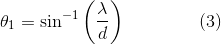
Replacing values:

Solving we obtain:

Part (b)
The new slit separation is:

Inserting (5) into (3) we have:
![\theta_{1}=\sin^{-1}\left [ \frac{ \lambda}{d_{orig}+A\sin(\omega t)} \right ]\: \: \: \: \: \: \: \: \: \: \: \: \: \: \: \: \: \: (6)](http://img.homeworklib.com/questions/296e70d0-7870-11ec-b712-bf8b15d641e2.png?x-oss-process=image/resize,w_560)
replacing values we obtain:
![\theta_{1}=\sin^{-1}\left [ \frac{ 546 \times 10^{-9}\,m}{1.0\times 10^{-6}\,m+\left (0.25\times 10^{-6}\,m \right )\sin(100 t)} \right ]\: \: \: \: \: \: \: \: \: \: \: \: \: \: \: \: \: \: (7)](http://img.homeworklib.com/questions/29c77870-7870-11ec-9b39-39bb4749e7fd.png?x-oss-process=image/resize,w_560)
or
![{\color{Blue} \theta_{1}=\sin^{-1}\left [ \frac{ 546 \times 10^{-3}}{1.0+0.25\sin(100 t)} \right ]}\: \: \: \: \: \: \: \: \: \: \: \: \: \: \: \: \: \: (8)](http://img.homeworklib.com/questions/2a1a7870-7870-11ec-b759-c77a78d34c2b.png?x-oss-process=image/resize,w_560)
Part (c)
The maximum value
for  can be obtained when:

which is satisfied for:

replacing (9) into (8) we obtain:

Part (d)
The minimum value for can be obtained when:

which is satisfied for

Inserting (11) into (8) we obtain:

Part (e)
The main parameter of
 ,
,  ,
,  ,
,  that affects the value of these angles is
.
that affects the value of these angles is
.
Add Answer to:
ident wavefronts barrier 1.0pm. A light beam of wavelength 546 A two-slit barrier has a slit...
Light of wavelength 605 nm falls on a double slit, and the first bright fringe of...
Light of wavelength 605 nm falls on a double slit, and the first bright fringe of the interference pattern is seen at an angle of 13.6° from the central maximum. Find the separation between the slits.
Light of wavelength 6.50 ✕ 102 nm falls on a double slit, and the first bright...
Light of wavelength 6.50 ✕ 102 nm falls on a double slit, and the first bright fringe of the interference pattern is observed to make an angle of 14° with the horizontal. Find the separation between the slits.
In a Young's double-slit experiment the wavelength of light used is 485 nm (in vacuum), and...
In a Young's double-slit experiment the wavelength of light used is 485 nm (in vacuum), and the separation between the slits is 1.5 × 10⁻⁶ m. Determine the angle that locates (a) the dark fringe for which m = 0, (b) the bright fringe for which m = 1, (c) the dark fringe for which m = 1, and (d) the bright fringe for which m = 2.
In a Young's double-slit experiment the wavelength of light used is 491 nm (in vacuum), and...
In a Young's double-slit experiment the wavelength of light used is 491 nm (in vacuum), and the separation between the slits is 1.1 × 10⁻⁶ m. Determine the angle that locates (a) the dark fringe for which m = 0, (b) the bright fringe for which m = 1, (c) the dark fringe for which m = 1, and (d) the bright fringe for which m = 2.
In a Young's double-slit experiment the wavelength of light used is 465 nm (in vacuum), and...
In a Young's double-slit experiment the wavelength of light used is 465 nm (in vacuum), and the separation between the slits is 1.1 × 10⁻⁶ m. Determine the angle that locates (a) the dark fringe for which m = 0, (b) the bright fringe for which m = 1, (c) the dark fringe for which m = 1, and (d) the bright fringe for which m = 2.
1) In a Young’s double-slit experiment, the wavelength of the light used is 520 nm (in...
1) In a Young’s double-slit experiment, the wavelength of the light used is 520 nm (in vacuum), and the separation between the slits is 1.43 × 10⁻⁶ ? . Determine the angle that locates a) the dark fringe for which m = 0, b) the bright fringe for which m = 1, c) the dark fringe for which m = 1, d) the bright fringe for which m = 2.
In a Young's double-slit experiment the wavelength of light used is 488 nm (in vacuum), and...
In a Young's double-slit experiment the wavelength of light used is 488 nm (in vacuum), and the separation between the slits is 1.2 × 10⁻⁶ m. Determine the angle that locates (a) the dark fringe for which m = 0, (b) the bright fringe for which m = 1, (c) the dark fringe for which m = 1, and (d) the bright fringe for which m = 2.
In a Young's double-slit experiment the wavelength of light used is 479 nm (in vacuum), and...
In a Young's double-slit experiment the wavelength of light used is 479 nm (in vacuum), and the separation between the slits is 1.7 × 10⁻⁶ m. Determine the angle that locates (a) the dark fringe for which m = 0, (b) the bright fringe for which m = 1, (c) the dark fringe for which m = 1, and (d) the bright fringe for which m = 2.
Light with a wavelength 430 nm passes through a double-slit system that has a slit separation...
 Light with a wavelength 430 nm passes through a double-slit system that has a slit separation d = 0.500 mm. Determine how far away a screen must be placed in order that a dark fringe appear directly opposite both slits, with just one bright fringe between them. 581 x cm
In a Young's double-slit experiment the wavelength of light used is 481 nm (in vacuum), and...
In a Young's double-slit experiment the wavelength of light used is 481 nm (in vacuum), and the separation between the slits is 1.9 × 10⁻⁶ m. Determine the angle that locates (a) the dark fringe for which m = 0, (b) the bright fringe for which m = 1, (c) the dark fringe for which m = 1, and (d) the bright fringe for which m = 2. To 3 significant figures.
 Light with a wavelength 430 nm passes through a double-slit system that has a slit separation d = 0.500 mm. Determine how far away a screen must be placed in order that a dark fringe appear directly opposite both slits, with just one bright fringe between them. 581 x cm
Most questions answered within 3 hours.
-
Where is the error in this code sequence?
String s1 = "Hello";
String s2 = "ello";...
asked 10 months ago -
Financial data for Joel de Paris, Inc., for last year
follow:
Joel de Paris, Inc.
Balance...
asked 10 months ago -
Consider this reaction:
Al2(SO4)3 (aq)+ BaCl3
(aq) Al2Cl6 (aq)- +
3BaSO4(s) . What is the...
asked 10 months ago -
Suppose that Savneet is considering increasing her
recent random sample from 20 car rentals to 40...
asked 10 months ago -
Trucks arrive at an unloading terminal at an average rate of 120
per hour.
Trucks arrive...
asked 10 months ago -
Why are methanol and ethanol completely soluble in water while
octanol is not very little soluble....
asked 10 months ago -
A facilities manager at a university reads in a research report
that the mean amount of...
asked 10 months ago -
When the CuSO4 is rehydrated by adding water to the anhydrous
compound, is this an endothermic...
asked 10 months ago -
A ray of sunlight is passing from diamond into crown glass; the
angle of incidence is...
asked 10 months ago -
A block of mass 0.249 kg is placed on top of a light, vertical
spring of...
asked 10 months ago -
how do the kidneys compensate in the presences of acidosis
a) trigger hyperventilate
b) reserve acid...
asked 10 months ago -
Question 501 pts
The rental rate of capital to the firm increases. Which of the
following...
asked 10 months ago