1. A 67-kg base runner begins his slide into second base when he is moving at...
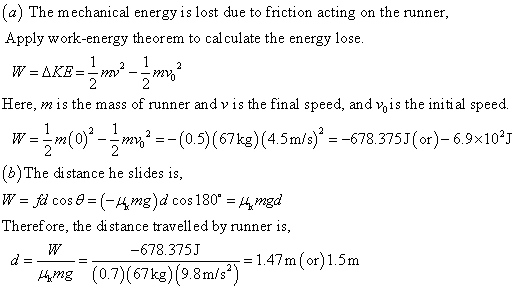
1. A 67-kg base runner begins his slide into second base when he is moving at a speed of 4.5 m/s. The coefficient of friction between his clothes and Earth is 0.70. He slides so that his speed is zero just as he reaches the base.
(a) How much mechanical energy is lost due to friction acting on the runner?
(b) How far does he slide?
2. A 0.32-kg stone is held 1.4 m above the top edge of a water well and then dropped into it. The well has a depth of 5.1 m.
(a) Taking y = 0 at the top edge of the well, what is the gravitational potential energy of the stone–Earth system before the stone is released?
(b) Taking y = 0 at the top edge of the well, what is the gravitational potential energy of the stone–Earth system when it reaches the bottom of the well?
(c) What is the change in gravitational potential energy of the system from release to reaching the bottom of the well?
3. In a control system, an accelerometer consists of a 4.91-g object sliding on a calibrated horizontal rail. A low-mass spring attaches the object to a flange at one end of the rail. Grease on the rail makes static friction negligible, but rapidly damps out vibrations of the sliding object. When subject to a steady acceleration of 0.824g, the object should be at a location 0.515 cm away from its equilibrium position. Find the force constant of the spring required for the calibration to be correct.
4. A 48-kg pole vaulter running at 12 m/s vaults over the bar. Her speed when she is above the bar is 1.7 m/s. Neglect air resistance, as well as any energy absorbed by the pole, and determine her altitude as she crosses the bar.
Homework Answers
Add Answer to:
1. A 67-kg base runner begins his slide into second base when he
is moving at...
1) A 67-kg base runner begins his slide into second base when he is moving at...
1) A 67-kg base runner begins his slide into second base when he is moving at a speed of 3.7 m/s. The coefficient of friction between his clothes and Earth is 0.70. He slides so that his speed is zero just as he reaches the base. (a) How much mechanical energy is lost due to friction acting on the runner? (b) How far does he slide? 2) A running 53-kg cheetah has a top speed of 31 m/s. (a) What...
A 71-kg base runner begins his slide into second base when he is moving at a...
A 71-kg base runner begins his slide into second base when he is moving at a speed of 4.7 m/s. The coefficient of friction between his clothes and Earth is 0.70. He slides so that his speed is zero just as he reaches the base. (a) How much mechanical energy is lost due to friction acting on the runner? J (b) How far does he slide? m
Sample Problems (Ch.5 Energy) 1A71.4 kg base runner begins his slide into second base when he...
 Sample Problems (Ch.5 Energy) 1A71.4 kg base runner begins his slide into second base when he is moving at a speed of 5-3 m/s. The coefficient of friction between his clothes and Earth is 0.78. He slides so that his speed is zero just as he reaches the base. (a) How much mechanical energy is lost due to friction acting on the runner? (b) How far does he slide? 2. A bead of mass m = 8.35 kg is released...
A 0.19-kg stone is held 1.4 m above the top edge of a water well and...
A 0.19-kg stone is held 1.4 m above the top edge of a water well and then dropped into it. The well has a depth of 5.1 m. (a) Relative to the configuration with the stone at the top edge of the well, what is the gravitational potential energy of the stone−Earth system before the stone is released? (b) Relative to the configuration with the stone at the top edge of the well, what is the gravitational potential energy of...
A 0.29-kg stone is held 1.5 m above the top edge of a water well and...
A 0.29-kg stone is held 1.5 m above the top edge of a water well and then dropped into it. The well has a depth of 5.5 m. (a) Relative to the configuration with the stone at the top edge of the well, what is the gravitational potential energy of the stone−Earth system before the stone is released? J (b) Relative to the configuration with the stone at the top edge of the well, what is the gravitational potential energy...
A 0.33-kg stone is held 1.2 m above the top edge of a water well and...
 A 0.33-kg stone is held 1.2 m above the top edge of a water well and then dropped into it. The well has a depth of 5.6 m. Relative to the configuration with the stone at the top edge of the well, what is the gravitational potential energy of the stone-Earth system before the stone is released? U_g (rounded to two decimals) = Relative to the configuration with the stone at the top edge of the well, what is the...
A 0.375 kg stone is held 1.42 m above the top edge of a water well...
A 0.375 kg stone is held 1.42 m above the top edge of a water well and then dropped into it. The well has a depth of 4.78 m. Take y = 0 at the top edge of the well. a) What is the gravitational potential energy of the stone-Earth system before the stone is released? b) What is the gravitational potential energy of the stone-Earth system when the stone reaches the bottom of the well. c) What is the...
A baseball player sprinting at 4.5 m/s begins to slide with his body flat on the...
A baseball player sprinting at 4.5 m/s begins to slide with his body flat on the ground when 2.8 m from home base.The coefficient of friction between the player’s uniform and the ground is 0.30.Does he make it home? If so,what is his speed as he reaches home?
3 Robert Hooke attaches springs to the bottoms of his shoes and slides down a curved,...
 3
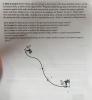
Robert Hooke attaches springs to the bottoms of his shoes and slides down a curved, frictionless slide, as show in the figure below. When he reaches the ground at the bottom, the springs compress against a low wall, and he then bounces back up the slide. Assume the spring is perfectly elastic and obeys Hooke's Law. Four points on the trajectory are labeled: At point 1, Hooke stars from rest at the top of the slide. At point 2,...
3
Robert Hooke attaches springs to the bottoms of his shoes and slides down a curved, frictionless slide, as show in the figure below. When he reaches the ground at the bottom, the springs compress against a low wall, and he then bounces back up the slide. Assume the spring is perfectly elastic and obeys Hooke's Law. Four points on the trajectory are labeled: At point 1, Hooke stars from rest at the top of the slide. At point 2,...
In the figure, a small block of mass m = 0.040 kg can slide along the...
 In the figure, a small block of mass m = 0.040 kg can slide
along the frictionless loop-the-loop, with loop radius R = 19 cm.
The block is released from rest at point P, at height h = 6R above
the bottom of the loop. How much work does the gravitational force
do on the block as the block travels from point P to (a) point Q
and (b) the top of the loop? If the gravitational potential energy
of...
In the figure, a small block of mass m = 0.040 kg can slide
along the frictionless loop-the-loop, with loop radius R = 19 cm.
The block is released from rest at point P, at height h = 6R above
the bottom of the loop. How much work does the gravitational force
do on the block as the block travels from point P to (a) point Q
and (b) the top of the loop? If the gravitational potential energy
of...
 Sample Problems (Ch.5 Energy) 1A71.4 kg base runner begins his slide into second base when he is moving at a speed of 5-3 m/s. The coefficient of friction between his clothes and Earth is 0.78. He slides so that his speed is zero just as he reaches the base. (a) How much mechanical energy is lost due to friction acting on the runner? (b) How far does he slide? 2. A bead of mass m = 8.35 kg is released...
 A 0.33-kg stone is held 1.2 m above the top edge of a water well and then dropped into it. The well has a depth of 5.6 m. Relative to the configuration with the stone at the top edge of the well, what is the gravitational potential energy of the stone-Earth system before the stone is released? U_g (rounded to two decimals) = Relative to the configuration with the stone at the top edge of the well, what is the...
 3
Robert Hooke attaches springs to the bottoms of his shoes and slides down a curved, frictionless slide, as show in the figure below. When he reaches the ground at the bottom, the springs compress against a low wall, and he then bounces back up the slide. Assume the spring is perfectly elastic and obeys Hooke's Law. Four points on the trajectory are labeled: At point 1, Hooke stars from rest at the top of the slide. At point 2,...
3
Robert Hooke attaches springs to the bottoms of his shoes and slides down a curved, frictionless slide, as show in the figure below. When he reaches the ground at the bottom, the springs compress against a low wall, and he then bounces back up the slide. Assume the spring is perfectly elastic and obeys Hooke's Law. Four points on the trajectory are labeled: At point 1, Hooke stars from rest at the top of the slide. At point 2,...
 In the figure, a small block of mass m = 0.040 kg can slide
along the frictionless loop-the-loop, with loop radius R = 19 cm.
The block is released from rest at point P, at height h = 6R above
the bottom of the loop. How much work does the gravitational force
do on the block as the block travels from point P to (a) point Q
and (b) the top of the loop? If the gravitational potential energy
of...
In the figure, a small block of mass m = 0.040 kg can slide
along the frictionless loop-the-loop, with loop radius R = 19 cm.
The block is released from rest at point P, at height h = 6R above
the bottom of the loop. How much work does the gravitational force
do on the block as the block travels from point P to (a) point Q
and (b) the top of the loop? If the gravitational potential energy
of...
Most questions answered within 3 hours.
-
Where is the error in this code sequence?
String s1 = "Hello";
String s2 = "ello";...
asked 10 months ago -
Financial data for Joel de Paris, Inc., for last year
follow:
Joel de Paris, Inc.
Balance...
asked 10 months ago -
Consider this reaction:
Al2(SO4)3 (aq)+ BaCl3
(aq) Al2Cl6 (aq)- +
3BaSO4(s) . What is the...
asked 10 months ago -
Suppose that Savneet is considering increasing her
recent random sample from 20 car rentals to 40...
asked 10 months ago -
Trucks arrive at an unloading terminal at an average rate of 120
per hour.
Trucks arrive...
asked 10 months ago -
Why are methanol and ethanol completely soluble in water while
octanol is not very little soluble....
asked 10 months ago -
A facilities manager at a university reads in a research report
that the mean amount of...
asked 10 months ago -
When the CuSO4 is rehydrated by adding water to the anhydrous
compound, is this an endothermic...
asked 10 months ago -
A ray of sunlight is passing from diamond into crown glass; the
angle of incidence is...
asked 10 months ago -
A block of mass 0.249 kg is placed on top of a light, vertical
spring of...
asked 10 months ago -
how do the kidneys compensate in the presences of acidosis
a) trigger hyperventilate
b) reserve acid...
asked 10 months ago -
Question 501 pts
The rental rate of capital to the firm increases. Which of the
following...
asked 10 months ago