Homework Answers
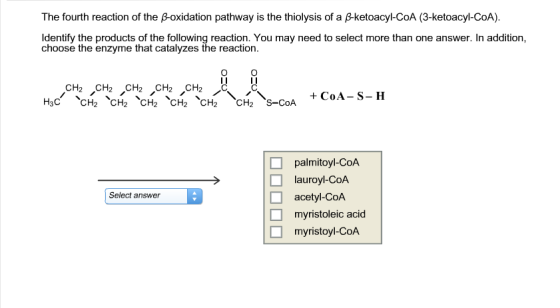
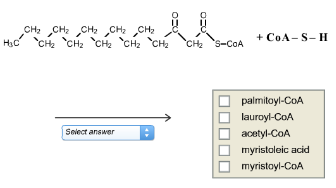
the enzyme that catalyze the enzyme is thiolase
the two products of the reaction are lauroyl-CoA and acetyl-CoA
Add Answer to:
The fourth reaction of the beta-oxidation pathway is the thiolysis of a beta-ketoacyl-CoA (3-ketoacyl-CoA).
Identify...
All of the following statements about beta-oxidation are true EXCEPT * Select only ONE answer choice....
All of the following statements about beta-oxidation are true EXCEPT * Select only ONE answer choice. The pathway helps to generate energy and acetyl CoA from fatty acyl CoA -The pathway produces NADH and FADH2 as products -The pathway is found in all tissues that contain mitochondria -The pathway feeds fatty acids into Glycolysis as acetyl-CoA -The pathway is rate limited by oxygen availability
5. ( pts) Draw the complete B-oxidation pathway of the following short chain fatty Acyl-CoA. Show...
 5. ( pts) Draw the complete B-oxidation pathway of the following short chain fatty Acyl-CoA. Show the structures of all reactants and products, as well as the names of the enzymes. You do not need to draw the structures of ATP, NADT, COA, etc., but do show them as reactants or products in the appropriate places. You do not need to show the mechanisms of the enzymes. (b) (3 pts) How many ATPs would be generated by the complete oxidation...
3. (10 pts) Citrate synthase catalyzes the reaction: Oxaloacetate + acetyl – COA → citrate +...
 3. (10 pts) Citrate synthase catalyzes the reaction: Oxaloacetate + acetyl – COA → citrate + HS – COA The standard free energy change for the reation is -31.5 k] . mol-1. a) Calculate the equilibrium constant for this reaction at 37°C. b) Would you expect this reaction to serve as a control point for its pathway (the citric acid cycle)?
The β-oxidation of odd-numbered FAs presents a small problem in that once most of the oxidation...
The β-oxidation of odd-numbered FAs presents a small problem in that once most of the oxidation has occurred, the last component is propionyl-CoA rather than acetyl CoA. This has one more carbon and as such cannot be utilized any further. Outline the events that control the metabolism of this unit in their proper order: 1) Methylmalonyl-CoA epimerase converts S-methylmalonyl-CoA to R-methylmalonyl-CoA. 2) Methylmalonyl-CoA mutase demethylates R-methylmalonyl-CoA to succinyl-CoA. 3) Propionyl-CoA carboxylase catalyzes the addition of CO2 to propionyl-CoA. 4) The...
Starting with Acetyl-CoA in the mitochondrial matrix, show how a molecule of acetyl-CoA may get incorporated...
Starting with Acetyl-CoA in the mitochondrial matrix, show how a molecule of acetyl-CoA may get incorporated into a molecule of phosphatyidylserine in the plasma membrane. You should summarize the pathways involved into the critical steps involved. You do NOT need to show every reaction and/or enzyme. You can present your summarizing note in any form like a table, diagram, or outline, do NOT describe it in just words. Your pathway should have a minimum of six steps. Label at least...
Starting with Acetyl-CoA in the mitochondrial matrix, show how a molecule of acetyl-CoA may get incorporated...
Starting with Acetyl-CoA in the mitochondrial matrix, show how a molecule of acetyl-CoA may get incorporated into a molecule of phosphatyidylserine in the plasma membrane. You should summarize the pathways involved into the critical steps involved. You do NOT need to show every reaction and/or enzyme. You can present your summarizing note in any form like a table, diagram, or outline, do NOT describe it in just words. Your pathway should have a minimum of six steps. Label at least...
1A) How many rounds/cycles of beta-oxidation would be needed to completely break down a 16-carbon fatty...
 1A) How many rounds/cycles of beta-oxidation would be needed to
completely break down a 16-carbon fatty acid molecule?
8
6
10
7
9
1B) What type of reaction is step 2?
isomerization
hydration
oxidation-reduction reaction
hydrolysis
1C) What type of enzyme catalyzes step 3?
oxidoreductase
lyase
hydrolase
transferase
ligase
1D) How many net ATP equivalents are generated
by the complete break down of a 12-Carbon fatty acid molecule?
97 ATP
95 ATP
100 ATP
146 ATP
124 ATP
117 ATP...
1A) How many rounds/cycles of beta-oxidation would be needed to
completely break down a 16-carbon fatty acid molecule?
8
6
10
7
9
1B) What type of reaction is step 2?
isomerization
hydration
oxidation-reduction reaction
hydrolysis
1C) What type of enzyme catalyzes step 3?
oxidoreductase
lyase
hydrolase
transferase
ligase
1D) How many net ATP equivalents are generated
by the complete break down of a 12-Carbon fatty acid molecule?
97 ATP
95 ATP
100 ATP
146 ATP
124 ATP
117 ATP...
5. The reaction below produces TWO different products from an E2 reaction pathway. Identify both elimination...
5. The reaction below produces TWO different products from an E2 reaction pathway. Identify both elimination products from this reaction. HINT: One of the elimination products should be relative easy to identify; the other elimination product is more challenging to determine. As a starting point, identify the most acidic proton in the substrate. NaoMe
5. The reaction below produces TWO different products from an E2 reaction pathway. Identify both elimination...
 5. The reaction below produces TWO different products from an E2 reaction pathway. Identify both elimination products from this reaction. HINT: One of the elimination products should be relative easy to identify; the other elimination product is more challenging to determine. As a starting point, identify the most acidic proton in the substrate. Nao Me
Given the reaction below, answer the following questions. COA ATP AMP+PP tu. R 0 R SCOA...
 Given the reaction below, answer the following questions. COA ATP AMP+PP tu. R 0 R SCOA 1. Name the enzyme that catalyzes this reaction. (2 pts.) 2. What is the common name for the lipid on the left, if it had eighteen carbons? (i.e. how did we refer to it in class?) (2 pts.) 3. If it was a 18:0 fatty acid, calculate the following upon its complete oxidation. • # of total FADH2 made (1 pt.) - # of...
 5. ( pts) Draw the complete B-oxidation pathway of the following short chain fatty Acyl-CoA. Show the structures of all reactants and products, as well as the names of the enzymes. You do not need to draw the structures of ATP, NADT, COA, etc., but do show them as reactants or products in the appropriate places. You do not need to show the mechanisms of the enzymes. (b) (3 pts) How many ATPs would be generated by the complete oxidation...
 3. (10 pts) Citrate synthase catalyzes the reaction: Oxaloacetate + acetyl – COA → citrate + HS – COA The standard free energy change for the reation is -31.5 k] . mol-1. a) Calculate the equilibrium constant for this reaction at 37°C. b) Would you expect this reaction to serve as a control point for its pathway (the citric acid cycle)?
 1A) How many rounds/cycles of beta-oxidation would be needed to
completely break down a 16-carbon fatty acid molecule?
8
6
10
7
9
1B) What type of reaction is step 2?
isomerization
hydration
oxidation-reduction reaction
hydrolysis
1C) What type of enzyme catalyzes step 3?
oxidoreductase
lyase
hydrolase
transferase
ligase
1D) How many net ATP equivalents are generated
by the complete break down of a 12-Carbon fatty acid molecule?
97 ATP
95 ATP
100 ATP
146 ATP
124 ATP
117 ATP...
1A) How many rounds/cycles of beta-oxidation would be needed to
completely break down a 16-carbon fatty acid molecule?
8
6
10
7
9
1B) What type of reaction is step 2?
isomerization
hydration
oxidation-reduction reaction
hydrolysis
1C) What type of enzyme catalyzes step 3?
oxidoreductase
lyase
hydrolase
transferase
ligase
1D) How many net ATP equivalents are generated
by the complete break down of a 12-Carbon fatty acid molecule?
97 ATP
95 ATP
100 ATP
146 ATP
124 ATP
117 ATP...
 5. The reaction below produces TWO different products from an E2 reaction pathway. Identify both elimination products from this reaction. HINT: One of the elimination products should be relative easy to identify; the other elimination product is more challenging to determine. As a starting point, identify the most acidic proton in the substrate. Nao Me
 Given the reaction below, answer the following questions. COA ATP AMP+PP tu. R 0 R SCOA 1. Name the enzyme that catalyzes this reaction. (2 pts.) 2. What is the common name for the lipid on the left, if it had eighteen carbons? (i.e. how did we refer to it in class?) (2 pts.) 3. If it was a 18:0 fatty acid, calculate the following upon its complete oxidation. • # of total FADH2 made (1 pt.) - # of...
Most questions answered within 3 hours.
-
Where is the error in this code sequence?
String s1 = "Hello";
String s2 = "ello";...
asked 11 months ago -
Financial data for Joel de Paris, Inc., for last year
follow:
Joel de Paris, Inc.
Balance...
asked 11 months ago -
Consider this reaction:
Al2(SO4)3 (aq)+ BaCl3
(aq) Al2Cl6 (aq)- +
3BaSO4(s) . What is the...
asked 11 months ago -
Suppose that Savneet is considering increasing her
recent random sample from 20 car rentals to 40...
asked 11 months ago -
Trucks arrive at an unloading terminal at an average rate of 120
per hour.
Trucks arrive...
asked 11 months ago -
Why are methanol and ethanol completely soluble in water while
octanol is not very little soluble....
asked 11 months ago -
A facilities manager at a university reads in a research report
that the mean amount of...
asked 11 months ago -
When the CuSO4 is rehydrated by adding water to the anhydrous
compound, is this an endothermic...
asked 11 months ago -
A ray of sunlight is passing from diamond into crown glass; the
angle of incidence is...
asked 11 months ago -
A block of mass 0.249 kg is placed on top of a light, vertical
spring of...
asked 11 months ago -
how do the kidneys compensate in the presences of acidosis
a) trigger hyperventilate
b) reserve acid...
asked 11 months ago -
Question 501 pts
The rental rate of capital to the firm increases. Which of the
following...
asked 11 months ago