
Homework Answers
Answer
Option A
The monetary policy can decrease the quantity of money and increase
interest rate which will decrease investment and consumption
spending which will shifts AD to left.
the taxes and transfer payment is not part of monetary policy.
Add Answer to:
Give some examples of monetary policy that decrease aggregate demand. Examples of monetary policy that decrease...
Complete the sentences. Aggregate demand increases if expected future income, inflation, or profits And aggregate demand...
 Complete the sentences. Aggregate demand increases if expected future income, inflation, or profits And aggregate demand increases if fiscal policy government expenditure. SA O A. decrease; increases O B. increase; decreases OC. decrease, decreases OD. increase: increases Aggregate demand increases if fiscal policy transfer payments O A. decreases; increases OB. increases; increases O C. increases; decreases OD. decreases, decreases Aggregate demand increases if monetary policy the quantity of money and interest rates Click to select your answer. Complete the sentences....
Tightening monetary policy causes interest rates to __________ and aggregate demand to __________. Group of answer...
Tightening monetary policy causes interest rates to __________ and aggregate demand to __________. Group of answer choices rise / increase fall / increase rise / decrease fall / decrease
17. (4 points) An autonomous easing of monetary policy will cause A) the quantity of aggregate...
 17. (4 points) An autonomous easing of monetary policy will cause A) the quantity of aggregate demand to increase. B) the quantity of aggregate demand to decrease. C) aggregate demand to decrease. D) aggregate demand to increase
An increase in the price level will A) shift the aggregate demand curve to the left.
7) An increase in the price level will A) shift the aggregate demand curve to the left. B) shift the aggregate demand curve to the right. C) move the economy up along the aggregate demand curve. D) move the economy down along the aggregate demand curve. 8) Expansionary monetary policy involves A) reducing money supply and lowering taxes B) increasing money supply to decrease interest rate C) increasing government spending and cutting money supply D) increasing the interest rate and increasing taxes 9) Long-run macroeconomic equilibrium occurs when A) aggregate demand...
Which of the following is a monetary policy intended to rein in inflation? a. Reduce interest...
Which of the following is a monetary policy intended to rein in inflation? a. Reduce interest rates to increase investment spending b. Increase the money supply to shift the aggregate demand curve rightward c. Reduce the interest paid on banks' reserves d. Decrease the money supply to shift the aggregate demand curve leftward
1) of the Central Bank of Kuwait puts in place an expansionary monetary policy, its decision...
 1) of the Central Bank of Kuwait puts in place an expansionary monetary policy, its decision is based on A) the fact that the economy is at ful employment B) Expectation of excessive inflation in the future C) the fact that the economy is in an expansion D) Unemployment level is high 2) When the interest rate is set at a very low rate A) the opportunity cost of holding money is very low B) the money demand will shift...
Suppose the federal government observes a decrease in net exports. Examine this event in terms of the aggregate demand...
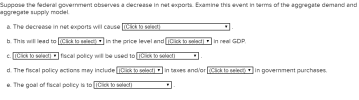 Suppose the federal government observes a decrease in net exports. Examine this event in terms of the aggregate demand and aggregate supply model. a. The decrease in net exports will cause (Click to select) b. This will lead to [(Click to select) v) in the price level and [(Click to select) v) in real GDP. c. (Click to select) v fiscal policy will be used to (Click to select) d. The fiscal policy actions may include (Click to select) in...
because it Monetary policy that decreases the interest rate is called A. contractionary monetary policy, reduces...
 because it Monetary policy that decreases the interest rate is called A. contractionary monetary policy, reduces AD. B. contractionary monetary policy; reduces SRAS. C. expansionary monetary policy; increases AD. D. expansionary monetary policy; increases SRAS. QUESTION 11 Other things the same, a fall in an economy's overall level of prices tends to A. raise both the quantity demanded and supplied of goods and services. B. raise the quantity demanded of goods and services, but lower the quantity supplied. C. lower...
In the graph, the initial aggregate supply curve is AS and the initial aggregate demand curve...
 In the graph, the initial aggregate supply curve is AS and the initial aggregate demand curve is ADo Some events that could have changed aggregate demand from AD, to AD are O A. a fall in the exchange rate or Price level 0 AS AS an increase in expected future inflation O B. a decrease in the money wage rate or 105 10 an increase in potential GDP ( 100 C. a decrease in expected future income or a decrease...
Which of the statements is true about monetary policy? a) Decrease in the money supply lowers...
Which of the statements is true about monetary policy? a) Decrease in the money supply lowers short-term interest rates and encourage investment and consumption demand. b) Monetary policy is determined by the Congress. c) Higher money supply does not have a permanent effect on economic activity because it results only in a higher price level in the long run. d) Monetary policy has the most immediate impact on the economy, but implementation of such a policy is usually slow.
 Complete the sentences. Aggregate demand increases if expected future income, inflation, or profits And aggregate demand increases if fiscal policy government expenditure. SA O A. decrease; increases O B. increase; decreases OC. decrease, decreases OD. increase: increases Aggregate demand increases if fiscal policy transfer payments O A. decreases; increases OB. increases; increases O C. increases; decreases OD. decreases, decreases Aggregate demand increases if monetary policy the quantity of money and interest rates Click to select your answer. Complete the sentences....
 17. (4 points) An autonomous easing of monetary policy will cause A) the quantity of aggregate demand to increase. B) the quantity of aggregate demand to decrease. C) aggregate demand to decrease. D) aggregate demand to increase
 1) of the Central Bank of Kuwait puts in place an expansionary monetary policy, its decision is based on A) the fact that the economy is at ful employment B) Expectation of excessive inflation in the future C) the fact that the economy is in an expansion D) Unemployment level is high 2) When the interest rate is set at a very low rate A) the opportunity cost of holding money is very low B) the money demand will shift...
 Suppose the federal government observes a decrease in net exports. Examine this event in terms of the aggregate demand and aggregate supply model. a. The decrease in net exports will cause (Click to select) b. This will lead to [(Click to select) v) in the price level and [(Click to select) v) in real GDP. c. (Click to select) v fiscal policy will be used to (Click to select) d. The fiscal policy actions may include (Click to select) in...
 because it Monetary policy that decreases the interest rate is called A. contractionary monetary policy, reduces AD. B. contractionary monetary policy; reduces SRAS. C. expansionary monetary policy; increases AD. D. expansionary monetary policy; increases SRAS. QUESTION 11 Other things the same, a fall in an economy's overall level of prices tends to A. raise both the quantity demanded and supplied of goods and services. B. raise the quantity demanded of goods and services, but lower the quantity supplied. C. lower...
 In the graph, the initial aggregate supply curve is AS and the initial aggregate demand curve is ADo Some events that could have changed aggregate demand from AD, to AD are O A. a fall in the exchange rate or Price level 0 AS AS an increase in expected future inflation O B. a decrease in the money wage rate or 105 10 an increase in potential GDP ( 100 C. a decrease in expected future income or a decrease...
Most questions answered within 3 hours.
-
Where is the error in this code sequence?
String s1 = "Hello";
String s2 = "ello";...
asked 11 months ago -
Financial data for Joel de Paris, Inc., for last year
follow:
Joel de Paris, Inc.
Balance...
asked 11 months ago -
Consider this reaction:
Al2(SO4)3 (aq)+ BaCl3
(aq) Al2Cl6 (aq)- +
3BaSO4(s) . What is the...
asked 11 months ago -
Suppose that Savneet is considering increasing her
recent random sample from 20 car rentals to 40...
asked 11 months ago -
Trucks arrive at an unloading terminal at an average rate of 120
per hour.
Trucks arrive...
asked 11 months ago -
Why are methanol and ethanol completely soluble in water while
octanol is not very little soluble....
asked 11 months ago -
A facilities manager at a university reads in a research report
that the mean amount of...
asked 11 months ago -
When the CuSO4 is rehydrated by adding water to the anhydrous
compound, is this an endothermic...
asked 11 months ago -
A ray of sunlight is passing from diamond into crown glass; the
angle of incidence is...
asked 11 months ago -
A block of mass 0.249 kg is placed on top of a light, vertical
spring of...
asked 11 months ago -
how do the kidneys compensate in the presences of acidosis
a) trigger hyperventilate
b) reserve acid...
asked 11 months ago -
Question 501 pts
The rental rate of capital to the firm increases. Which of the
following...
asked 11 months ago