Assume that the number of telephone calls arriving at a switchboard by time t (minutes) is...
Assume that the number of telephone calls arriving at a switchboard by time t (minutes) is described by Poison process {N(t)}. On average, one call comes in every 10 minutes.
What is the probability that two or more calls will occur in 10 < t ≤ 20?
Homework Answers

Add Answer to:
Assume that the number of telephone calls arriving at a
switchboard by time t (minutes) is...
8.186 The number N(t) of phone calls arriving at a switchboard during the first t minutes...
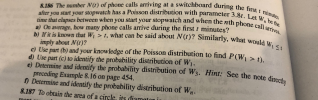 8.186 The number N(t) of phone calls arriving at a switchboard during the first t minutes time that elapses between when you start your stopwatch and when the nth phone call arrives. after you start your stopwatch has a Poisson distribution with parameter 3.8t. Let W be the a) On average, how many phone calls arrive during the first t minutes? b) If it is known that Wi > t, what can be said about N(t)? Similarly, what would Wit...
The number of phone calls arriving at a switchboard can be represented by a Poisson random...
The number of phone calls arriving at a switchboard can be represented by a Poisson random variable. The average number of phone calls per hour is 1.7. (a) Find the probability of getting a total of at least 3 phone calls in the next hour. (b) Find the probability of getting a total of at least 3 phone calls in the next two hours. (c) Find the probability that it is more than 30 minutes until the next call arrives....
The random variable x is the number of the number of calls received by a switchboard....
The random variable x is the number of the number of calls received by a switchboard. Suppose x follows a Poisson distribution and the average number of occurrences in 20 minutes is 2. (1) What is the probability that between 10:00 and 10:30 the switchboard will receive exactly 5 calls? (2) What is the probability that between 10:00 and 10:30 the switchboard will receive more than 2 calls but fewer than 6 calls? Need Help
U JOM U OL- 5.71 Two telephone calls come into a switchboard at random times in...
 U JOM U OL- 5.71 Two telephone calls come into a switchboard at random times in a fixed one-hour period. Assume that the calls are made independently of one another. What is the probability that the calls are made a b in the first half hour? within five minutes of each other?
The average number of calls received by a switchboard in a 30 minute period is 20....
The average number of calls received by a switchboard in a 30 minute period is 20. (A) What is the probability that between 10 and 10:30 the switchboard will recieve exaxtly 5 calls? (B) What is the probability that between 10 and 10:30 the switchboard will recieve more than 9 calls but less than 15 calls? (C) What is the probability that between 10 and 10:30 the switchboard will receive less than 7 calls?
Assg11. The average number of calls received by a switchboard in a 30-minute period is 20...
 Assg11. The average number of calls received by a switchboard in a 30-minute period is 20 a. What is the probability that between 10:00 and 10:30 the switchboard will receive exactly 10 calls? b. What is the probability that between 10:00 and 10:30 the switchboard will receive more than 9 calls but fewer than 15 calls? c. What is the probability that between 10:00 and 10:30 the switchboard will receive fewer than 7 calls?
The time (in minutes) between telephone calls at an insurance claims office has the exponential probability...
 The time (in minutes) between telephone calls at an insurance claims office has the exponential probability distribution: f(x) = 0.20 -0.202 for x 20 a. What is the mean time between telephone calls? Mean time (u) = minutes b. What is the probability of 36 seconds or less between telephone calls? (Note: 36 seconds = 0.60 minutes) If required, round your answer to four decimal places. P(x S 0.60) - c. What is the probability of 3 minute or less...
The number of calls arriving at a switchboard from noon to 1 p.m. during the business...
 The number of calls arriving at a switchboard from noon to 1
p.m. during the business days Monday through Friday is monitored
for six weeks (i.e. 30 days). Let X be defined as the number of
calls during that one-hour period. The relative frequency of calls
was recorded and reported as:
Values 5 6 8 9 10 11 12 13 14 15
Rel. Freq. 0.067 0.067 0.100 0.133 0.200 0.133 0.133 0.067 0.033
0.067
Does the assumption of a Poisson...
The number of calls arriving at a switchboard from noon to 1
p.m. during the business days Monday through Friday is monitored
for six weeks (i.e. 30 days). Let X be defined as the number of
calls during that one-hour period. The relative frequency of calls
was recorded and reported as:
Values 5 6 8 9 10 11 12 13 14 15
Rel. Freq. 0.067 0.067 0.100 0.133 0.200 0.133 0.133 0.067 0.033
0.067
Does the assumption of a Poisson...
The switchboard operator in a large law office receives calls at a rate of 100 per...
The switchboard operator in a large law office receives calls at a rate of 100 per hour according to a Poisson distribution. The average time required to process a call is 30 seconds, exponentially distributed. Assuming that the single-server waiting line model applies, answer the following questions. A. What percentage of the time is the operator busy? B. What is the average time required until the operator answers a call? C. What is the average number of calls waiting to...
Problem 3-33 (Algorithmic) The time (in minutes) between telephone calls at an insurance claims office has the exponent...
 Problem 3-33 (Algorithmic) The time (in minutes) between telephone calls at an insurance claims office has the exponential probability distribution: f(z) 0.40e 0.40s for x 2 0 a. What is the mean time between telephone calls? Mean time (H)- minutes b. what is the probability of 18 seconds or less between telephone calls? (Note: 18 seconds = 0.30 minutes) If required, round your answer to four decimal places. P (x s 0.30)- c. What is the probability of 3 minute...
 8.186 The number N(t) of phone calls arriving at a switchboard during the first t minutes time that elapses between when you start your stopwatch and when the nth phone call arrives. after you start your stopwatch has a Poisson distribution with parameter 3.8t. Let W be the a) On average, how many phone calls arrive during the first t minutes? b) If it is known that Wi > t, what can be said about N(t)? Similarly, what would Wit...
 U JOM U OL- 5.71 Two telephone calls come into a switchboard at random times in a fixed one-hour period. Assume that the calls are made independently of one another. What is the probability that the calls are made a b in the first half hour? within five minutes of each other?
 Assg11. The average number of calls received by a switchboard in a 30-minute period is 20 a. What is the probability that between 10:00 and 10:30 the switchboard will receive exactly 10 calls? b. What is the probability that between 10:00 and 10:30 the switchboard will receive more than 9 calls but fewer than 15 calls? c. What is the probability that between 10:00 and 10:30 the switchboard will receive fewer than 7 calls?
 The time (in minutes) between telephone calls at an insurance claims office has the exponential probability distribution: f(x) = 0.20 -0.202 for x 20 a. What is the mean time between telephone calls? Mean time (u) = minutes b. What is the probability of 36 seconds or less between telephone calls? (Note: 36 seconds = 0.60 minutes) If required, round your answer to four decimal places. P(x S 0.60) - c. What is the probability of 3 minute or less...
 The number of calls arriving at a switchboard from noon to 1
p.m. during the business days Monday through Friday is monitored
for six weeks (i.e. 30 days). Let X be defined as the number of
calls during that one-hour period. The relative frequency of calls
was recorded and reported as:
Values 5 6 8 9 10 11 12 13 14 15
Rel. Freq. 0.067 0.067 0.100 0.133 0.200 0.133 0.133 0.067 0.033
0.067
Does the assumption of a Poisson...
The number of calls arriving at a switchboard from noon to 1
p.m. during the business days Monday through Friday is monitored
for six weeks (i.e. 30 days). Let X be defined as the number of
calls during that one-hour period. The relative frequency of calls
was recorded and reported as:
Values 5 6 8 9 10 11 12 13 14 15
Rel. Freq. 0.067 0.067 0.100 0.133 0.200 0.133 0.133 0.067 0.033
0.067
Does the assumption of a Poisson...
 Problem 3-33 (Algorithmic) The time (in minutes) between telephone calls at an insurance claims office has the exponential probability distribution: f(z) 0.40e 0.40s for x 2 0 a. What is the mean time between telephone calls? Mean time (H)- minutes b. what is the probability of 18 seconds or less between telephone calls? (Note: 18 seconds = 0.30 minutes) If required, round your answer to four decimal places. P (x s 0.30)- c. What is the probability of 3 minute...
Most questions answered within 3 hours.
-
Where is the error in this code sequence?
String s1 = "Hello";
String s2 = "ello";...
asked 11 months ago -
Financial data for Joel de Paris, Inc., for last year
follow:
Joel de Paris, Inc.
Balance...
asked 11 months ago -
Consider this reaction:
Al2(SO4)3 (aq)+ BaCl3
(aq) Al2Cl6 (aq)- +
3BaSO4(s) . What is the...
asked 11 months ago -
Suppose that Savneet is considering increasing her
recent random sample from 20 car rentals to 40...
asked 11 months ago -
Trucks arrive at an unloading terminal at an average rate of 120
per hour.
Trucks arrive...
asked 11 months ago -
Why are methanol and ethanol completely soluble in water while
octanol is not very little soluble....
asked 11 months ago -
A facilities manager at a university reads in a research report
that the mean amount of...
asked 11 months ago -
When the CuSO4 is rehydrated by adding water to the anhydrous
compound, is this an endothermic...
asked 11 months ago -
A ray of sunlight is passing from diamond into crown glass; the
angle of incidence is...
asked 11 months ago -
A block of mass 0.249 kg is placed on top of a light, vertical
spring of...
asked 11 months ago -
how do the kidneys compensate in the presences of acidosis
a) trigger hyperventilate
b) reserve acid...
asked 11 months ago -
Question 501 pts
The rental rate of capital to the firm increases. Which of the
following...
asked 11 months ago