How much aluminum oxide and how much carbon are needed to prepare 395 g of aluminum...
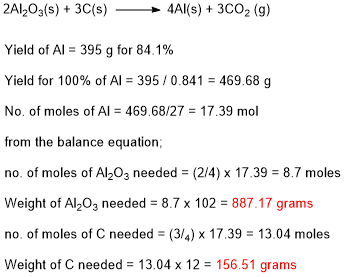
How much aluminum oxide and how much carbon are needed to prepare 395 g of aluminum by the balanced chemical reaction (below) if the reaction proceeds to 84.1 % yield?
2Al2O3(s)+3C(s) 4Al(s)+3CO2(g)
A_ ( ) g Al2O3
B_ ( ) g C
Homework Answers
Add Answer to:
How much aluminum oxide and how much carbon are needed to
prepare 395 g of aluminum...
The extraction of aluminum metal from the aluminum hydroxide in bauxite ore by the Hall-Héroult process...
The extraction of aluminum metal from the aluminum hydroxide in bauxite ore by the Hall-Héroult process is one of the most remarkable success stories of late 19th century practical chemistry, turning aluminum from a rare and precious metal into the cheap commodity it is today. In the first step, aluminum hydroxide reacts to form alumina and water: 2AlOH3 (s) → Al2O3 (s) + 3H2O (g) In the second step, alumina and carbon react to form aluminum and carbon dioxide: 2Al2O3...
The extraction of aluminum metal from the aluminum hydroxide found in bauxite by the Hall-Héroult process...
The extraction of aluminum metal from the aluminum hydroxide found in bauxite by the Hall-Héroult process is one of the most remarkable success stories of 19th century chemistry, turning aluminum from a rare and precious metal into the cheap commodity it is today. In the first step, aluminum hydroxide reacts to form alumina Al2O3 and water: 2AlOH3(s)→ Al2O3(s)+ 3H2O(g) In the second step, alumina Al2O3 and carbon react to form aluminum and carbon dioxide: 2Al2O3(s)+ 3C(s)→ 4Al(s)+ 3CO2(g) Suppose the...
7. Below is the electrolysis of aluminum oxide. How many grams of aluminum oxide is needed...
 7. Below is the electrolysis of aluminum oxide. How many grams of aluminum oxide is needed to make 60.0 g of aluminum? Al2O3(s) electrolysis Al(s) + O2(g) SAL2O3 HAL+. 302 60g . 26.98 -2.22 2.22. 1. 11 mol x101.96 = 1.13 40 g of benzene is mixed with 125 g of bromine. Which is the limiting reagent according nhamical reaction below?
7. Below is the electrolysis of aluminum oxide. How many grams of aluminum oxide is needed...
 7. Below is the electrolysis of aluminum oxide. How many grams of aluminum oxide is needed to make 60.0 g of aluminum? Al(s) + O2(9) Al2O3(s) electrolysis with 125 g of bromine. Which is the limiting reagent according We were unable to transcribe this image
Write the net chemical equation for the production of aluminum from aluminum hydroxide and carbon. Be...
Write the net chemical equation for the production of aluminum from aluminum hydroxide and carbon. Be sure your equation is balanced and proper phases: step 1: 2Al(OH)3 (s) --> Al2O3(s) +3H2O (g) step 2: 2Al2O3(s)+2C(s) --> 3Al(s)+3CO2(g)
If 16.0 grams of aluminum oxide were actually produced, what is the percent yield of the...
If 16.0 grams of aluminum oxide were actually produced, what is the percent yield of the reaction below given that you start with 10.0 g of Al and 19.0 grams of O2? Reaction: 4Al+3O2 yields 2 Al2O3
Consider the reaction for the formation of aluminum oxide from aluminum and oxygen. 4Al(s)+3O2(g)⟶2Al2O3(s) ΔH1
Consider the reaction for the formation of aluminum oxide from aluminum and oxygen.4Al(s)+3O2(g)⟶2Al2O3(s) ΔH11. Express the enthalpy of the following reaction, ΔH2, in terms of ΔH1.2Al2O3(s)⟶4Al(s)+3O2(g) ΔH2ΔH2=2. Express the enthalpy of the following reaction, ΔH3, in terms of ΔH1.12Al(s)+9O2(g)⟶6Al2O3(s) ΔH3 12Al(s)+9O2(g)⟶6Al2O3(s) ΔH3ΔH3=3. Express the enthalpy of the following reaction, ΔH4, in terms of ΔH1.2Al(s)+32O2(g)⟶Al2O3(s) ΔH4 2Al(s)+32O2(g)⟶Al2O3(s) ΔH4ΔH4=
Aluminum oxide (Al2O3) is produced according to the following equation. 4 Al(s) + 3 O2(g) →...
Aluminum oxide (Al2O3) is produced according to the following equation. 4 Al(s) + 3 O2(g) → 2 Al2O3(s) If the reaction occurs with an 82.4% yield, what mass of aluminum should be reacted with excess oxygen to produce 45.0 grams of Al2O3? a. 54.6 g Al b. 37.9 g Al c. 35.1 g Al d. 23.8 g Al e. 28.9 g Al How do we solve this problem
Consider the reaction: 4Al(s) + 3O2(g) →2Al2O3(s). What is the percent yield of aluminum oxide (molar...
Consider the reaction: 4Al(s) + 3O2(g) →2Al2O3(s). What is the percent yield of aluminum oxide (molar mass: 102 g/mol) when 122 g Al react with excess oxygen to produce 185 g of aluminum oxide? A. 86.1 % B. 80.3 % C. 78.5 % D. 66.7 % E. 48.7 %
Aluminum forms a layer of aluminum oxide when exposed to air which protects the bulk metal...
Aluminum forms a layer of aluminum oxide when exposed to air which protects the bulk metal from further corrosion, 4Al(s) + 3O2(g) → 2Al2O3(s). ΔG° for this reaction is ___________ and this reaction is ____________ . ΔG°f (kJ/mol) Al(s) 0 O2(g) 0 Al2O3(s) -1576.4 Select one: a. 0 kJ/mol; at equilibrium b. 3152.8 kJ/mol; spontaneous c. 3152.8 kJ/mol; nonspontaneous d. -3152.8 kJ/mol; spontaneous e. -3152.8 kJ/mol, nonspontaneous
 7. Below is the electrolysis of aluminum oxide. How many grams of aluminum oxide is needed to make 60.0 g of aluminum? Al2O3(s) electrolysis Al(s) + O2(g) SAL2O3 HAL+. 302 60g . 26.98 -2.22 2.22. 1. 11 mol x101.96 = 1.13 40 g of benzene is mixed with 125 g of bromine. Which is the limiting reagent according nhamical reaction below?
 7. Below is the electrolysis of aluminum oxide. How many grams of aluminum oxide is needed to make 60.0 g of aluminum? Al(s) + O2(9) Al2O3(s) electrolysis with 125 g of bromine. Which is the limiting reagent according We were unable to transcribe this image
Most questions answered within 3 hours.
-
Where is the error in this code sequence?
String s1 = "Hello";
String s2 = "ello";...
asked 11 months ago -
Financial data for Joel de Paris, Inc., for last year
follow:
Joel de Paris, Inc.
Balance...
asked 11 months ago -
Consider this reaction:
Al2(SO4)3 (aq)+ BaCl3
(aq) Al2Cl6 (aq)- +
3BaSO4(s) . What is the...
asked 11 months ago -
Suppose that Savneet is considering increasing her
recent random sample from 20 car rentals to 40...
asked 11 months ago -
Trucks arrive at an unloading terminal at an average rate of 120
per hour.
Trucks arrive...
asked 11 months ago -
Why are methanol and ethanol completely soluble in water while
octanol is not very little soluble....
asked 11 months ago -
A facilities manager at a university reads in a research report
that the mean amount of...
asked 11 months ago -
When the CuSO4 is rehydrated by adding water to the anhydrous
compound, is this an endothermic...
asked 11 months ago -
A ray of sunlight is passing from diamond into crown glass; the
angle of incidence is...
asked 11 months ago -
A block of mass 0.249 kg is placed on top of a light, vertical
spring of...
asked 11 months ago -
how do the kidneys compensate in the presences of acidosis
a) trigger hyperventilate
b) reserve acid...
asked 11 months ago -
Question 501 pts
The rental rate of capital to the firm increases. Which of the
following...
asked 11 months ago