
Homework Answers
6)
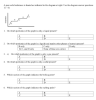
1 is where temperature of solid is increasing
2 is line at which melting is taking place where solid is changing to liquid
This is taking place at 0 oC
So, melting point is 0 oC
1 is where temperature of liquid is increasing
Answer: 0 oC
Add Answer to:
6) The heat curve represents a substance that exists in three phases -solid, Iquid, and gas....
// Chemical potential/phases A substance has three phases: gas, liquid, and solid. The chemical potentials of various phases are illustrated below. T (K) 1) For a given temperature, which of the sta...
 //
Chemical potential/phases A substance has three phases: gas, liquid, and solid. The chemical potentials of various phases are illustrated below. T (K) 1) For a given temperature, which of the states represents an equilibrium condition? Submit 2) If the substance starts out in state Q and is held at constant temperature, what happens if it is allowed to reach equilibrium? The substance will freeze. The substance will evaporate The substance will melt and evaporate. The substance will sublime. Nothing...
//
Chemical potential/phases A substance has three phases: gas, liquid, and solid. The chemical potentials of various phases are illustrated below. T (K) 1) For a given temperature, which of the states represents an equilibrium condition? Submit 2) If the substance starts out in state Q and is held at constant temperature, what happens if it is allowed to reach equilibrium? The substance will freeze. The substance will evaporate The substance will melt and evaporate. The substance will sublime. Nothing...
. 1. Is the melting point of substance A (a) greater than, (b) less than or...
 .
1. Is the melting point of substance A (a) greater than, (b)
less than or (c) equal to the
melting point of substance B?
Explain your reasoning.
2. Is the specific heat of substance A in its solid state (a)
greater than, less than, or (c)
equal to the specific heat of substance B in its solid
state?
Explain your reasoning.
3. Is the latent heat of fusion of substance A (a) greater than,
(b) less than or (c)...
.
1. Is the melting point of substance A (a) greater than, (b)
less than or (c) equal to the
melting point of substance B?
Explain your reasoning.
2. Is the specific heat of substance A in its solid state (a)
greater than, less than, or (c)
equal to the specific heat of substance B in its solid
state?
Explain your reasoning.
3. Is the latent heat of fusion of substance A (a) greater than,
(b) less than or (c)...
Consider the heating curve of a substance in the mebe across the curve. what is happening...
 Consider the heating curve of a substance in the mebe across the curve. what is happening at point 47 Temperature of Substance Heat Added the solid is melting to liquid the temperature of the solid is increasing € ) e https Noregonstate instructure.com/course/1772484/ 25601/ Consider the heating curve of a substance in the image below. Moving from left to right across the curve, what is happening at point 47 Temperature of Substance Heat Added the solidis melting to bud the...
Consider the heating curve of a substance in the image below. Moving from left to right...
 Consider the heating curve of a substance in the image below.
Moving from left to right across the curve, what is happening at
point 3?
4 5 Temperature of Substance 3 2. Heat Added the temperature of the solid is increasing the liquid is evaporating to yield gas O the temperature of the gas is increasing the temperature of the liquid is increasing the solid is melting to liquid
Consider the heating curve of a substance in the image below.
Moving from left to right across the curve, what is happening at
point 3?
4 5 Temperature of Substance 3 2. Heat Added the temperature of the solid is increasing the liquid is evaporating to yield gas O the temperature of the gas is increasing the temperature of the liquid is increasing the solid is melting to liquid
Compare and contrast the three phases of matter and give an example of a substance in...
Compare and contrast the three phases of matter and give an example of a substance in each phase. Based on kinetic molecular theory, what happens to the kinetic energy of the molecules of a substance as it goes from solid to liquid to gas?From a molecular point of view, explain why evaporation is a cooling process. What cools? Give an example.From a molecular point of view, explain why condensation is a warming process. What warms? Give an example.Why is a...
6. Use the phase diagram below to answer the following questions. Pressure (Atmosphere) 45° 60° 100°...
 6. Use the phase diagram below to answer the following questions. Pressure (Atmosphere) 45° 60° 100° 110° Temperature (°C) a. Which section represents the solid phase? b. What section represents the liquid phase? c. What section represents the gas phase? d. What letter represents the triple point? the definition of a triple point? In your own words, what is e. What is this substance's normal melting point, at 1 atmosphere of pressure? f. What is this substance's normal boiling point,...
A pure solid substance is heated as indicated in the diagram at right. Use the diagram...
 A pure solid substance is heated as indicated in the diagram at right. Use the diagram answer questions 1) - 6) Time 1. On which portion(s) of the graph is only a liquid present? B. On which portion(s) of the graph is a liquid (and maybe other phases of matter) present? 2. B only B, C, and D only C only None of these are correct. D only 3. c) On which portion(s) of the graph is only a gas...
6. Shown below is the heating curve for a substance. The five segments of the heating...
 6. Shown below is the heating curve for a substance. The five segments of the heating curve are labeled A-E 130 100 T (°C) heat added (kJ) I. ndicate the phases of matter present when the substance is at each point (A-E) on the heating curve For this substance, which phase of matter has the largest heat capacity? How can you tell? In what state of matter would this substance exist at room temperature? How can you tell? IV. In...
O GASES, LUIDJA Identifying phase transitions on a heating curve A pure v ample of Substance...
 O GASES, LUIDJA Identifying phase transitions on a heating curve A pure v ample of Substance X is put into an evacuated flask. The flask is heated at a ste graph of the results: temperature (°C) heat added (kJ/mol) Use this graph to answer the following questions: What is the melting point of X? Ilc What phase (physical state) of X would you expect to find in the flask after 10 kJ/mol of heat has been added? (check all that...
m Temperature (°C) c Time (minutes) Given: The heating curve above is for a solid substance...
 m Temperature (°C) c Time (minutes) Given: The heating curve above is for a solid substance (at point A) heated until it is a gas at Point F. What is the enthalpy of the substance in the curve going from point D through Point E? (note: I had to type out delta instaed of using the symbol) © - delta Hrus 0 - delta Hyap 0 + delta Hrus + delta Hyap
 //
Chemical potential/phases A substance has three phases: gas, liquid, and solid. The chemical potentials of various phases are illustrated below. T (K) 1) For a given temperature, which of the states represents an equilibrium condition? Submit 2) If the substance starts out in state Q and is held at constant temperature, what happens if it is allowed to reach equilibrium? The substance will freeze. The substance will evaporate The substance will melt and evaporate. The substance will sublime. Nothing...
//
Chemical potential/phases A substance has three phases: gas, liquid, and solid. The chemical potentials of various phases are illustrated below. T (K) 1) For a given temperature, which of the states represents an equilibrium condition? Submit 2) If the substance starts out in state Q and is held at constant temperature, what happens if it is allowed to reach equilibrium? The substance will freeze. The substance will evaporate The substance will melt and evaporate. The substance will sublime. Nothing...
 .
1. Is the melting point of substance A (a) greater than, (b)
less than or (c) equal to the
melting point of substance B?
Explain your reasoning.
2. Is the specific heat of substance A in its solid state (a)
greater than, less than, or (c)
equal to the specific heat of substance B in its solid
state?
Explain your reasoning.
3. Is the latent heat of fusion of substance A (a) greater than,
(b) less than or (c)...
.
1. Is the melting point of substance A (a) greater than, (b)
less than or (c) equal to the
melting point of substance B?
Explain your reasoning.
2. Is the specific heat of substance A in its solid state (a)
greater than, less than, or (c)
equal to the specific heat of substance B in its solid
state?
Explain your reasoning.
3. Is the latent heat of fusion of substance A (a) greater than,
(b) less than or (c)...
 Consider the heating curve of a substance in the mebe across the curve. what is happening at point 47 Temperature of Substance Heat Added the solid is melting to liquid the temperature of the solid is increasing € ) e https Noregonstate instructure.com/course/1772484/ 25601/ Consider the heating curve of a substance in the image below. Moving from left to right across the curve, what is happening at point 47 Temperature of Substance Heat Added the solidis melting to bud the...
 Consider the heating curve of a substance in the image below.
Moving from left to right across the curve, what is happening at
point 3?
4 5 Temperature of Substance 3 2. Heat Added the temperature of the solid is increasing the liquid is evaporating to yield gas O the temperature of the gas is increasing the temperature of the liquid is increasing the solid is melting to liquid
Consider the heating curve of a substance in the image below.
Moving from left to right across the curve, what is happening at
point 3?
4 5 Temperature of Substance 3 2. Heat Added the temperature of the solid is increasing the liquid is evaporating to yield gas O the temperature of the gas is increasing the temperature of the liquid is increasing the solid is melting to liquid
 6. Use the phase diagram below to answer the following questions. Pressure (Atmosphere) 45° 60° 100° 110° Temperature (°C) a. Which section represents the solid phase? b. What section represents the liquid phase? c. What section represents the gas phase? d. What letter represents the triple point? the definition of a triple point? In your own words, what is e. What is this substance's normal melting point, at 1 atmosphere of pressure? f. What is this substance's normal boiling point,...
 A pure solid substance is heated as indicated in the diagram at right. Use the diagram answer questions 1) - 6) Time 1. On which portion(s) of the graph is only a liquid present? B. On which portion(s) of the graph is a liquid (and maybe other phases of matter) present? 2. B only B, C, and D only C only None of these are correct. D only 3. c) On which portion(s) of the graph is only a gas...
 6. Shown below is the heating curve for a substance. The five segments of the heating curve are labeled A-E 130 100 T (°C) heat added (kJ) I. ndicate the phases of matter present when the substance is at each point (A-E) on the heating curve For this substance, which phase of matter has the largest heat capacity? How can you tell? In what state of matter would this substance exist at room temperature? How can you tell? IV. In...
 O GASES, LUIDJA Identifying phase transitions on a heating curve A pure v ample of Substance X is put into an evacuated flask. The flask is heated at a ste graph of the results: temperature (°C) heat added (kJ/mol) Use this graph to answer the following questions: What is the melting point of X? Ilc What phase (physical state) of X would you expect to find in the flask after 10 kJ/mol of heat has been added? (check all that...
 m Temperature (°C) c Time (minutes) Given: The heating curve above is for a solid substance (at point A) heated until it is a gas at Point F. What is the enthalpy of the substance in the curve going from point D through Point E? (note: I had to type out delta instaed of using the symbol) © - delta Hrus 0 - delta Hyap 0 + delta Hrus + delta Hyap
Most questions answered within 3 hours.
-
Where is the error in this code sequence?
String s1 = "Hello";
String s2 = "ello";...
asked 10 months ago -
Financial data for Joel de Paris, Inc., for last year
follow:
Joel de Paris, Inc.
Balance...
asked 10 months ago -
Consider this reaction:
Al2(SO4)3 (aq)+ BaCl3
(aq) Al2Cl6 (aq)- +
3BaSO4(s) . What is the...
asked 10 months ago -
Suppose that Savneet is considering increasing her
recent random sample from 20 car rentals to 40...
asked 10 months ago -
Trucks arrive at an unloading terminal at an average rate of 120
per hour.
Trucks arrive...
asked 10 months ago -
Why are methanol and ethanol completely soluble in water while
octanol is not very little soluble....
asked 10 months ago -
A facilities manager at a university reads in a research report
that the mean amount of...
asked 10 months ago -
When the CuSO4 is rehydrated by adding water to the anhydrous
compound, is this an endothermic...
asked 10 months ago -
A ray of sunlight is passing from diamond into crown glass; the
angle of incidence is...
asked 10 months ago -
A block of mass 0.249 kg is placed on top of a light, vertical
spring of...
asked 10 months ago -
how do the kidneys compensate in the presences of acidosis
a) trigger hyperventilate
b) reserve acid...
asked 10 months ago -
Question 501 pts
The rental rate of capital to the firm increases. Which of the
following...
asked 10 months ago