
Homework Answers
Add Answer to:
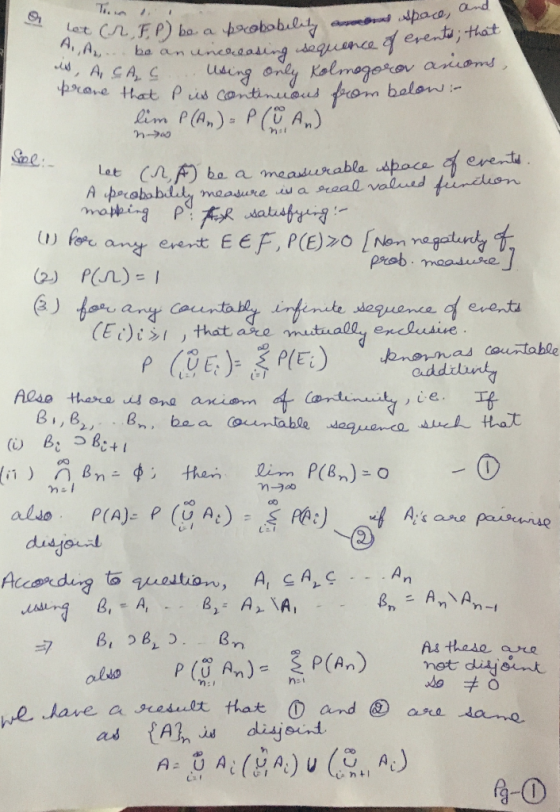
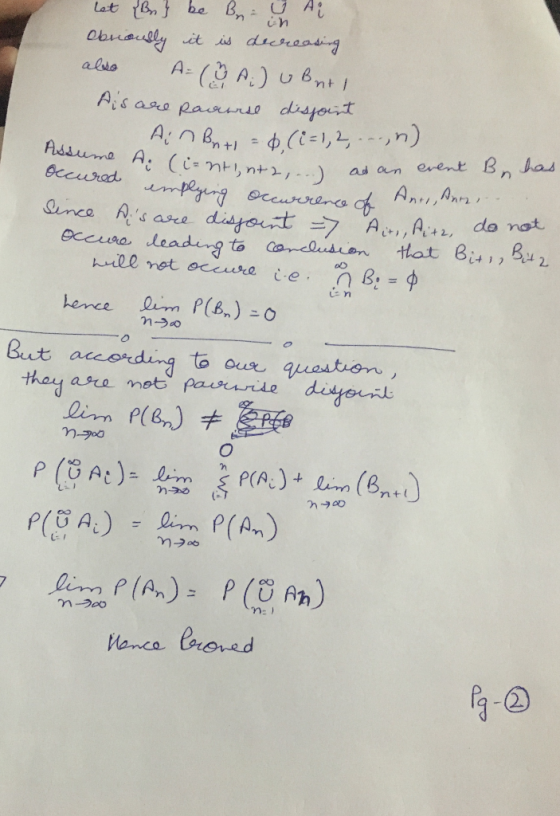
3. Let (12, F,P) be a probability space, and A1, A2, ... be an increasing sequence...
Show: Let A1, A2, ... be a infinitely countable collection of events, then P lim P...
 Show:
Let A1, A2, ... be a infinitely countable collection of events, then P lim P (UA m+00 i=1
Show:
Let A1, A2, ... be a infinitely countable collection of events, then P lim P (UA m+00 i=1
6. Show that if A1, A2, ... is an expanding sequence of events, that is, AC...
 6. Show that if A1, A2, ... is an expanding sequence of events, that is, AC A₂C...... then P(ALU AQU....) = lim P(An). 1-00
Let A1, A2, ...An Prove : P(Un k=1 Ak) = P9A1) + P(A1c ...... Problem 4.Let...
 Let A1, A2, ...An Prove : P(Un k=1 Ak) = P9A1) + P(A1c
......
Problem 4.Let A1, A2, . . . , An be events. Prove
Let A1, A2, ...An Prove : P(Un k=1 Ak) = P9A1) + P(A1c
......
Problem 4.Let A1, A2, . . . , An be events. Prove
LIDO D EDIUL 9. Let A1, A2, ... be a sequence of events. Show that PA...
 LIDO D EDIUL 9. Let A1, A2, ... be a sequence of events. Show that PA A - A) = P(A) - PA A - UAA-2 UAA) for i = 2, 3,.... Hint: You don't need induction to prove this. You can assume, without proof, that A A-2 UA A-2 UAA = A (A-2 UA-2 UA) and A = AB Ü AB
1. Prove“inclusion-exclusion,”thatP(A∪B)=P(A)+P(B)−P(A∩B). 2. Prove the “unionbound, ”thatP(A1∪A2)≤P(A1)+P(A2). Under what conditions does the equality hold? 3. Provethat,...
1. Prove“inclusion-exclusion,”thatP(A∪B)=P(A)+P(B)−P(A∩B). 2. Prove the “unionbound, ”thatP(A1∪A2)≤P(A1)+P(A2). Under what conditions does the equality hold? 3. Provethat, for A1 andA2 disjoint, P(A1∪A2|B)=P(A1|B)+P(A2|B). 4. A and B are independent events with nonzero probability. Prove whether or not A and Bc are independent.
: Let a1, a2, a3, . . . be the sequence of integers defined by a1 = 1 and defined for n ≥ 2 by the recurrence relation a...
: Let a1, a2, a3, . . . be the sequence of integers defined by a1 = 1 and defined for n ≥ 2 by the recurrence relation an = 3an−1 + 1. Using the Principle of Mathematical Induction, prove for all integers n ≥ 1 that an = (3 n − 1) /2 .
Problems 5) Let (X, M, u) be a measure space, and f e Lt. Assume that...
 Problems 5) Let (X, M, u) be a measure space, and f e Lt. Assume that S fdu = 1. Prove that 00, 0<a<1, lim n ln (1 +(${2))a) du(x) = { 1, a = 1, 10. a 1. Hint: Use Fatou's lemma for a < 1 and LDCT for a > 1 (dominate by af). 1+00)
(1) Let a (.. ,a-2, a-1,ao, a1, a2,...) be a sequence of real numbers so that f(n) an. (We may eq...
 (1) Let a (.. ,a-2, a-1,ao, a1, a2,...) be a sequence of real numbers so that f(n) an. (We may equivalently write a = (abez) Consider the homogeneous linear recurrence p(A)/(n) = (A2-A-1)/(n) = 0. (a) Show ak-2-ak-ak-1 for all k z. (b) When we let ao 0 and a 1 we arrive at our usual Fibonacci numbers, f However, given the result from (a) we many consider f-k where k0. Using the Principle of Strong Mathematical Induction slow j-,-(-1...
Problem (5), 10 points Let a0:a1, a2, be a sequence of positive integers for which ao-1, and a2n2...
 Problem (5), 10 points Let a0:a1, a2, be a sequence of positive integers for which ao-1, and a2n2an an+ for n 2 0. Prove that an and an+l are relatively prime for every non-negative integer n. 2n+an for n >0
Problem (5), 10 points Let a0:a1, a2, be a sequence of positive integers for which ao-1, and a2n2an an+ for n 2 0. Prove that an and an+l are relatively prime for every non-negative integer n. 2n+an for n >0
Problem (5), 10 points Let a0:a1, a2, be a sequence of positive integers for which ao-1, and a2n2an an+ for n 2 0. Prove that an and an+l are relatively prime for every non-negative integer n. 2n+an for n >0
(3) Let (2,A, /i) be a measure space. Let f : N > R* be a nonnegative measurable function. Define the sequence fn(x)...
 (3) Let (2,A, /i) be a measure space. Let f : N > R* be a nonnegative measurable function. Define the sequence fn(x) = min{f(x), n}, n E N. Prove that for any A E A f du lim fn du A 4 (You must show that the integrals exist.)
(3) Let (2,A, /i) be a measure space. Let f : N > R* be a nonnegative measurable function. Define the sequence fn(x) = min{f(x), n}, n E N. Prove...
(3) Let (2,A, /i) be a measure space. Let f : N > R* be a nonnegative measurable function. Define the sequence fn(x) = min{f(x), n}, n E N. Prove that for any A E A f du lim fn du A 4 (You must show that the integrals exist.)
(3) Let (2,A, /i) be a measure space. Let f : N > R* be a nonnegative measurable function. Define the sequence fn(x) = min{f(x), n}, n E N. Prove...
 Show:
Let A1, A2, ... be a infinitely countable collection of events, then P lim P (UA m+00 i=1
Show:
Let A1, A2, ... be a infinitely countable collection of events, then P lim P (UA m+00 i=1
 6. Show that if A1, A2, ... is an expanding sequence of events, that is, AC A₂C...... then P(ALU AQU....) = lim P(An). 1-00
 Let A1, A2, ...An Prove : P(Un k=1 Ak) = P9A1) + P(A1c
......
Problem 4.Let A1, A2, . . . , An be events. Prove
Let A1, A2, ...An Prove : P(Un k=1 Ak) = P9A1) + P(A1c
......
Problem 4.Let A1, A2, . . . , An be events. Prove
 LIDO D EDIUL 9. Let A1, A2, ... be a sequence of events. Show that PA A - A) = P(A) - PA A - UAA-2 UAA) for i = 2, 3,.... Hint: You don't need induction to prove this. You can assume, without proof, that A A-2 UA A-2 UAA = A (A-2 UA-2 UA) and A = AB Ü AB
 Problems 5) Let (X, M, u) be a measure space, and f e Lt. Assume that S fdu = 1. Prove that 00, 0<a<1, lim n ln (1 +(${2))a) du(x) = { 1, a = 1, 10. a 1. Hint: Use Fatou's lemma for a < 1 and LDCT for a > 1 (dominate by af). 1+00)
 (1) Let a (.. ,a-2, a-1,ao, a1, a2,...) be a sequence of real numbers so that f(n) an. (We may equivalently write a = (abez) Consider the homogeneous linear recurrence p(A)/(n) = (A2-A-1)/(n) = 0. (a) Show ak-2-ak-ak-1 for all k z. (b) When we let ao 0 and a 1 we arrive at our usual Fibonacci numbers, f However, given the result from (a) we many consider f-k where k0. Using the Principle of Strong Mathematical Induction slow j-,-(-1...
 Problem (5), 10 points Let a0:a1, a2, be a sequence of positive integers for which ao-1, and a2n2an an+ for n 2 0. Prove that an and an+l are relatively prime for every non-negative integer n. 2n+an for n >0
Problem (5), 10 points Let a0:a1, a2, be a sequence of positive integers for which ao-1, and a2n2an an+ for n 2 0. Prove that an and an+l are relatively prime for every non-negative integer n. 2n+an for n >0
Problem (5), 10 points Let a0:a1, a2, be a sequence of positive integers for which ao-1, and a2n2an an+ for n 2 0. Prove that an and an+l are relatively prime for every non-negative integer n. 2n+an for n >0
 (3) Let (2,A, /i) be a measure space. Let f : N > R* be a nonnegative measurable function. Define the sequence fn(x) = min{f(x), n}, n E N. Prove that for any A E A f du lim fn du A 4 (You must show that the integrals exist.)
(3) Let (2,A, /i) be a measure space. Let f : N > R* be a nonnegative measurable function. Define the sequence fn(x) = min{f(x), n}, n E N. Prove...
(3) Let (2,A, /i) be a measure space. Let f : N > R* be a nonnegative measurable function. Define the sequence fn(x) = min{f(x), n}, n E N. Prove that for any A E A f du lim fn du A 4 (You must show that the integrals exist.)
(3) Let (2,A, /i) be a measure space. Let f : N > R* be a nonnegative measurable function. Define the sequence fn(x) = min{f(x), n}, n E N. Prove...
Most questions answered within 3 hours.
-
Where is the error in this code sequence?
String s1 = "Hello";
String s2 = "ello";...
asked 10 months ago -
Financial data for Joel de Paris, Inc., for last year
follow:
Joel de Paris, Inc.
Balance...
asked 10 months ago -
Consider this reaction:
Al2(SO4)3 (aq)+ BaCl3
(aq) Al2Cl6 (aq)- +
3BaSO4(s) . What is the...
asked 10 months ago -
Suppose that Savneet is considering increasing her
recent random sample from 20 car rentals to 40...
asked 10 months ago -
Trucks arrive at an unloading terminal at an average rate of 120
per hour.
Trucks arrive...
asked 10 months ago -
Why are methanol and ethanol completely soluble in water while
octanol is not very little soluble....
asked 10 months ago -
A facilities manager at a university reads in a research report
that the mean amount of...
asked 10 months ago -
When the CuSO4 is rehydrated by adding water to the anhydrous
compound, is this an endothermic...
asked 10 months ago -
A ray of sunlight is passing from diamond into crown glass; the
angle of incidence is...
asked 10 months ago -
A block of mass 0.249 kg is placed on top of a light, vertical
spring of...
asked 10 months ago -
how do the kidneys compensate in the presences of acidosis
a) trigger hyperventilate
b) reserve acid...
asked 10 months ago -
Question 501 pts
The rental rate of capital to the firm increases. Which of the
following...
asked 10 months ago