
Homework Answers
Add Answer to:
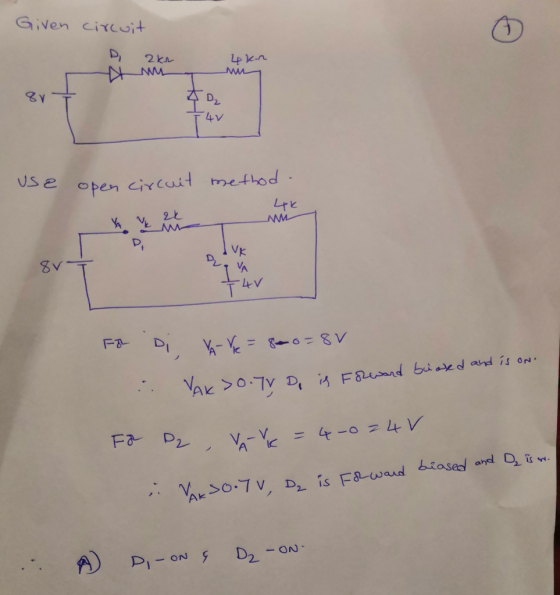
Find the operational state of diodes shown in the figure given below. Assume non-ideal diode model...
For the diodes, use the models shown below; the regular diode model has 0.7V forward bias...
 For the diodes, use the models shown below; the regular diode
model has 0.7V forward bias voltage; the Zener diode model has -3V
breakdown voltage
Question 2 (25 points) For the diodes, use the models shown below; the regular diode model has 0.7V forward bias voltage; the Zener diode model has -3V breakdown voltage. a) Determine the minimum positive value of in to make D1 conduct current. (10 pts) b) Determine the minimum positive value of lin to make D2...
For the diodes, use the models shown below; the regular diode
model has 0.7V forward bias voltage; the Zener diode model has -3V
breakdown voltage
Question 2 (25 points) For the diodes, use the models shown below; the regular diode model has 0.7V forward bias voltage; the Zener diode model has -3V breakdown voltage. a) Determine the minimum positive value of in to make D1 conduct current. (10 pts) b) Determine the minimum positive value of lin to make D2...
Part IIl: Diodes The Ideal-Diode Model a) For the circuit below, find ID and VD for the case VDD 5 V and R 10 k2. Assum...
 Part IIl: Diodes The Ideal-Diode Model a) For the circuit below, find ID and VD for the case VDD 5 V and R 10 k2. Assume that the diode has a voltage of 0.7 V at 1-mA current. Use (a) iteration and (b) the constant-voltage-drop model with VD 0.7 V 홍Yo b) Design the circuit below to provide an output voltage of 2.4 V. Assume that the diodes available have 0.7-V drop at 1 mA. +10 V Vo
Part IIl:...
Part IIl: Diodes The Ideal-Diode Model a) For the circuit below, find ID and VD for the case VDD 5 V and R 10 k2. Assume that the diode has a voltage of 0.7 V at 1-mA current. Use (a) iteration and (b) the constant-voltage-drop model with VD 0.7 V 홍Yo b) Design the circuit below to provide an output voltage of 2.4 V. Assume that the diodes available have 0.7-V drop at 1 mA. +10 V Vo
Part IIl:...
A) Find the Qpoint for the diode using the ideal diode model. B) Find the Qpoint...
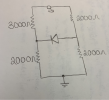 A) Find the Qpoint for the diode using the ideal diode
model.
B) Find the Qpoint for the diode using the constant voltage
drop model with Von=0.6V.
+3 oooA 3000 a000几
A) Find the Qpoint for the diode using the ideal diode
model.
B) Find the Qpoint for the diode using the constant voltage
drop model with Von=0.6V.
+3 oooA 3000 a000几
41) Given the following circuit, determine the voltage across the diode. (Assume ideal silicon diode) [1...
 41) Given the following circuit, determine the voltage across the diode. (Assume ideal silicon diode) [1 mark] a. OV 10 K2 10 k2 b. 4V c. 8V d. 0.7V
This is a Diode constant voltage model - clipping circuits Please explain steps as you solve....
 This is a Diode constant voltage model - clipping
circuits
Please explain steps as you solve. Thank you very much for
your help. please ask if there is anything not clear about the
problem
W (a) For the circuit shown below use the constant voltage diode model (Vp=0.7 V), and find the state of diodes D, and D2 (ie. ON or OFF) and determine the voltage and the current for each. 32k2 OV 5 mA 103=_ ; VD3= 104= ;...
This is a Diode constant voltage model - clipping
circuits
Please explain steps as you solve. Thank you very much for
your help. please ask if there is anything not clear about the
problem
W (a) For the circuit shown below use the constant voltage diode model (Vp=0.7 V), and find the state of diodes D, and D2 (ie. ON or OFF) and determine the voltage and the current for each. 32k2 OV 5 mA 103=_ ; VD3= 104= ;...
2.1- Analyze the circuit shown in figure (2); find the diode states by using ideal- (4...
 2.1- Analyze the circuit shown in figure (2); find the diode states by using ideal- (4 Marks) diode model. Starting by assuming D1 is off and D2 is on. D2 Figure (2)
ideal diodes 2 Assuming ideal diodes, for the diode circuit shown: Select one: a. None of...
 ideal diodes
2 Assuming ideal diodes, for the diode circuit shown: Select one: a. None of these b. The minimum output voltage is +V2 c. The maximum output voltage is -V1 d. The gain is equal to 0 when V is < +V1 and > -V2 e. The gain is equal to O when V is > +V1, or < -v2 Ch
ideal diodes
2 Assuming ideal diodes, for the diode circuit shown: Select one: a. None of these b. The minimum output voltage is +V2 c. The maximum output voltage is -V1 d. The gain is equal to 0 when V is < +V1 and > -V2 e. The gain is equal to O when V is > +V1, or < -v2 Ch
nsider the circult shown on the right. a) Which diodes are forward biased and which are...
 nsider the circult shown on the right. a) Which diodes are forward biased and which are reverse biased? b) Assume 0.7 V drop across each forward- D1 -5V biased diode and find Vo. +5V D2 Vo +5VD3 -5V D4 Two ideal diodes are placed in a circuit shown on the 2. D1 120 D2 60 Va right: a) Determine which diodes conduct and which R 18 5.4V 5V ones do not b) Assume D1 and D2 both conduct. Find Va...
Assume the diode is ideal Determine if the diode is ON or OFf Find the voltage...
 Assume the diode is ideal Determine if the diode is ON or OFf Find the voltage labeled v in the diode circuit below. There will be no partial credit for this problem. Even if your answer is correct, you must show your work to receive points 2 kn 2 k2 T3mA 4V
For the double diode circuit shown in figure 2-1, answer the following questions. In Figure 2-1...
 For the double diode circuit shown in figure 2-1, answer the following questions. In Figure 2-1 a) (10pts) For the triangular wave input shown (Vin), sketch the output voltage (Vout) using the constant voltage drop model (CVD: Vo-0.7V). Be sure to note the voltage values on the y-axis of your Vout plot and show any equations you used to determine those values ime FEE 334: Spring 2019 Midterm b) (2pts) During the middle of the first time segment (when Vin...
 For the diodes, use the models shown below; the regular diode
model has 0.7V forward bias voltage; the Zener diode model has -3V
breakdown voltage
Question 2 (25 points) For the diodes, use the models shown below; the regular diode model has 0.7V forward bias voltage; the Zener diode model has -3V breakdown voltage. a) Determine the minimum positive value of in to make D1 conduct current. (10 pts) b) Determine the minimum positive value of lin to make D2...
For the diodes, use the models shown below; the regular diode
model has 0.7V forward bias voltage; the Zener diode model has -3V
breakdown voltage
Question 2 (25 points) For the diodes, use the models shown below; the regular diode model has 0.7V forward bias voltage; the Zener diode model has -3V breakdown voltage. a) Determine the minimum positive value of in to make D1 conduct current. (10 pts) b) Determine the minimum positive value of lin to make D2...
 Part IIl: Diodes The Ideal-Diode Model a) For the circuit below, find ID and VD for the case VDD 5 V and R 10 k2. Assume that the diode has a voltage of 0.7 V at 1-mA current. Use (a) iteration and (b) the constant-voltage-drop model with VD 0.7 V 홍Yo b) Design the circuit below to provide an output voltage of 2.4 V. Assume that the diodes available have 0.7-V drop at 1 mA. +10 V Vo
Part IIl:...
Part IIl: Diodes The Ideal-Diode Model a) For the circuit below, find ID and VD for the case VDD 5 V and R 10 k2. Assume that the diode has a voltage of 0.7 V at 1-mA current. Use (a) iteration and (b) the constant-voltage-drop model with VD 0.7 V 홍Yo b) Design the circuit below to provide an output voltage of 2.4 V. Assume that the diodes available have 0.7-V drop at 1 mA. +10 V Vo
Part IIl:...
 A) Find the Qpoint for the diode using the ideal diode
model.
B) Find the Qpoint for the diode using the constant voltage
drop model with Von=0.6V.
+3 oooA 3000 a000几
A) Find the Qpoint for the diode using the ideal diode
model.
B) Find the Qpoint for the diode using the constant voltage
drop model with Von=0.6V.
+3 oooA 3000 a000几
 41) Given the following circuit, determine the voltage across the diode. (Assume ideal silicon diode) [1 mark] a. OV 10 K2 10 k2 b. 4V c. 8V d. 0.7V
 This is a Diode constant voltage model - clipping
circuits
Please explain steps as you solve. Thank you very much for
your help. please ask if there is anything not clear about the
problem
W (a) For the circuit shown below use the constant voltage diode model (Vp=0.7 V), and find the state of diodes D, and D2 (ie. ON or OFF) and determine the voltage and the current for each. 32k2 OV 5 mA 103=_ ; VD3= 104= ;...
This is a Diode constant voltage model - clipping
circuits
Please explain steps as you solve. Thank you very much for
your help. please ask if there is anything not clear about the
problem
W (a) For the circuit shown below use the constant voltage diode model (Vp=0.7 V), and find the state of diodes D, and D2 (ie. ON or OFF) and determine the voltage and the current for each. 32k2 OV 5 mA 103=_ ; VD3= 104= ;...
 2.1- Analyze the circuit shown in figure (2); find the diode states by using ideal- (4 Marks) diode model. Starting by assuming D1 is off and D2 is on. D2 Figure (2)
 ideal diodes
2 Assuming ideal diodes, for the diode circuit shown: Select one: a. None of these b. The minimum output voltage is +V2 c. The maximum output voltage is -V1 d. The gain is equal to 0 when V is < +V1 and > -V2 e. The gain is equal to O when V is > +V1, or < -v2 Ch
ideal diodes
2 Assuming ideal diodes, for the diode circuit shown: Select one: a. None of these b. The minimum output voltage is +V2 c. The maximum output voltage is -V1 d. The gain is equal to 0 when V is < +V1 and > -V2 e. The gain is equal to O when V is > +V1, or < -v2 Ch
 nsider the circult shown on the right. a) Which diodes are forward biased and which are reverse biased? b) Assume 0.7 V drop across each forward- D1 -5V biased diode and find Vo. +5V D2 Vo +5VD3 -5V D4 Two ideal diodes are placed in a circuit shown on the 2. D1 120 D2 60 Va right: a) Determine which diodes conduct and which R 18 5.4V 5V ones do not b) Assume D1 and D2 both conduct. Find Va...
 Assume the diode is ideal Determine if the diode is ON or OFf Find the voltage labeled v in the diode circuit below. There will be no partial credit for this problem. Even if your answer is correct, you must show your work to receive points 2 kn 2 k2 T3mA 4V
 For the double diode circuit shown in figure 2-1, answer the following questions. In Figure 2-1 a) (10pts) For the triangular wave input shown (Vin), sketch the output voltage (Vout) using the constant voltage drop model (CVD: Vo-0.7V). Be sure to note the voltage values on the y-axis of your Vout plot and show any equations you used to determine those values ime FEE 334: Spring 2019 Midterm b) (2pts) During the middle of the first time segment (when Vin...
Most questions answered within 3 hours.
-
Where is the error in this code sequence?
String s1 = "Hello";
String s2 = "ello";...
asked 11 months ago -
Financial data for Joel de Paris, Inc., for last year
follow:
Joel de Paris, Inc.
Balance...
asked 11 months ago -
Consider this reaction:
Al2(SO4)3 (aq)+ BaCl3
(aq) Al2Cl6 (aq)- +
3BaSO4(s) . What is the...
asked 11 months ago -
Suppose that Savneet is considering increasing her
recent random sample from 20 car rentals to 40...
asked 11 months ago -
Trucks arrive at an unloading terminal at an average rate of 120
per hour.
Trucks arrive...
asked 11 months ago -
Why are methanol and ethanol completely soluble in water while
octanol is not very little soluble....
asked 11 months ago -
A facilities manager at a university reads in a research report
that the mean amount of...
asked 11 months ago -
When the CuSO4 is rehydrated by adding water to the anhydrous
compound, is this an endothermic...
asked 11 months ago -
A ray of sunlight is passing from diamond into crown glass; the
angle of incidence is...
asked 11 months ago -
A block of mass 0.249 kg is placed on top of a light, vertical
spring of...
asked 11 months ago -
how do the kidneys compensate in the presences of acidosis
a) trigger hyperventilate
b) reserve acid...
asked 11 months ago -
Question 501 pts
The rental rate of capital to the firm increases. Which of the
following...
asked 11 months ago