
Homework Answers
Mix proportioning for a concrete of M30
grade
A·I STIPULATIONS FOR PROPORTIONING
a) Grade designation : M30
b) Type of cement : OPC 53 Grade conforming IS 12269
c) Maximum nominal size of aggregate : 20mm
d) Minimum cement content : 320 kg/m3
e) Maximum water-cement ratio : 0.45
f) Workability : 120mm slump
g) Exposure condition : Moderate (For Reinforced Concrete)
h) Method of concrete placing : Pumping
j) Degree of supervision : Good
k) Type of aggregate : Crushed Angular Aggregates
m) Maximum cement content : 360 kg/m3
n) Chemical admixture type : Super Plasticizer ECMAS HP 890
A-2 TEST DATA FOR MATERIALS
a) Cement used : OPC 53 Grade conforming IS 12269
b) Specific gravity of cement : 3.05
c) Chemical admixture : Super Plasticizer conforming to IS 9103 (ECMAS HP 890)
d) Specific gravity of
1) Coarse aggregate 20mm : 2.67
2) Fine aggregate : 2.65
3) GGBS : 2.84 (JSW)
e) Water absorption:
1) Coarse aggregate : 0.75%
2) Fine aggregate (M.sand) : 1.25%
A-3 TARGET STRENGTH FOR MIX PROPORTIONING
f’ck =fck + 1.65 s
where
f’ck = target average compressive strength at 28 days,
fck = characteristics compressive strength at 28 days, and
s = standard deviation.
Standard Deviation, s = 5 N/mm2. Therefore, target strength = 30 + 1.65 x 5 = 38.25 N/mm2.
A-4 SELECTION OF WATER•CEMENT RATIO
Adopted maximum water-cement ratio = 0.44. From the Table 5 of IS
456 for Very severe Exposure maximum Water Cement Ratio is 0.45
0.44 < 0.45 Hence ok.
A-5 SELECTION OF WATER CONTENT
Maximum water content for 20 mm aggregate = 186 litre (for 25 to 50
mm slump range) Estimated water content for 100 mm slump = 186+
(6/186) = 197 litre.
(Note: If Super plasticizer is used, the water content can be reduced upto 20% and above.)
Based on trials with Super plasticizer water content reduction of 20% has been achieved, Hence the arrived water content = 197-[197 x (20/100)] = 158 litre.
A-6 CALCULATION OF CEMENT CONTENT
Adopted w/c Ratio = 0.44
Cement Content = 158/0.44 = 359 kg/m3
From Table 5 of IS 456, Minimum cement content for ‘Moderate’
exposure conditions 320kg/m3
= 359 kg/m3 > 340 kg/m3 hence ok.
A-7 PROPORTIO0N OF VOLUME OF COARSE AGGREGATE AND FINE
AGGREGATE CONTENT
Volume of coarse aggregate corresponding to 20 mm size aggregate
and fine aggregate (Zone II) for water-cement ratio of 0.50 =0.62
.
In the present case water-cement ratio is 0.44. Therefore, volume of coarse aggregate is required to be increased to decrease the fine aggregate content. As the water-cement ratio is lower by 0.06. The proportion of volume of coarse aggregate is increased by 0.02 (at the rate of -/+ 0.01 for every ± 0.05 change in water-cement ratio).
Therefore, corrected proportion of volume of coarse aggregate for the water-cement ratio of 0.44 = 0.64
NOTE – In case the coarse aggregate is not angular one, then also volume of coarse aggregate may be required to be increased suitably based on experience & Site conditions.
For pumpable concrete these values should be reduced up to 10%. Therefore, volume of coarse aggregate =0.64 x 0.9 =0.576.
Volume of fine aggregate content = 1 – 0.576= 0.424.
A-8 MIX CALCULATIONS
The mix calculations per unit volume of concrete shall be as
follows:
a) Volume of concrete = 1 m3
b) Volume of cement = [Mass of cement] / {[Specific Gravity of
Cement] x 1000}
= 359/{3.05 x 1000}
= 0.117m3
c) Volume of water = [Mass of water] / {[Specific Gravity of
water] x 1000}
= 158/{1 x 1000}
= 0.158m3
d) Volume of chemical admixture = 1.75 litres/ m3 (By Trial and Error Method used 0.4% by the weight cement)
e) Volume of all in aggregate = [a-(b+c+d)]
= [1-(0.114+0.158+0.004)]
= 0.724m3
f) Mass of coarse aggregate= e x Volume of Coarse Aggregate x
Specific Gravity of Fine Aggregate x 1000
= 0.724x 0.576 x 2.67 x 1000
= 1113 kg/m3
g) Mass of fine aggregate= e x Volume of Fine Aggregate x
Specific Gravity of Fine Aggregate x 1000
= 0.724x 0.576x 2.60 x 1000
= 798 kg/m3
A-9 MIX PROPORTIONS
Cement = 359 kg/m3
GGBS = 72 kg/m3 (20% By Total weight of Cement)
Water = 158 l/m3
Fine aggregate = 798 kg/m3 Coarse aggregate 20mm = 882 kg/m3
12mm = 223 kg/m3 (20% By Total weight of Coarse Aggregate)
Chemical admixture = 1.34 kg/m3 (0.4% by the weight of
cement)
Density of concrete = 2430 kg/m3
Water-cement ratio = 0.47
Mix Proportion By weight = 1:2.21:3.09
NOTE – Aggregates should be used in saturated surface dry condition. If otherwise, when computing the requirement of mixing water, allowance shall be made for the free (surface) moisture contributed by the fine and coarse aggregates. On the other hand, if the aggregates are dry the amount of mixing water should be increased by an amount equal to the moisture likely to be absorbed by the aggregates. Necessary adjustments are also required to be made In mass of aggregates. The surface water and percent water absorption of aggregates shall be determined
A-10 The slump shall he measured and the water content and dosage of admixture shall be adjusted for achieving the required s lump based on trial , if required. The mix proportions shall he reworked for the actual water content and checked for durability requirements.
Add Answer to:
Mix Design -2: Grade : M30 Workability : 120mm Specific gravity of Cement: 3.05 Specific gravity...
Find field mix proportions =? Date Concrete is used for foundation – mild exposure Specified compressive...
Find field mix proportions =? Date Concrete is used for foundation – mild exposure Specified compressive strength of concrete = 3000 psi Cement type I Maximum size of coarse aggregate = 1 and ½ inch Specific gravity of coarse aggregate = 2.69 Absorption capacity CA = 0.8 % Moisture content of CA = 2 % Dry – rodded weight CA = 105 pcf Specific gravity of Fine Aggregate = 2.65 Absorption capacity FA = 6% Moisture content of FA =...
please help with this concrete design mix problem (40 points) Design the concrete mix according to...
 please help with this concrete design mix problem
(40 points) Design the concrete mix according to the following conditions. Perform the necessary computations to determine all ingredients in (kg) per unit volume of mix, and state resources and cite references used for each step. Summarize your design in the table at the bottom, and answer the questions beneath the table. Application Environment Area 52, airport location Idaho, (150m x 50m) runway test section Exposures: freeze-thaw, deicers Design Environment Concrete Requirements:...
please help with this concrete design mix problem
(40 points) Design the concrete mix according to the following conditions. Perform the necessary computations to determine all ingredients in (kg) per unit volume of mix, and state resources and cite references used for each step. Summarize your design in the table at the bottom, and answer the questions beneath the table. Application Environment Area 52, airport location Idaho, (150m x 50m) runway test section Exposures: freeze-thaw, deicers Design Environment Concrete Requirements:...
10. You are working on a concrete mix design that requires each cubic meter of concrete...
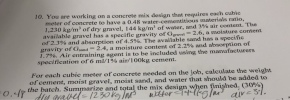 10. You are working on a concrete mix design that requires each cubic meter of concrete to have a 0.48 water-cementitious materials r atio, 1,230 kg/m' of dry gravel, 144 kg/m3 of water, and 3% air content. The available gravel has a specific gravity of Ggravel 2.6, a moisture content of2.3% and absorption of 4.5%. The available sand has a specific gravity of Gsand-2.4, a moisture content of 2.2% and absorption of 1.7%. Air entraining agent is to be included...
NEC2103-Engineering Materials and Construction Example Mix Design Problems Question 2. Design a concrete mix using...
 NEC2103-Engineering Materials and Construction Example Mix Design Problems Question 2. Design a concrete mix using fly ash from the following data for use as fly ash concrete blocks. Use the British DOE method to calculate the required amounts (in kg/m') of water, cement, course aggregate and fine aggregate. Characteristic 28 days mean strength 25 MPa Risk factor may be taken =1.65 Standard deviation = 5.0 The max. size of coarse, aggregate C.A. = 20 mm 40% F.A. passes through 600...
Please show which equations you use and describe in detail. 21. concrete mix design, Design the...
 Please show which equations
you use and describe in detail.
21. concrete mix design, Design the concrete mix according to the following conditions: Design Environment Unreinforced slab, Bozeman, Montana (cold climate) Required design strength = 3500 psi Slab thickness = 12 in Statistical data indicate a standard deviation of compressive strength of 250 psi is expected (more than 30 samples). Only air entrainer is allowed Available materials Air entrainer: manufacture specification is 0.15 fl oz/1%/100 lb cement Coarse aggregate: 2...
Please show which equations
you use and describe in detail.
21. concrete mix design, Design the concrete mix according to the following conditions: Design Environment Unreinforced slab, Bozeman, Montana (cold climate) Required design strength = 3500 psi Slab thickness = 12 in Statistical data indicate a standard deviation of compressive strength of 250 psi is expected (more than 30 samples). Only air entrainer is allowed Available materials Air entrainer: manufacture specification is 0.15 fl oz/1%/100 lb cement Coarse aggregate: 2...
Design the concrete mix according to the following conditions: Design Environment Pavement slab, Bozeman, Montana (cold...
 Design the concrete mix according to the following conditions: Design Environment Pavement slab, Bozeman, Montana (cold climate) Required design strength = 3000 psi Slab thickness = 12 in. Statistical data indicate a standard deviation of compressive strength of 250 psi is expected (more than 30 samples). Only air entrainer is allowed. Available Materials Air entrainer: Manufacture specification is 0.15 fl oz/1% air/100 lb cement. Coarse aggregate: 2 in. nominal maximum size, crushed stone Bulk oven-dry specific gravity = 2.573, absorption...
Question 10 The aggregate mix used percent coarse aggregates, 52 percent fine aggregates, respective bulk specific...
 Question 10 The aggregate mix used percent coarse aggregates, 52 percent fine aggregates, respective bulk specific gravities of these mate specific gravity from this total mix) are as follows: for the design of an asphalt concrete mixture consists of 40 and 8 percent mineral fillers. The rials are 2.680, 2.720, and 2.830. The of the asphalt cement is 1.020. Results of tests on specimens prepa aggregate combination and various percentages of ent (by weight of Weight of Specimen (g) Asphln...
Name ent VENT Activity 25-2-Specific Gravity Measurem It is desired to measure the specific gravity of...
 Name ent VENT Activity 25-2-Specific Gravity Measurem It is desired to measure the specific gravity of a process fluid in a vessel using a differential pressure transmitter. The process fluid may have any specific gravity in the range of 1.050 to 1.150. The upper and ower d/p cell connections are below the overflow level in the vessel. The distance between the two connections is 96". The process fluid is corrosive to the d/p cell, but it is compatible with water,...
Problem 2 Samples of coarse aggregate (CA) are collected at a stockpile and submitted for lab testing to determine their specific gravities. Tests were completed in accordance with ASTM C127-12 a...
 Problem 2 Samples of coarse aggregate (CA) are collected at a stockpile and submitted for lab testing to determine their specific gravities. Tests were completed in accordance with ASTM C127-12 and the following masses are found: Mass Property 6,296 6,214 4,293 Mass of moist aggregate sample as submitted: Mass of oven-dried aggregate: Mass of aggregates submerged in water: Mass of SSD (Saturated Surface Dry) aggregate: 6,227 Using this data find the following: a) Aggregate bulk dry specific gravity b) Aggregate...
Case Study N.G. is a 21-year-old year-old college student who is admitted to the hospital with...
 Case Study N.G. is a 21-year-old year-old college student who is admitted to the hospital with a diagnosis acute poststreptococcal glomerulonephritis. He was seen at the college's student neam center because of swelling around his eyes and rusty-colored urine. His history based on medical records from the student health center indicates that he had a sore throat several weeks ago that he ignored because it resolved in 4 to 5 days. His past medical history positive for type 1 diabetes...
 please help with this concrete design mix problem
(40 points) Design the concrete mix according to the following conditions. Perform the necessary computations to determine all ingredients in (kg) per unit volume of mix, and state resources and cite references used for each step. Summarize your design in the table at the bottom, and answer the questions beneath the table. Application Environment Area 52, airport location Idaho, (150m x 50m) runway test section Exposures: freeze-thaw, deicers Design Environment Concrete Requirements:...
please help with this concrete design mix problem
(40 points) Design the concrete mix according to the following conditions. Perform the necessary computations to determine all ingredients in (kg) per unit volume of mix, and state resources and cite references used for each step. Summarize your design in the table at the bottom, and answer the questions beneath the table. Application Environment Area 52, airport location Idaho, (150m x 50m) runway test section Exposures: freeze-thaw, deicers Design Environment Concrete Requirements:...
 10. You are working on a concrete mix design that requires each cubic meter of concrete to have a 0.48 water-cementitious materials r atio, 1,230 kg/m' of dry gravel, 144 kg/m3 of water, and 3% air content. The available gravel has a specific gravity of Ggravel 2.6, a moisture content of2.3% and absorption of 4.5%. The available sand has a specific gravity of Gsand-2.4, a moisture content of 2.2% and absorption of 1.7%. Air entraining agent is to be included...
 NEC2103-Engineering Materials and Construction Example Mix Design Problems Question 2. Design a concrete mix using fly ash from the following data for use as fly ash concrete blocks. Use the British DOE method to calculate the required amounts (in kg/m') of water, cement, course aggregate and fine aggregate. Characteristic 28 days mean strength 25 MPa Risk factor may be taken =1.65 Standard deviation = 5.0 The max. size of coarse, aggregate C.A. = 20 mm 40% F.A. passes through 600...
 Please show which equations
you use and describe in detail.
21. concrete mix design, Design the concrete mix according to the following conditions: Design Environment Unreinforced slab, Bozeman, Montana (cold climate) Required design strength = 3500 psi Slab thickness = 12 in Statistical data indicate a standard deviation of compressive strength of 250 psi is expected (more than 30 samples). Only air entrainer is allowed Available materials Air entrainer: manufacture specification is 0.15 fl oz/1%/100 lb cement Coarse aggregate: 2...
Please show which equations
you use and describe in detail.
21. concrete mix design, Design the concrete mix according to the following conditions: Design Environment Unreinforced slab, Bozeman, Montana (cold climate) Required design strength = 3500 psi Slab thickness = 12 in Statistical data indicate a standard deviation of compressive strength of 250 psi is expected (more than 30 samples). Only air entrainer is allowed Available materials Air entrainer: manufacture specification is 0.15 fl oz/1%/100 lb cement Coarse aggregate: 2...
 Design the concrete mix according to the following conditions: Design Environment Pavement slab, Bozeman, Montana (cold climate) Required design strength = 3000 psi Slab thickness = 12 in. Statistical data indicate a standard deviation of compressive strength of 250 psi is expected (more than 30 samples). Only air entrainer is allowed. Available Materials Air entrainer: Manufacture specification is 0.15 fl oz/1% air/100 lb cement. Coarse aggregate: 2 in. nominal maximum size, crushed stone Bulk oven-dry specific gravity = 2.573, absorption...
 Question 10 The aggregate mix used percent coarse aggregates, 52 percent fine aggregates, respective bulk specific gravities of these mate specific gravity from this total mix) are as follows: for the design of an asphalt concrete mixture consists of 40 and 8 percent mineral fillers. The rials are 2.680, 2.720, and 2.830. The of the asphalt cement is 1.020. Results of tests on specimens prepa aggregate combination and various percentages of ent (by weight of Weight of Specimen (g) Asphln...
 Name ent VENT Activity 25-2-Specific Gravity Measurem It is desired to measure the specific gravity of a process fluid in a vessel using a differential pressure transmitter. The process fluid may have any specific gravity in the range of 1.050 to 1.150. The upper and ower d/p cell connections are below the overflow level in the vessel. The distance between the two connections is 96". The process fluid is corrosive to the d/p cell, but it is compatible with water,...
 Problem 2 Samples of coarse aggregate (CA) are collected at a stockpile and submitted for lab testing to determine their specific gravities. Tests were completed in accordance with ASTM C127-12 and the following masses are found: Mass Property 6,296 6,214 4,293 Mass of moist aggregate sample as submitted: Mass of oven-dried aggregate: Mass of aggregates submerged in water: Mass of SSD (Saturated Surface Dry) aggregate: 6,227 Using this data find the following: a) Aggregate bulk dry specific gravity b) Aggregate...
 Case Study N.G. is a 21-year-old year-old college student who is admitted to the hospital with a diagnosis acute poststreptococcal glomerulonephritis. He was seen at the college's student neam center because of swelling around his eyes and rusty-colored urine. His history based on medical records from the student health center indicates that he had a sore throat several weeks ago that he ignored because it resolved in 4 to 5 days. His past medical history positive for type 1 diabetes...
Most questions answered within 3 hours.
-
Where is the error in this code sequence?
String s1 = "Hello";
String s2 = "ello";...
asked 10 months ago -
Financial data for Joel de Paris, Inc., for last year
follow:
Joel de Paris, Inc.
Balance...
asked 10 months ago -
Consider this reaction:
Al2(SO4)3 (aq)+ BaCl3
(aq) Al2Cl6 (aq)- +
3BaSO4(s) . What is the...
asked 10 months ago -
Suppose that Savneet is considering increasing her
recent random sample from 20 car rentals to 40...
asked 10 months ago -
Trucks arrive at an unloading terminal at an average rate of 120
per hour.
Trucks arrive...
asked 10 months ago -
Why are methanol and ethanol completely soluble in water while
octanol is not very little soluble....
asked 10 months ago -
A facilities manager at a university reads in a research report
that the mean amount of...
asked 10 months ago -
When the CuSO4 is rehydrated by adding water to the anhydrous
compound, is this an endothermic...
asked 10 months ago -
A ray of sunlight is passing from diamond into crown glass; the
angle of incidence is...
asked 10 months ago -
A block of mass 0.249 kg is placed on top of a light, vertical
spring of...
asked 10 months ago -
how do the kidneys compensate in the presences of acidosis
a) trigger hyperventilate
b) reserve acid...
asked 10 months ago -
Question 501 pts
The rental rate of capital to the firm increases. Which of the
following...
asked 10 months ago