This is for a polymer lab. Please answer all parts of the
questions clearly and explain thoroughly. Thank You!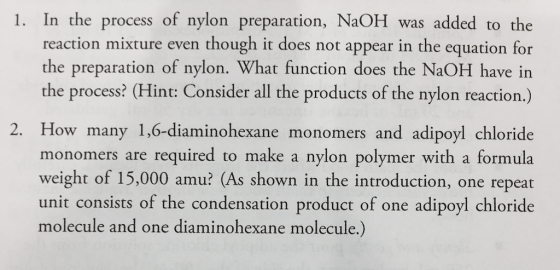
Homework Answers
 As 67.2 i.e . 63 dimer units
are present.
As 67.2 i.e . 63 dimer units
are present.
So, 63 molecules each of hexamethylene diammine and adipoyl chloride would be required
Add Answer to:
This is for a polymer lab. Please answer all parts of the
questions clearly and explain...
please help with all the questions Meisa Taha 2. Define each term: addition (polymer), block (polymer), copolymer. Draw (in correct format) an addition block copolymer in the space below. Indicate...
 please help with all the questions
Meisa Taha 2. Define each term: addition (polymer), block (polymer), copolymer. Draw (in correct format) an addition block copolymer in the space below. Indicate which monomers are used in the polymerization, and which parts are repeated in the polymer structure. 5 points 3 Condensation polymer. 6 points. e one example of a condensation polymer. Do not use "R" groups NOT NYLON. b. Show the monomer(s), polymer, and label the repeat unit. c. Provide a...
please help with all the questions
Meisa Taha 2. Define each term: addition (polymer), block (polymer), copolymer. Draw (in correct format) an addition block copolymer in the space below. Indicate which monomers are used in the polymerization, and which parts are repeated in the polymer structure. 5 points 3 Condensation polymer. 6 points. e one example of a condensation polymer. Do not use "R" groups NOT NYLON. b. Show the monomer(s), polymer, and label the repeat unit. c. Provide a...
please answer all the questions ! Question 16 Consider the Carvacrol molecule below and determine which...
 please answer all the questions !
Question 16 Consider the Carvacrol molecule below and determine which class of terpenes it belongs in. OH monoterpene tetraterpene diterpene triterpene sesquiterpene Question 19 Predict the products when triacontyl hexadecanoate, a major component of beeswax, is treated with aqueous NaOH. CHỊCH, CHỊCH,CH, NaOH, Q. CHICHICOH CHACH.COM CHACH. ONA HACH MACONI CH3(CH2)14 COH + CH3(CH2)28CH2ONa CH3(CH2)14COH + CH3(CH2)28CH2OH I 11 CH3(CH2)14CNa + CH3(CH2)28CH2OH CH3(CH2)14CONa + CH3(CH2)28CH2OH IV II O O O O III IV none...
please answer all the questions !
Question 16 Consider the Carvacrol molecule below and determine which class of terpenes it belongs in. OH monoterpene tetraterpene diterpene triterpene sesquiterpene Question 19 Predict the products when triacontyl hexadecanoate, a major component of beeswax, is treated with aqueous NaOH. CHỊCH, CHỊCH,CH, NaOH, Q. CHICHICOH CHACH.COM CHACH. ONA HACH MACONI CH3(CH2)14 COH + CH3(CH2)28CH2ONa CH3(CH2)14COH + CH3(CH2)28CH2OH I 11 CH3(CH2)14CNa + CH3(CH2)28CH2OH CH3(CH2)14CONa + CH3(CH2)28CH2OH IV II O O O O III IV none...
please answee all 3 pages! they are multiple choice 3. Answer the following questions. Clearly mark...
 please answee all 3 pages! they are multiple choice
3. Answer the following questions. Clearly mark your answer. (1 point each: 25 points total) a. Circle the substrate that will give 4 different products when reacted fully under hydroboration-oxidation conditions. b. Circle the substrate that will not result in a tertiary alkyl chloride when treated with HCI. C. Circle the alkene that can be most easily formed under unimolecular elimination d. Circle the alkene that will react fastest with m-chloroperoxybenzoic...
please answee all 3 pages! they are multiple choice
3. Answer the following questions. Clearly mark your answer. (1 point each: 25 points total) a. Circle the substrate that will give 4 different products when reacted fully under hydroboration-oxidation conditions. b. Circle the substrate that will not result in a tertiary alkyl chloride when treated with HCI. C. Circle the alkene that can be most easily formed under unimolecular elimination d. Circle the alkene that will react fastest with m-chloroperoxybenzoic...
**PLEASE ANSWER ALL QUESTIONS AND EXPLAIN ** TUTORIAL 7. GROUP 16 ELEMENTS 1. What are the...
 **PLEASE ANSWER ALL QUESTIONS AND EXPLAIN **
TUTORIAL 7. GROUP 16 ELEMENTS 1. What are the two commercial methods for the preparation of oxygen? 2. Give an example of an acidic oxide and a basic oxide. 3. Name the allotropes of oxygen and sulphur and discuss how they can he 4. Give uses of the following: SO2, Na2S20s and H2SO4. 5. Give equations for the steps in the contact process for the manufacture o 6. Write equations for the following:...
**PLEASE ANSWER ALL QUESTIONS AND EXPLAIN **
TUTORIAL 7. GROUP 16 ELEMENTS 1. What are the two commercial methods for the preparation of oxygen? 2. Give an example of an acidic oxide and a basic oxide. 3. Name the allotropes of oxygen and sulphur and discuss how they can he 4. Give uses of the following: SO2, Na2S20s and H2SO4. 5. Give equations for the steps in the contact process for the manufacture o 6. Write equations for the following:...
all 4 questions. plz mark the answer clearly. For the Following Questions: Consider the reaction of...
 all 4 questions. plz mark the answer clearly.
For the Following Questions: Consider the reaction of Fe(NO3)2 (aq) and KOH(aq). Follow each part to find the correct Molecular, Complete lonic, and Net lonic Equation for this reaction. Solubility rules are very useful when determining the physical states of the products. Solubility Rules for Ionic Compounds Substance Na, K, NHA, NO; SO4 CI, Br",r Ag ОН Rules Ionic compounds which contain these ions are soluble. Most ionic compounds containing sulfate are...
all 4 questions. plz mark the answer clearly.
For the Following Questions: Consider the reaction of Fe(NO3)2 (aq) and KOH(aq). Follow each part to find the correct Molecular, Complete lonic, and Net lonic Equation for this reaction. Solubility rules are very useful when determining the physical states of the products. Solubility Rules for Ionic Compounds Substance Na, K, NHA, NO; SO4 CI, Br",r Ag ОН Rules Ionic compounds which contain these ions are soluble. Most ionic compounds containing sulfate are...
Please and all three questions and explain how you got to your answer. I'm really lost...
 Please and all three questions
and explain how you got to your answer. I'm really lost and I have
an exam in 7 days! A step by step would be appreciated.
1.(4 points) Predict the order of radical stability (1 = most stable; 4 = least stable). 2. (4 points) Based on the pka data circle the molecule that is most acidic. Explain your answer. RE-H R-C-R RH pka 25 pka 45 pka 50 3. (4 points) Briefly explain why...
Please and all three questions
and explain how you got to your answer. I'm really lost and I have
an exam in 7 days! A step by step would be appreciated.
1.(4 points) Predict the order of radical stability (1 = most stable; 4 = least stable). 2. (4 points) Based on the pka data circle the molecule that is most acidic. Explain your answer. RE-H R-C-R RH pka 25 pka 45 pka 50 3. (4 points) Briefly explain why...
please answer all the parts Supplemental Questions - Titration Lab, 1. Indicate how each of the...
 please answer all the parts
Supplemental Questions - Titration Lab, 1. Indicate how each of the following would affect the values of K, for the weak acid unknown and for the dibasic salt and the value of the molar mass for the dibasic salt (Would the determined values be higher or lower than the actual values?). Use larger, smaller or no change. And as always....Explain. a. The titrant (either the NaOH or the HCI) molarity is actually HIGHER than that...
please answer all the parts
Supplemental Questions - Titration Lab, 1. Indicate how each of the following would affect the values of K, for the weak acid unknown and for the dibasic salt and the value of the molar mass for the dibasic salt (Would the determined values be higher or lower than the actual values?). Use larger, smaller or no change. And as always....Explain. a. The titrant (either the NaOH or the HCI) molarity is actually HIGHER than that...
please answer all the questions and explain and write clearly what do you mean this is...
 please answer all the questions and explain and write
clearly
what do you mean this is all the complete question I have
there is nothing else
You are interested in studying the neurological effects of dehydrogenated brominate oil, a food additive. You randomly select 25 Sprague-Dawley rats and add a dosage to their drinking water. Because the additive is odorless and colorless, the rats readily consume it. After six months you sacrifice the rats, microsection their brains and count the...
please answer all the questions and explain and write
clearly
what do you mean this is all the complete question I have
there is nothing else
You are interested in studying the neurological effects of dehydrogenated brominate oil, a food additive. You randomly select 25 Sprague-Dawley rats and add a dosage to their drinking water. Because the additive is odorless and colorless, the rats readily consume it. After six months you sacrifice the rats, microsection their brains and count the...
prelab /postlab all questions please Questions 1. For the reaction at 20°C, NH3(aq) + H+ (aq)...
 prelab /postlab all questions please
Questions 1. For the reaction at 20°C, NH3(aq) + H+ (aq) NH4(aq), the equilibrium constant is calculated to be K = to 4.5 x10%. CHAT] A. Write the Equilibrium expression for this reaction. Keq = ỞNH TH] B. From the size of the number for Keq, does the equilibrium lie to the left or to the right? Right 2. If the reaction between iron(III) ion and thiocyanate ion, Fe3+ (aq) + SCN (aq) → FeSCN2+(aq),...
prelab /postlab all questions please
Questions 1. For the reaction at 20°C, NH3(aq) + H+ (aq) NH4(aq), the equilibrium constant is calculated to be K = to 4.5 x10%. CHAT] A. Write the Equilibrium expression for this reaction. Keq = ỞNH TH] B. From the size of the number for Keq, does the equilibrium lie to the left or to the right? Right 2. If the reaction between iron(III) ion and thiocyanate ion, Fe3+ (aq) + SCN (aq) → FeSCN2+(aq),...
Experiment: A mixture of equal proportions of benzoic acid, ethyl 4-aminobenzoate, and 1,4-dimethoxybenzene are to be...
Experiment: A mixture of equal proportions of benzoic acid, ethyl 4-aminobenzoate, and 1,4-dimethoxybenzene are to be separated by extraction using the solvent diethyl ether. Day 1: Part A. Isolation of the basic component: In a small beaker, dissolve 3 g of the mixture (benzoic acid, ethyl 4-aminobenzoate, and 1,4-dimethoxybenzene) in 30 mL of diethyl ether and transfer the mixture to a 125- mL separatory funnel (see Fig. 1) using a little diethyl ether to complete the transfer. Add 10 mL...
 please help with all the questions
Meisa Taha 2. Define each term: addition (polymer), block (polymer), copolymer. Draw (in correct format) an addition block copolymer in the space below. Indicate which monomers are used in the polymerization, and which parts are repeated in the polymer structure. 5 points 3 Condensation polymer. 6 points. e one example of a condensation polymer. Do not use "R" groups NOT NYLON. b. Show the monomer(s), polymer, and label the repeat unit. c. Provide a...
please help with all the questions
Meisa Taha 2. Define each term: addition (polymer), block (polymer), copolymer. Draw (in correct format) an addition block copolymer in the space below. Indicate which monomers are used in the polymerization, and which parts are repeated in the polymer structure. 5 points 3 Condensation polymer. 6 points. e one example of a condensation polymer. Do not use "R" groups NOT NYLON. b. Show the monomer(s), polymer, and label the repeat unit. c. Provide a...
 please answer all the questions !
Question 16 Consider the Carvacrol molecule below and determine which class of terpenes it belongs in. OH monoterpene tetraterpene diterpene triterpene sesquiterpene Question 19 Predict the products when triacontyl hexadecanoate, a major component of beeswax, is treated with aqueous NaOH. CHỊCH, CHỊCH,CH, NaOH, Q. CHICHICOH CHACH.COM CHACH. ONA HACH MACONI CH3(CH2)14 COH + CH3(CH2)28CH2ONa CH3(CH2)14COH + CH3(CH2)28CH2OH I 11 CH3(CH2)14CNa + CH3(CH2)28CH2OH CH3(CH2)14CONa + CH3(CH2)28CH2OH IV II O O O O III IV none...
please answer all the questions !
Question 16 Consider the Carvacrol molecule below and determine which class of terpenes it belongs in. OH monoterpene tetraterpene diterpene triterpene sesquiterpene Question 19 Predict the products when triacontyl hexadecanoate, a major component of beeswax, is treated with aqueous NaOH. CHỊCH, CHỊCH,CH, NaOH, Q. CHICHICOH CHACH.COM CHACH. ONA HACH MACONI CH3(CH2)14 COH + CH3(CH2)28CH2ONa CH3(CH2)14COH + CH3(CH2)28CH2OH I 11 CH3(CH2)14CNa + CH3(CH2)28CH2OH CH3(CH2)14CONa + CH3(CH2)28CH2OH IV II O O O O III IV none...
 please answee all 3 pages! they are multiple choice
3. Answer the following questions. Clearly mark your answer. (1 point each: 25 points total) a. Circle the substrate that will give 4 different products when reacted fully under hydroboration-oxidation conditions. b. Circle the substrate that will not result in a tertiary alkyl chloride when treated with HCI. C. Circle the alkene that can be most easily formed under unimolecular elimination d. Circle the alkene that will react fastest with m-chloroperoxybenzoic...
please answee all 3 pages! they are multiple choice
3. Answer the following questions. Clearly mark your answer. (1 point each: 25 points total) a. Circle the substrate that will give 4 different products when reacted fully under hydroboration-oxidation conditions. b. Circle the substrate that will not result in a tertiary alkyl chloride when treated with HCI. C. Circle the alkene that can be most easily formed under unimolecular elimination d. Circle the alkene that will react fastest with m-chloroperoxybenzoic...
 **PLEASE ANSWER ALL QUESTIONS AND EXPLAIN **
TUTORIAL 7. GROUP 16 ELEMENTS 1. What are the two commercial methods for the preparation of oxygen? 2. Give an example of an acidic oxide and a basic oxide. 3. Name the allotropes of oxygen and sulphur and discuss how they can he 4. Give uses of the following: SO2, Na2S20s and H2SO4. 5. Give equations for the steps in the contact process for the manufacture o 6. Write equations for the following:...
**PLEASE ANSWER ALL QUESTIONS AND EXPLAIN **
TUTORIAL 7. GROUP 16 ELEMENTS 1. What are the two commercial methods for the preparation of oxygen? 2. Give an example of an acidic oxide and a basic oxide. 3. Name the allotropes of oxygen and sulphur and discuss how they can he 4. Give uses of the following: SO2, Na2S20s and H2SO4. 5. Give equations for the steps in the contact process for the manufacture o 6. Write equations for the following:...
 all 4 questions. plz mark the answer clearly.
For the Following Questions: Consider the reaction of Fe(NO3)2 (aq) and KOH(aq). Follow each part to find the correct Molecular, Complete lonic, and Net lonic Equation for this reaction. Solubility rules are very useful when determining the physical states of the products. Solubility Rules for Ionic Compounds Substance Na, K, NHA, NO; SO4 CI, Br",r Ag ОН Rules Ionic compounds which contain these ions are soluble. Most ionic compounds containing sulfate are...
all 4 questions. plz mark the answer clearly.
For the Following Questions: Consider the reaction of Fe(NO3)2 (aq) and KOH(aq). Follow each part to find the correct Molecular, Complete lonic, and Net lonic Equation for this reaction. Solubility rules are very useful when determining the physical states of the products. Solubility Rules for Ionic Compounds Substance Na, K, NHA, NO; SO4 CI, Br",r Ag ОН Rules Ionic compounds which contain these ions are soluble. Most ionic compounds containing sulfate are...
 Please and all three questions
and explain how you got to your answer. I'm really lost and I have
an exam in 7 days! A step by step would be appreciated.
1.(4 points) Predict the order of radical stability (1 = most stable; 4 = least stable). 2. (4 points) Based on the pka data circle the molecule that is most acidic. Explain your answer. RE-H R-C-R RH pka 25 pka 45 pka 50 3. (4 points) Briefly explain why...
Please and all three questions
and explain how you got to your answer. I'm really lost and I have
an exam in 7 days! A step by step would be appreciated.
1.(4 points) Predict the order of radical stability (1 = most stable; 4 = least stable). 2. (4 points) Based on the pka data circle the molecule that is most acidic. Explain your answer. RE-H R-C-R RH pka 25 pka 45 pka 50 3. (4 points) Briefly explain why...
 please answer all the parts
Supplemental Questions - Titration Lab, 1. Indicate how each of the following would affect the values of K, for the weak acid unknown and for the dibasic salt and the value of the molar mass for the dibasic salt (Would the determined values be higher or lower than the actual values?). Use larger, smaller or no change. And as always....Explain. a. The titrant (either the NaOH or the HCI) molarity is actually HIGHER than that...
please answer all the parts
Supplemental Questions - Titration Lab, 1. Indicate how each of the following would affect the values of K, for the weak acid unknown and for the dibasic salt and the value of the molar mass for the dibasic salt (Would the determined values be higher or lower than the actual values?). Use larger, smaller or no change. And as always....Explain. a. The titrant (either the NaOH or the HCI) molarity is actually HIGHER than that...
 please answer all the questions and explain and write
clearly
what do you mean this is all the complete question I have
there is nothing else
You are interested in studying the neurological effects of dehydrogenated brominate oil, a food additive. You randomly select 25 Sprague-Dawley rats and add a dosage to their drinking water. Because the additive is odorless and colorless, the rats readily consume it. After six months you sacrifice the rats, microsection their brains and count the...
please answer all the questions and explain and write
clearly
what do you mean this is all the complete question I have
there is nothing else
You are interested in studying the neurological effects of dehydrogenated brominate oil, a food additive. You randomly select 25 Sprague-Dawley rats and add a dosage to their drinking water. Because the additive is odorless and colorless, the rats readily consume it. After six months you sacrifice the rats, microsection their brains and count the...
 prelab /postlab all questions please
Questions 1. For the reaction at 20°C, NH3(aq) + H+ (aq) NH4(aq), the equilibrium constant is calculated to be K = to 4.5 x10%. CHAT] A. Write the Equilibrium expression for this reaction. Keq = ỞNH TH] B. From the size of the number for Keq, does the equilibrium lie to the left or to the right? Right 2. If the reaction between iron(III) ion and thiocyanate ion, Fe3+ (aq) + SCN (aq) → FeSCN2+(aq),...
prelab /postlab all questions please
Questions 1. For the reaction at 20°C, NH3(aq) + H+ (aq) NH4(aq), the equilibrium constant is calculated to be K = to 4.5 x10%. CHAT] A. Write the Equilibrium expression for this reaction. Keq = ỞNH TH] B. From the size of the number for Keq, does the equilibrium lie to the left or to the right? Right 2. If the reaction between iron(III) ion and thiocyanate ion, Fe3+ (aq) + SCN (aq) → FeSCN2+(aq),...
Most questions answered within 3 hours.
-
Where is the error in this code sequence?
String s1 = "Hello";
String s2 = "ello";...
asked 10 months ago -
Financial data for Joel de Paris, Inc., for last year
follow:
Joel de Paris, Inc.
Balance...
asked 10 months ago -
Consider this reaction:
Al2(SO4)3 (aq)+ BaCl3
(aq) Al2Cl6 (aq)- +
3BaSO4(s) . What is the...
asked 10 months ago -
Suppose that Savneet is considering increasing her
recent random sample from 20 car rentals to 40...
asked 10 months ago -
Trucks arrive at an unloading terminal at an average rate of 120
per hour.
Trucks arrive...
asked 10 months ago -
Why are methanol and ethanol completely soluble in water while
octanol is not very little soluble....
asked 10 months ago -
A facilities manager at a university reads in a research report
that the mean amount of...
asked 10 months ago -
When the CuSO4 is rehydrated by adding water to the anhydrous
compound, is this an endothermic...
asked 10 months ago -
A ray of sunlight is passing from diamond into crown glass; the
angle of incidence is...
asked 10 months ago -
A block of mass 0.249 kg is placed on top of a light, vertical
spring of...
asked 10 months ago -
how do the kidneys compensate in the presences of acidosis
a) trigger hyperventilate
b) reserve acid...
asked 10 months ago -
Question 501 pts
The rental rate of capital to the firm increases. Which of the
following...
asked 10 months ago