
Homework Answers
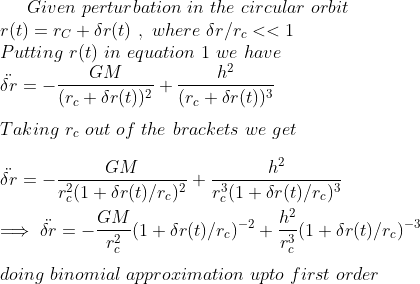
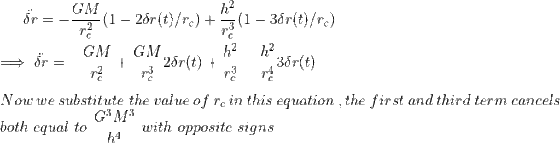
Finally we have here ,
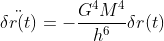
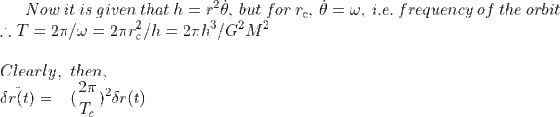
This equation has the solution of the form y(x)=Acos(kx)+Bsin(kx) where, k=2*pi /T Hence for some initial condition it can be easily written as ;

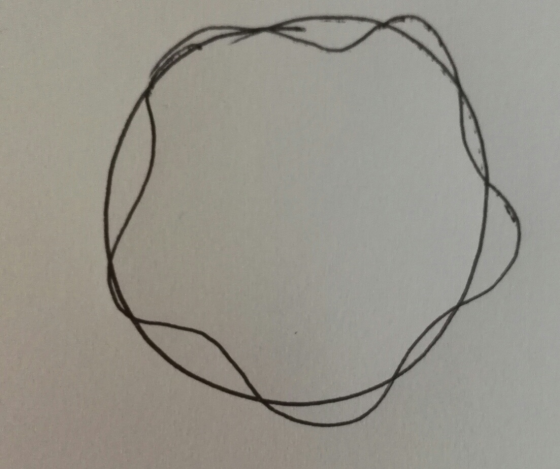
The modified shape will still be like a circle but along with sinusoidal variations over that circle.
Add Answer to:
4. Consider a planet in orbit about a star of mass M. Let the x-y plane...
Problem 1 Planetary Orbits Consider the two-body problem for a planet-star system. The planet, of mass...
 Problem 1 Planetary Orbits Consider the two-body problem for a planet-star system. The planet, of mass m, is initially in a circular orbit of radius r and angular speed w about the star, of mass M. (i) What is the gravitational potential energy of the system, U? What is the kinetic energy of the planet, K? What is the total energy of the system, E = K +U? (ii) The star suddenly loses half of its mass, M + M/2....
A planet of mass m = 1.55 x 1024 kg is orbiting in a circular path...
A planet of mass m = 1.55 x 1024 kg is orbiting in a circular path a star of mass M = 9.75 x 1029 kg. The radius of the orbit is R = 4.65 x 10⁷ km. What is the orbital period (in earth days) of the planet? Where G = 6.67 � 10-11 N�m2/kg2 and 1 day = 8.54 � 104 s. I used the formula and got T = 247 s = 0.0289 days, but the online...
7Okn4. Tidal Forces: A comet of mass m and radius R approaches the Sun with a...
 7Okn4. Tidal Forces: A comet of mass m and radius R approaches the Sun with a trajectory described by C ( L/Gm2 Mn)-4 x 10° km, and eccentricity e-0.967. Will the comet break apart by tidal forces, or retun another day? (m -2 x 10 kg, R 10 km, MN-2 x 10" kg) Points (20) m! eliptcal trajectory 34 Roche Limit 5). Binary Star System: Consider a planetary system as pictured (not to scale), with the stars in a circular...
Please use the formulate sheet and show all steps to make sure the question is worth...
 Please use the formulate sheet and show all steps to make sure
the question is worth any points
a) The initial ratio of deuterium (D) to hydrogen (H) in a planet's atmosphere was 175000; however, the present ratio is 1/1500 and the initial and final abundances of D are 5 x 10° atoms per m3 and 9 x 10⁶ atoms per m2, respectively. What fraction of deuterium has been lost, and what fraction of hydrogen has been lost in this...
Please use the formulate sheet and show all steps to make sure
the question is worth any points
a) The initial ratio of deuterium (D) to hydrogen (H) in a planet's atmosphere was 175000; however, the present ratio is 1/1500 and the initial and final abundances of D are 5 x 10° atoms per m3 and 9 x 10⁶ atoms per m2, respectively. What fraction of deuterium has been lost, and what fraction of hydrogen has been lost in this...
 Problem 1 Planetary Orbits Consider the two-body problem for a planet-star system. The planet, of mass m, is initially in a circular orbit of radius r and angular speed w about the star, of mass M. (i) What is the gravitational potential energy of the system, U? What is the kinetic energy of the planet, K? What is the total energy of the system, E = K +U? (ii) The star suddenly loses half of its mass, M + M/2....
 7Okn4. Tidal Forces: A comet of mass m and radius R approaches the Sun with a trajectory described by C ( L/Gm2 Mn)-4 x 10° km, and eccentricity e-0.967. Will the comet break apart by tidal forces, or retun another day? (m -2 x 10 kg, R 10 km, MN-2 x 10" kg) Points (20) m! eliptcal trajectory 34 Roche Limit 5). Binary Star System: Consider a planetary system as pictured (not to scale), with the stars in a circular...
 Please use the formulate sheet and show all steps to make sure
the question is worth any points
a) The initial ratio of deuterium (D) to hydrogen (H) in a planet's atmosphere was 175000; however, the present ratio is 1/1500 and the initial and final abundances of D are 5 x 10° atoms per m3 and 9 x 10⁶ atoms per m2, respectively. What fraction of deuterium has been lost, and what fraction of hydrogen has been lost in this...
Please use the formulate sheet and show all steps to make sure
the question is worth any points
a) The initial ratio of deuterium (D) to hydrogen (H) in a planet's atmosphere was 175000; however, the present ratio is 1/1500 and the initial and final abundances of D are 5 x 10° atoms per m3 and 9 x 10⁶ atoms per m2, respectively. What fraction of deuterium has been lost, and what fraction of hydrogen has been lost in this...
Most questions answered within 3 hours.
-
Where is the error in this code sequence?
String s1 = "Hello";
String s2 = "ello";...
asked 11 months ago -
Financial data for Joel de Paris, Inc., for last year
follow:
Joel de Paris, Inc.
Balance...
asked 11 months ago -
Consider this reaction:
Al2(SO4)3 (aq)+ BaCl3
(aq) Al2Cl6 (aq)- +
3BaSO4(s) . What is the...
asked 11 months ago -
Suppose that Savneet is considering increasing her
recent random sample from 20 car rentals to 40...
asked 11 months ago -
Trucks arrive at an unloading terminal at an average rate of 120
per hour.
Trucks arrive...
asked 11 months ago -
Why are methanol and ethanol completely soluble in water while
octanol is not very little soluble....
asked 11 months ago -
A facilities manager at a university reads in a research report
that the mean amount of...
asked 11 months ago -
When the CuSO4 is rehydrated by adding water to the anhydrous
compound, is this an endothermic...
asked 11 months ago -
A ray of sunlight is passing from diamond into crown glass; the
angle of incidence is...
asked 11 months ago -
A block of mass 0.249 kg is placed on top of a light, vertical
spring of...
asked 11 months ago -
how do the kidneys compensate in the presences of acidosis
a) trigger hyperventilate
b) reserve acid...
asked 11 months ago -
Question 501 pts
The rental rate of capital to the firm increases. Which of the
following...
asked 11 months ago