
Homework Answers
Add Answer to:
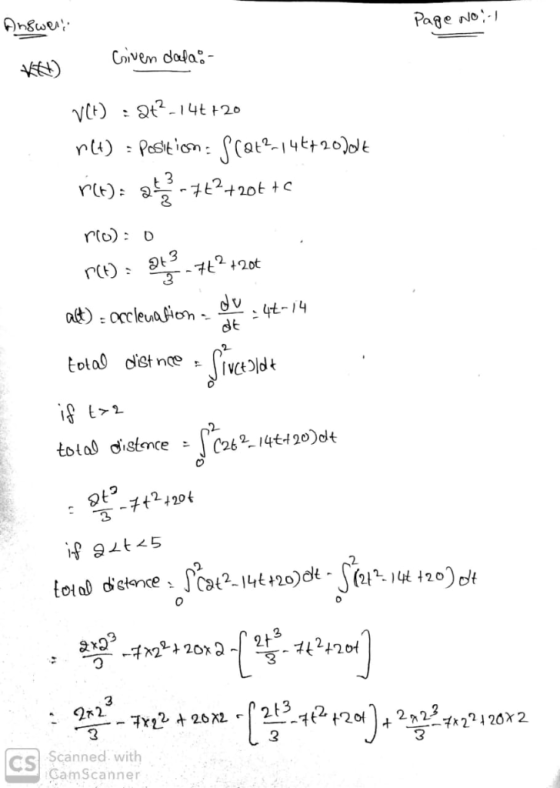
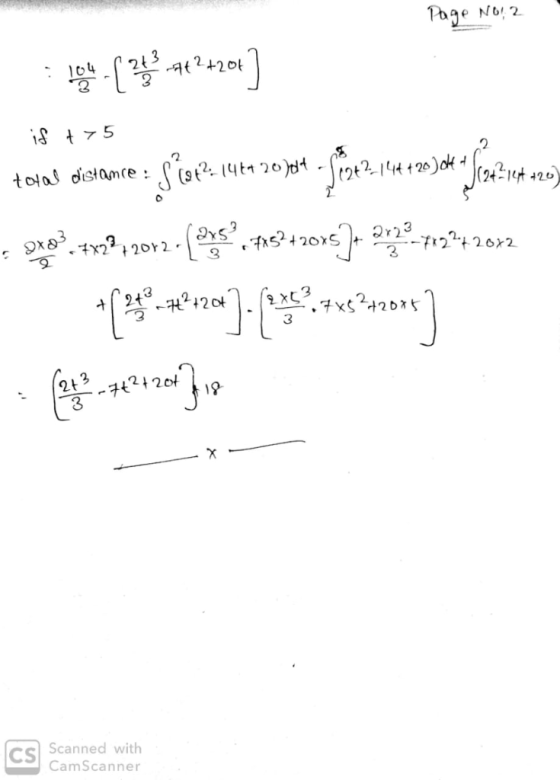
n unrs S hown on this question sheet. Starting from the origin, the velocity of a...
2) The magnitude of the acceleration of an object moving in rectilinear motion is a=12 sn,...
 2) The magnitude of the acceleration of an object moving in rectilinear motion is a=12 sn, where a is in m/s' and s is the distance of the point from the origin in meters. When the time t is 2 seconds, the point is 16m to the right of the origin and has a velocity of 32m/s to the right and an acceleration of 48m/s to the right. Determine: a) the velocity and acceleration of the particle when time is...
A particle leaves the origin with an initial velocity v⃗ =(2.40m/s)x^, and moves with constant acceleration...
A particle leaves the origin with an initial velocity v⃗ =(2.40m/s)x^, and moves with constant acceleration a⃗ =(−1.90m/s2)x^+(3.20m/s2)y^. How far does the particle move in the x direction before turning around? What is the particle's velocity at this time? Calculate the particle's position at t = 0.500 s, 1.00 s, 1.50 s, and 2.00 s. Use these results to sketch x and y positions versus time for the particle.
A 18.00 kg particle starts from the origin at time zero. Its velocity as a function...
A 18.00 kg particle starts from the origin at time zero. Its velocity as a function of time is given by = 7t2î + 3tĵ where is in meters per second and t is in seconds. (Use the following as necessary: t.) (a) Find its position as a function of time. = b) Describe its motion qualitatively. This answer has not been graded yet. (c) Find its acceleration as a function of time. = m/s2 (d) Find the net force exerted...
The function s(t)=ť - 12t - 9 gives the distance from a starting point at time...
 The function s(t)=ť - 12t - 9 gives the distance from a starting point at time t of a particle moving along a line. Find the velocity and acceleration functions. Then find the velocity and acceleration at t= 0 and t=3. Assume that time is measured in seconds and distance is measured in centimeters. Velocity will be in centimeters per second (cm/sec) and acceleration in centimeters per second per second (cm/sec2). The velocity function is v(t) = (Simplify your answer.)
A 17.00 kg particle starts from the origin at time zero. Its velocity as a function...
A 17.00 kg particle starts from the origin at time zero. Its velocity as a function of time is given by v with arrow = 10t2î + 3tĵ where v with arrow is in meters per second and t is in seconds. (Use the following as necessary: t.) (a) Find its position as a function of time. r with arrow = (b) Describe its motion qualitatively. This answer has not been graded yet. (c) Find its acceleration as a function...
The acceleration of a particle as it moves along a straight line is given by a=(2t−1)...
The acceleration of a particle as it moves along a straight line is given by a=(2t−1) m/s2, where t is in seconds. Suppose that s = 4 m and v = 8 m/s when t = 0. a)Determine the particle's velocity when t = 4 s . b)Determine the particle's position when t = 4 s c)Determine the total distance the particle travels during the 4-s time period.
ADp Sto A 15.00 kg particle starts from the origin at time zero. Its velocity as...
 ADp Sto A 15.00 kg particle starts from the origin at time zero. Its velocity as a function of time is given by -oi+4d where V is in meters per second and t is in seconds. (Use the following as necessary: t.) (a) Find its position as a function of time. F31+221 (b) Describe its motion qualitatively. This answer has not been graded yet. (c) Find its acceleration as a function of time. a6r1+4rj x m/s (d) Find the net...
The velocity function of a rectilinear motion in (m/s) is given by the v(t) = 8t...
 The velocity function of a rectilinear motion in (m/s) is given by the v(t) = 8t - 3, 2 st 55 Find the distance travelled during the given time.
1 In many fluids, the flow velocity is observed to vary linearly from zero at the...
 1 In many fluids, the flow velocity is observed to vary linearly from zero at the bottom to u at the top. Moreover, the magnitude F of the force acting on the top plate is found to be proportional to the speed and the area A of eaclh plate, and inversely proportional to their distance separation y The proportionality factor μ is the viscosity of the fluid. Using the above equation find out the dimensions of (10 pts.) A car...
Not sure if these are right 2· The e motion of a particle is modelled by the equation s(e) 5+9t-6t2+t3, where s is measured in metres and t is time in seconds. a) When is the particle at rest? (2)...
 Not
sure if these are right
2· The e motion of a particle is modelled by the equation s(e) 5+9t-6t2+t3, where s is measured in metres and t is time in seconds. a) When is the particle at rest? (2) (3) When is the particle moving in a positive direction? b) vct) -124+30 Ct-1 Ct d-9-12t t3t2 ve) c) Draw a diagram to show the motion of the particle with respect to a distance axis, Indicate key time values Determine...
Not
sure if these are right
2· The e motion of a particle is modelled by the equation s(e) 5+9t-6t2+t3, where s is measured in metres and t is time in seconds. a) When is the particle at rest? (2) (3) When is the particle moving in a positive direction? b) vct) -124+30 Ct-1 Ct d-9-12t t3t2 ve) c) Draw a diagram to show the motion of the particle with respect to a distance axis, Indicate key time values Determine...
 2) The magnitude of the acceleration of an object moving in rectilinear motion is a=12 sn, where a is in m/s' and s is the distance of the point from the origin in meters. When the time t is 2 seconds, the point is 16m to the right of the origin and has a velocity of 32m/s to the right and an acceleration of 48m/s to the right. Determine: a) the velocity and acceleration of the particle when time is...
 The function s(t)=ť - 12t - 9 gives the distance from a starting point at time t of a particle moving along a line. Find the velocity and acceleration functions. Then find the velocity and acceleration at t= 0 and t=3. Assume that time is measured in seconds and distance is measured in centimeters. Velocity will be in centimeters per second (cm/sec) and acceleration in centimeters per second per second (cm/sec2). The velocity function is v(t) = (Simplify your answer.)
 ADp Sto A 15.00 kg particle starts from the origin at time zero. Its velocity as a function of time is given by -oi+4d where V is in meters per second and t is in seconds. (Use the following as necessary: t.) (a) Find its position as a function of time. F31+221 (b) Describe its motion qualitatively. This answer has not been graded yet. (c) Find its acceleration as a function of time. a6r1+4rj x m/s (d) Find the net...
 The velocity function of a rectilinear motion in (m/s) is given by the v(t) = 8t - 3, 2 st 55 Find the distance travelled during the given time.
 1 In many fluids, the flow velocity is observed to vary linearly from zero at the bottom to u at the top. Moreover, the magnitude F of the force acting on the top plate is found to be proportional to the speed and the area A of eaclh plate, and inversely proportional to their distance separation y The proportionality factor μ is the viscosity of the fluid. Using the above equation find out the dimensions of (10 pts.) A car...
 Not
sure if these are right
2· The e motion of a particle is modelled by the equation s(e) 5+9t-6t2+t3, where s is measured in metres and t is time in seconds. a) When is the particle at rest? (2) (3) When is the particle moving in a positive direction? b) vct) -124+30 Ct-1 Ct d-9-12t t3t2 ve) c) Draw a diagram to show the motion of the particle with respect to a distance axis, Indicate key time values Determine...
Not
sure if these are right
2· The e motion of a particle is modelled by the equation s(e) 5+9t-6t2+t3, where s is measured in metres and t is time in seconds. a) When is the particle at rest? (2) (3) When is the particle moving in a positive direction? b) vct) -124+30 Ct-1 Ct d-9-12t t3t2 ve) c) Draw a diagram to show the motion of the particle with respect to a distance axis, Indicate key time values Determine...
Most questions answered within 3 hours.
-
Where is the error in this code sequence?
String s1 = "Hello";
String s2 = "ello";...
asked 10 months ago -
Financial data for Joel de Paris, Inc., for last year
follow:
Joel de Paris, Inc.
Balance...
asked 10 months ago -
Consider this reaction:
Al2(SO4)3 (aq)+ BaCl3
(aq) Al2Cl6 (aq)- +
3BaSO4(s) . What is the...
asked 10 months ago -
Suppose that Savneet is considering increasing her
recent random sample from 20 car rentals to 40...
asked 10 months ago -
Trucks arrive at an unloading terminal at an average rate of 120
per hour.
Trucks arrive...
asked 10 months ago -
Why are methanol and ethanol completely soluble in water while
octanol is not very little soluble....
asked 10 months ago -
A facilities manager at a university reads in a research report
that the mean amount of...
asked 10 months ago -
When the CuSO4 is rehydrated by adding water to the anhydrous
compound, is this an endothermic...
asked 10 months ago -
A ray of sunlight is passing from diamond into crown glass; the
angle of incidence is...
asked 10 months ago -
A block of mass 0.249 kg is placed on top of a light, vertical
spring of...
asked 10 months ago -
how do the kidneys compensate in the presences of acidosis
a) trigger hyperventilate
b) reserve acid...
asked 10 months ago -
Question 501 pts
The rental rate of capital to the firm increases. Which of the
following...
asked 10 months ago