Solve only Question # 32. Q 31 is just given to provide information if you need.
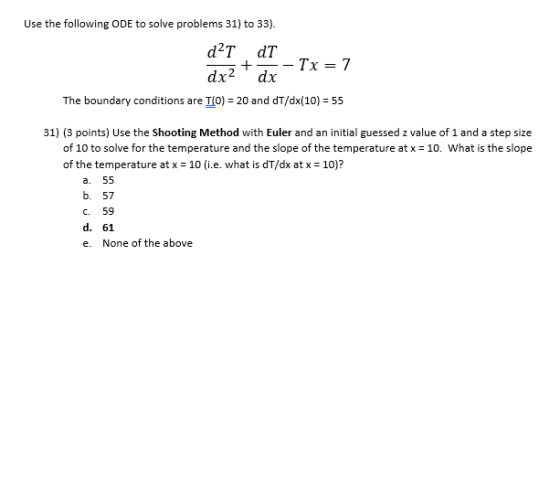
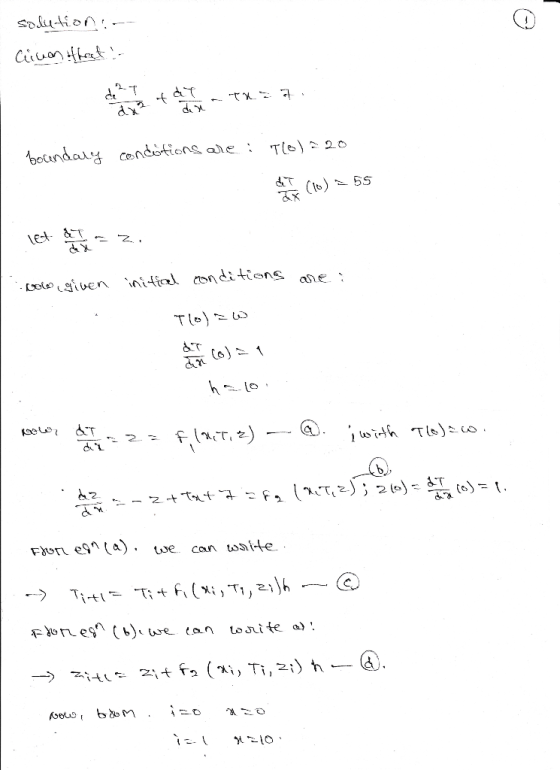
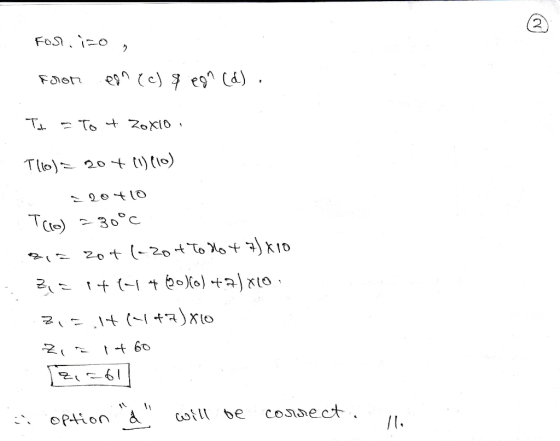
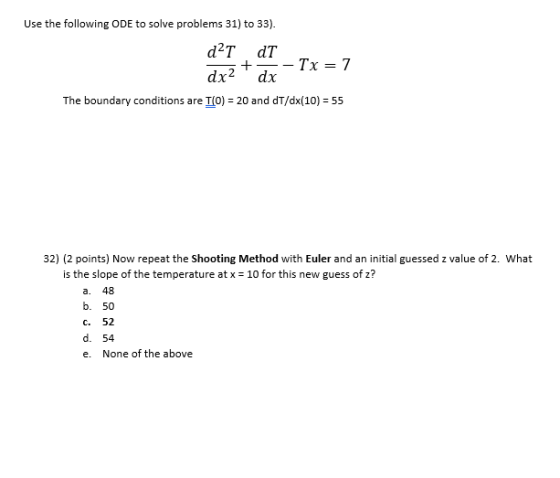
NOTE: Plz solve step by step method so i can learn the process. Thanks
Homework Answers
![So] *. = 55 Bounda«i Condi tionsT 20 T h) 10 Step SIze let us assame dri zo t hC1-.zot T0 χ0 2 o 250 2, - 52](http://img.homeworklib.com/questions/6702ff50-8779-11ec-8343-47d2b18e1088.png?x-oss-process=image/resize,w_560)
Add Answer to:
Solve only Question # 32. Q 31 is just given to provide
information if you need....
! Required information An insulated heated rod with a uniform heat source can be modeled with...
 ! Required information An insulated heated rod with a uniform heat source can be modeled with the Poisson equation as given below. de = -f(x) Given: A heat source fx) = 25°C/m2 and the boundary conditions Tlx = 0) = 40 °C and Tlx = 10) = 200 °C Solve the ODE using the shooting method. (Round the final answer to the nearest integer.) The temperature distribution at x = 4 is K. Use the fourth-order RK method using a...
I need help with question 30d 16. y = 0 (that is, y(x) = 0 for...
 I need help with question 30d
16. y = 0 (that is, y(x) = 0 for all x, also written y(x) = 0) is a solution of (2) (not of (1) if (x) • o , called the trivial solution 17. The sum of a solution of (1) and a solution of (2) is a solution of (1). 18. The difference of two solutions of (1) is a solution of (2). 19. If yı is a solution of (1), what...
I need help with question 30d
16. y = 0 (that is, y(x) = 0 for all x, also written y(x) = 0) is a solution of (2) (not of (1) if (x) • o , called the trivial solution 17. The sum of a solution of (1) and a solution of (2) is a solution of (1). 18. The difference of two solutions of (1) is a solution of (2). 19. If yı is a solution of (1), what...
Please solve c and d in Question 3. You may find the information from the previous...
 Please solve c and d in
Question 3. You may find the information from the previous
questions helpful.
2 Question 2 Integrated rate law The other method to establish rate laws is to measure the remaining concentrations of a reactat at different times during the reaction. The concentrations of reactant for reaction A → 2B + C measured as a function of time at 25 C are listed in the following table. t (s) [A] (M) t (s) [A] (M)...
Please solve c and d in
Question 3. You may find the information from the previous
questions helpful.
2 Question 2 Integrated rate law The other method to establish rate laws is to measure the remaining concentrations of a reactat at different times during the reaction. The concentrations of reactant for reaction A → 2B + C measured as a function of time at 25 C are listed in the following table. t (s) [A] (M) t (s) [A] (M)...
 ! Required information An insulated heated rod with a uniform heat source can be modeled with the Poisson equation as given below. de = -f(x) Given: A heat source fx) = 25°C/m2 and the boundary conditions Tlx = 0) = 40 °C and Tlx = 10) = 200 °C Solve the ODE using the shooting method. (Round the final answer to the nearest integer.) The temperature distribution at x = 4 is K. Use the fourth-order RK method using a...
 I need help with question 30d
16. y = 0 (that is, y(x) = 0 for all x, also written y(x) = 0) is a solution of (2) (not of (1) if (x) • o , called the trivial solution 17. The sum of a solution of (1) and a solution of (2) is a solution of (1). 18. The difference of two solutions of (1) is a solution of (2). 19. If yı is a solution of (1), what...
I need help with question 30d
16. y = 0 (that is, y(x) = 0 for all x, also written y(x) = 0) is a solution of (2) (not of (1) if (x) • o , called the trivial solution 17. The sum of a solution of (1) and a solution of (2) is a solution of (1). 18. The difference of two solutions of (1) is a solution of (2). 19. If yı is a solution of (1), what...
 Please solve c and d in
Question 3. You may find the information from the previous
questions helpful.
2 Question 2 Integrated rate law The other method to establish rate laws is to measure the remaining concentrations of a reactat at different times during the reaction. The concentrations of reactant for reaction A → 2B + C measured as a function of time at 25 C are listed in the following table. t (s) [A] (M) t (s) [A] (M)...
Please solve c and d in
Question 3. You may find the information from the previous
questions helpful.
2 Question 2 Integrated rate law The other method to establish rate laws is to measure the remaining concentrations of a reactat at different times during the reaction. The concentrations of reactant for reaction A → 2B + C measured as a function of time at 25 C are listed in the following table. t (s) [A] (M) t (s) [A] (M)...
Most questions answered within 3 hours.
-
Where is the error in this code sequence?
String s1 = "Hello";
String s2 = "ello";...
asked 10 months ago -
Financial data for Joel de Paris, Inc., for last year
follow:
Joel de Paris, Inc.
Balance...
asked 10 months ago -
Consider this reaction:
Al2(SO4)3 (aq)+ BaCl3
(aq) Al2Cl6 (aq)- +
3BaSO4(s) . What is the...
asked 10 months ago -
Suppose that Savneet is considering increasing her
recent random sample from 20 car rentals to 40...
asked 10 months ago -
Trucks arrive at an unloading terminal at an average rate of 120
per hour.
Trucks arrive...
asked 10 months ago -
Why are methanol and ethanol completely soluble in water while
octanol is not very little soluble....
asked 10 months ago -
A facilities manager at a university reads in a research report
that the mean amount of...
asked 10 months ago -
When the CuSO4 is rehydrated by adding water to the anhydrous
compound, is this an endothermic...
asked 10 months ago -
A ray of sunlight is passing from diamond into crown glass; the
angle of incidence is...
asked 10 months ago -
A block of mass 0.249 kg is placed on top of a light, vertical
spring of...
asked 10 months ago -
how do the kidneys compensate in the presences of acidosis
a) trigger hyperventilate
b) reserve acid...
asked 10 months ago -
Question 501 pts
The rental rate of capital to the firm increases. Which of the
following...
asked 10 months ago