

Homework Answers
Add Answer to:
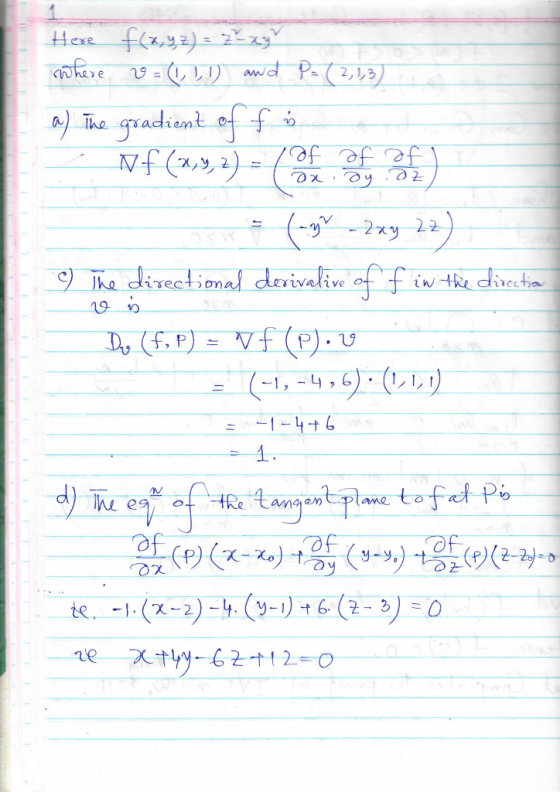
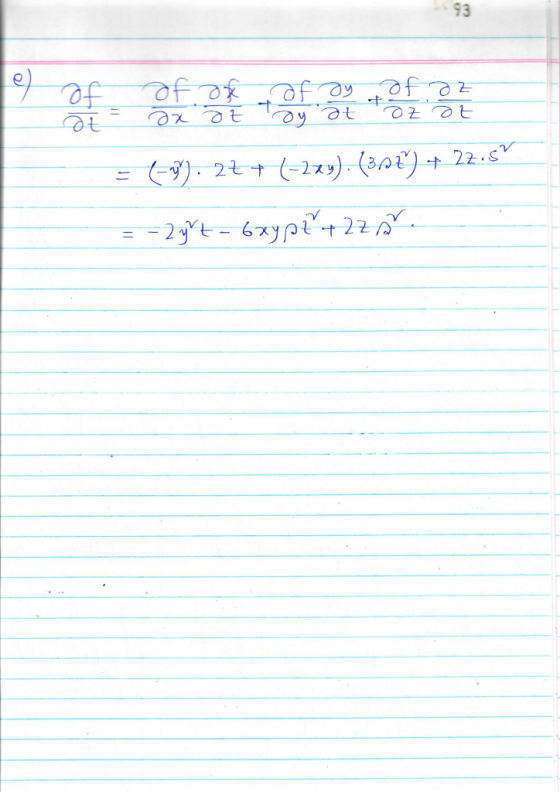
-n ', S Let f(x,yZFz2_xy. Let v=<1,1,1>. Let point P=<2,1,3> a. Compute gradient of fx,y,z) b....
Consider the following function 6 f(x, y,z)=z - x? cos(my) + xy? (i) Find the gradient...
 Consider the following function 6 f(x, y,z)=z - x? cos(my) + xy? (i) Find the gradient of the function f(x, y, z) at the point P,(2,-1,-7). (ii) Find the directional derivative of f(x, y, z) at P,(2,-1,-7) along the direction of the vector ū = 2î+j+2k. (iii) Find the equation of the tangent plane to the surface given below at the point P,(2,-1, -7). 6 :- xcos(ty) + = 0 xy
Problem 1: Let F(, y,) be a function given by F(, y, z) (r2+y)e. Let S be the surface in R given ...
 Problem 1: Let F(, y,) be a function given by F(, y, z) (r2+y)e. Let S be the surface in R given by the equation Fr, y, 2) 2. (a) Find an equation of the tangent plane to the surface S at the point p(-1,1,0) (b)Find the directional derivative -1,1,0) of F(,y,2) in the direction of the unit vector u = (ui, t», t's) at the point p(-1,1,0) - In what direction is this derivative maximal? In what direction is...
E ana the gradient IV.1 The level curves of the function z fix, y) are sketched in the figure bel...
 e ana the gradient IV.1 The level curves of the function z fix, y) are sketched in the figure below: 20 50 100 10 150 10 20 30 Let u= (l,-) and v=죠(1,1) Estimate the derivatives at the indicated point: DJい IV.2 (The Directional Derivative) Compute the derivative of the function f(x,y,z)-sin(2x-y)+ cos(2y-2) Ft%r,-r) in the direction of the vector". (-2,-1, 2) at the point
e ana the gradient IV.1 The level curves of the function z fix, y) are...
e ana the gradient IV.1 The level curves of the function z fix, y) are sketched in the figure below: 20 50 100 10 150 10 20 30 Let u= (l,-) and v=죠(1,1) Estimate the derivatives at the indicated point: DJい IV.2 (The Directional Derivative) Compute the derivative of the function f(x,y,z)-sin(2x-y)+ cos(2y-2) Ft%r,-r) in the direction of the vector". (-2,-1, 2) at the point
e ana the gradient IV.1 The level curves of the function z fix, y) are...
5) Let P(1,2,2) be a point, and f(x,y,z) and g(x,y,z) be two differentiable functions satisfying the...
 5) Let P(1,2,2) be a point, and f(x,y,z) and g(x,y,z) be two differentiable functions satisfying the following conditions. 1) f(P)=1 and g(P)=4 og IT) = -2 Oz IP III) The direction in which f increases most rapidly at the point Pis ū=4i - +8k , and the derivative in this direction is 3. IV) Equation of the plane tangent to the surface f(x,y,z)+3g(x,y,z)=13 at the int P is x+4y + 5z =19 According to this, calculate og Ox . (20P)
7. Use a gradient to compute the tangent plane to z = V x2 + y2...
 7. Use a gradient to compute the tangent plane to z = V x2 + y2 at (1,0,1). 8. Compute D f (p) where v = (1, 1, 1), p = (1,2,0) and f(x, y, z) = xe*** Remember to normalize if needed.
17. Given f(x, y, z) = x^yz -- xyz', P(2,-1,1) and vector v =<1,0,1 >. Find...
 17. Given f(x, y, z) = x^yz -- xyz', P(2,-1,1) and vector v =<1,0,1 >. Find i. the directional derivative of the function at the point P in the direction of v. ii. the maximum rate of change of f.
1 1 Consider the function f(x.y,z) 2x y 2 the point P(3,0,1), and the unit vector...
 1 1 Consider the function f(x.y,z) 2x y 2 the point P(3,0,1), and the unit vector u 0 Compute the gradient of f and evaluate it at P b. Find the unit vector in the direction of maximum increase of f at P c. Find the rate of change of the function in the direction of maximum increase at P d. Find the directional derivative at P in the direction of the given vector. a.
1 1 Consider the function...
1 1 Consider the function f(x.y,z) 2x y 2 the point P(3,0,1), and the unit vector u 0 Compute the gradient of f and evaluate it at P b. Find the unit vector in the direction of maximum increase of f at P c. Find the rate of change of the function in the direction of maximum increase at P d. Find the directional derivative at P in the direction of the given vector. a.
1 1 Consider the function...
9. If f(x, y, z) = x sin yz. (a) (2 points) Find the gradient off...
 9. If f(x, y, z) = x sin yz. (a) (2 points) Find the gradient off (b) (3 points) Find the directional derivative off at (1, 3, 0) in the direction of v= i +2j – k.
(1 point) Suppose f (r,y)= P = (1, -2) and v=3i - 3j. A. Find the...
 (1 point) Suppose f (r,y)= P = (1, -2) and v=3i - 3j. A. Find the gradient of 1 Uf = 1 it -x/y^2 Note: Your answers should be expressions of x and y, eg "3x - 4y" j j B. Find the gradient off at the point P. (VA)(P) = 1 i+ -2 Note: Your answers should be numbers C. Find the directional derivative off at P in the direction of v. Duf = 9 Note: Your answer should...
true or false is zero. F 9. The plane tangent to the surface za the point (0,0, 3) is given by the equation 2x - 12y -z+3-0. 10. If f is a differentiable function and zf(x -y), then z +. T 11. If...
 true or false
is zero. F 9. The plane tangent to the surface za the point (0,0, 3) is given by the equation 2x - 12y -z+3-0. 10. If f is a differentiable function and zf(x -y), then z +. T 11. If a unit vector u makes the angle of π/4 with the gradient ▽f(P), the directional derivative Duf(P) is equal to |Vf(P)I/2. F 12. There is a point on the hyperboloid 2 -y is parallel to the plane...
true or false
is zero. F 9. The plane tangent to the surface za the point (0,0, 3) is given by the equation 2x - 12y -z+3-0. 10. If f is a differentiable function and zf(x -y), then z +. T 11. If a unit vector u makes the angle of π/4 with the gradient ▽f(P), the directional derivative Duf(P) is equal to |Vf(P)I/2. F 12. There is a point on the hyperboloid 2 -y is parallel to the plane...
 Consider the following function 6 f(x, y,z)=z - x? cos(my) + xy? (i) Find the gradient of the function f(x, y, z) at the point P,(2,-1,-7). (ii) Find the directional derivative of f(x, y, z) at P,(2,-1,-7) along the direction of the vector ū = 2î+j+2k. (iii) Find the equation of the tangent plane to the surface given below at the point P,(2,-1, -7). 6 :- xcos(ty) + = 0 xy
 Problem 1: Let F(, y,) be a function given by F(, y, z) (r2+y)e. Let S be the surface in R given by the equation Fr, y, 2) 2. (a) Find an equation of the tangent plane to the surface S at the point p(-1,1,0) (b)Find the directional derivative -1,1,0) of F(,y,2) in the direction of the unit vector u = (ui, t», t's) at the point p(-1,1,0) - In what direction is this derivative maximal? In what direction is...
 e ana the gradient IV.1 The level curves of the function z fix, y) are sketched in the figure below: 20 50 100 10 150 10 20 30 Let u= (l,-) and v=죠(1,1) Estimate the derivatives at the indicated point: DJい IV.2 (The Directional Derivative) Compute the derivative of the function f(x,y,z)-sin(2x-y)+ cos(2y-2) Ft%r,-r) in the direction of the vector". (-2,-1, 2) at the point
e ana the gradient IV.1 The level curves of the function z fix, y) are...
e ana the gradient IV.1 The level curves of the function z fix, y) are sketched in the figure below: 20 50 100 10 150 10 20 30 Let u= (l,-) and v=죠(1,1) Estimate the derivatives at the indicated point: DJい IV.2 (The Directional Derivative) Compute the derivative of the function f(x,y,z)-sin(2x-y)+ cos(2y-2) Ft%r,-r) in the direction of the vector". (-2,-1, 2) at the point
e ana the gradient IV.1 The level curves of the function z fix, y) are...
 5) Let P(1,2,2) be a point, and f(x,y,z) and g(x,y,z) be two differentiable functions satisfying the following conditions. 1) f(P)=1 and g(P)=4 og IT) = -2 Oz IP III) The direction in which f increases most rapidly at the point Pis ū=4i - +8k , and the derivative in this direction is 3. IV) Equation of the plane tangent to the surface f(x,y,z)+3g(x,y,z)=13 at the int P is x+4y + 5z =19 According to this, calculate og Ox . (20P)
 7. Use a gradient to compute the tangent plane to z = V x2 + y2 at (1,0,1). 8. Compute D f (p) where v = (1, 1, 1), p = (1,2,0) and f(x, y, z) = xe*** Remember to normalize if needed.
 17. Given f(x, y, z) = x^yz -- xyz', P(2,-1,1) and vector v =<1,0,1 >. Find i. the directional derivative of the function at the point P in the direction of v. ii. the maximum rate of change of f.
 1 1 Consider the function f(x.y,z) 2x y 2 the point P(3,0,1), and the unit vector u 0 Compute the gradient of f and evaluate it at P b. Find the unit vector in the direction of maximum increase of f at P c. Find the rate of change of the function in the direction of maximum increase at P d. Find the directional derivative at P in the direction of the given vector. a.
1 1 Consider the function...
1 1 Consider the function f(x.y,z) 2x y 2 the point P(3,0,1), and the unit vector u 0 Compute the gradient of f and evaluate it at P b. Find the unit vector in the direction of maximum increase of f at P c. Find the rate of change of the function in the direction of maximum increase at P d. Find the directional derivative at P in the direction of the given vector. a.
1 1 Consider the function...
 9. If f(x, y, z) = x sin yz. (a) (2 points) Find the gradient off (b) (3 points) Find the directional derivative off at (1, 3, 0) in the direction of v= i +2j – k.
 (1 point) Suppose f (r,y)= P = (1, -2) and v=3i - 3j. A. Find the gradient of 1 Uf = 1 it -x/y^2 Note: Your answers should be expressions of x and y, eg "3x - 4y" j j B. Find the gradient off at the point P. (VA)(P) = 1 i+ -2 Note: Your answers should be numbers C. Find the directional derivative off at P in the direction of v. Duf = 9 Note: Your answer should...
 true or false
is zero. F 9. The plane tangent to the surface za the point (0,0, 3) is given by the equation 2x - 12y -z+3-0. 10. If f is a differentiable function and zf(x -y), then z +. T 11. If a unit vector u makes the angle of π/4 with the gradient ▽f(P), the directional derivative Duf(P) is equal to |Vf(P)I/2. F 12. There is a point on the hyperboloid 2 -y is parallel to the plane...
true or false
is zero. F 9. The plane tangent to the surface za the point (0,0, 3) is given by the equation 2x - 12y -z+3-0. 10. If f is a differentiable function and zf(x -y), then z +. T 11. If a unit vector u makes the angle of π/4 with the gradient ▽f(P), the directional derivative Duf(P) is equal to |Vf(P)I/2. F 12. There is a point on the hyperboloid 2 -y is parallel to the plane...
Most questions answered within 3 hours.
-
Where is the error in this code sequence?
String s1 = "Hello";
String s2 = "ello";...
asked 11 months ago -
Financial data for Joel de Paris, Inc., for last year
follow:
Joel de Paris, Inc.
Balance...
asked 11 months ago -
Consider this reaction:
Al2(SO4)3 (aq)+ BaCl3
(aq) Al2Cl6 (aq)- +
3BaSO4(s) . What is the...
asked 11 months ago -
Suppose that Savneet is considering increasing her
recent random sample from 20 car rentals to 40...
asked 11 months ago -
Trucks arrive at an unloading terminal at an average rate of 120
per hour.
Trucks arrive...
asked 11 months ago -
Why are methanol and ethanol completely soluble in water while
octanol is not very little soluble....
asked 11 months ago -
A facilities manager at a university reads in a research report
that the mean amount of...
asked 11 months ago -
When the CuSO4 is rehydrated by adding water to the anhydrous
compound, is this an endothermic...
asked 11 months ago -
A ray of sunlight is passing from diamond into crown glass; the
angle of incidence is...
asked 11 months ago -
A block of mass 0.249 kg is placed on top of a light, vertical
spring of...
asked 11 months ago -
how do the kidneys compensate in the presences of acidosis
a) trigger hyperventilate
b) reserve acid...
asked 11 months ago -
Question 501 pts
The rental rate of capital to the firm increases. Which of the
following...
asked 11 months ago