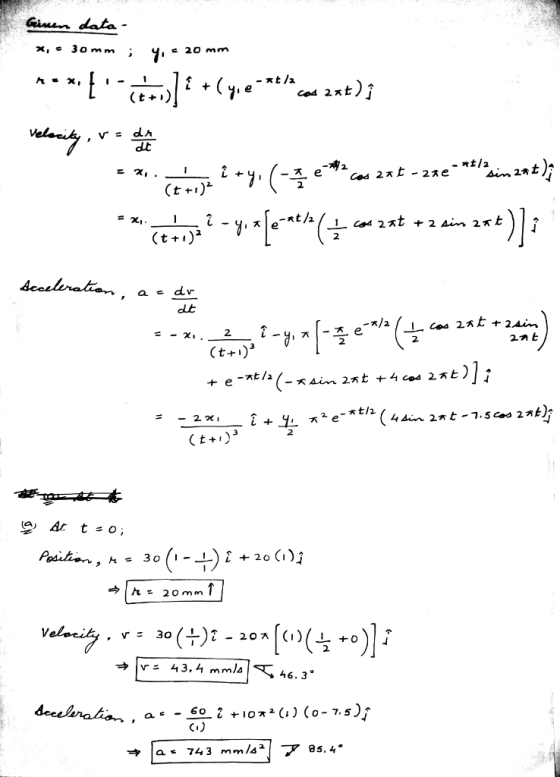
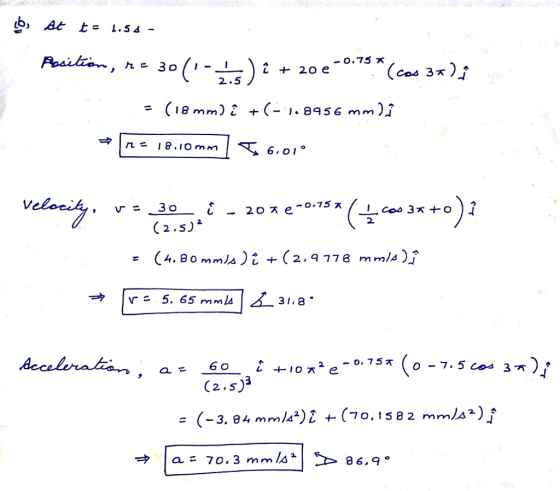
![11.93 The damped motion of a vibrating particle is defined by the position vector r x1 [1-1 (1+ 1)]i-ole-rt 2 cos 2ztj, where t is expressed in seconds. For x1-30 mm and y1 20 mm, determine the position, the velocity, and the acceleration of the particle when (a) 0, (b) t = 1.5 s 1.0 0.5H 0 0.2 0.4 x/xi -0.5 Fig. P11.93](http://img.homeworklib.com/questions/a3519440-88d7-11ec-8a92-c7e304c41eea.png?x-oss-process=image/resize,w_560)
Hello,
would you solve this problem with details of your work. the answer for this question is in the book solution for Vector mechanical engineering, but i would lilke to see more detalis of the work.Thanks
Homework Answers
Add Answer to:
Hello,
would you solve this problem with details of your work. the
answer for this question...
y/yi PROBLEM 11.93 The damped motion of a vibrating particle is defined by the position vector...
 y/yi PROBLEM 11.93 The damped motion of a vibrating particle is defined by the position vector r +)+2co2,where r is expressed in seconds. For 30 mm and y,-20 min, determine the position, the velocity, and the acceleration of the particle when (a) t0, (b) t-1.5 s. 1.0 0.5 0 0.4 06 t 0.2 -0.5
Hello, I would like to see the first few problems solved to see what the question...
 Hello, I would like to see the first few problems solved to see
what the question is asking me. Its been a while for me with math
stats and regression math. Thank you so much in advance.
1. Let Xi, . . . , X3 i id. N(-1, 4) and Yi, . . . , Ys i N(0, 1) b t. Using properties of e independden the normal distribution, derive the distribution of the following random variables. (b) W2=12-1(X +1)...
Hello, I would like to see the first few problems solved to see
what the question is asking me. Its been a while for me with math
stats and regression math. Thank you so much in advance.
1. Let Xi, . . . , X3 i id. N(-1, 4) and Yi, . . . , Ys i N(0, 1) b t. Using properties of e independden the normal distribution, derive the distribution of the following random variables. (b) W2=12-1(X +1)...
Hello, I would like to discuss with someone the work that i've done on my own...
 Hello,
I would like to discuss with someone the work that i've done
on my own regarding part d).
So we have d unique eigenvalues and d < n. if d=n, then we
only have a trivial solution (by the rank nullity theorem), but
this is a contradiction because v is a non-zero eigen vector.
hence the determinant (A- \lambda*I) =0. where this determinant
is equal to the characteristic polynomial equation.
The polynomial equation p(A)= \prod (A- \lambda_i * I)...
Hello,
I would like to discuss with someone the work that i've done
on my own regarding part d).
So we have d unique eigenvalues and d < n. if d=n, then we
only have a trivial solution (by the rank nullity theorem), but
this is a contradiction because v is a non-zero eigen vector.
hence the determinant (A- \lambda*I) =0. where this determinant
is equal to the characteristic polynomial equation.
The polynomial equation p(A)= \prod (A- \lambda_i * I)...
Hello, I was wondering if you would answer the following questions for me. Thank you! QUESTION...
 Hello, I was wondering if you
would answer the following questions for me. Thank you!
QUESTION 3 How many 2-member committees can be formed from a group of 7 people? O 21 00 42 0 1 QUESTION 4 In how many different ways can 8 books be arranged on a shelf? 40320 O 1 O 8 O 56
Hello, I was wondering if you
would answer the following questions for me. Thank you!
QUESTION 3 How many 2-member committees can be formed from a group of 7 people? O 21 00 42 0 1 QUESTION 4 In how many different ways can 8 books be arranged on a shelf? 40320 O 1 O 8 O 56
Hello, please help me with this homework problem. Please show all work. (Correct answers are listed...
 Hello, please help me with this homework problem. Please show
all work. (Correct answers are listed at the bottom)
Homework Assignment #33 10 points The University of Akron Department of Civil Engineering 4300 202: Introduction to Mechanics of Solids 1. A solid tube is subjected to the loading shown. The tube has a diameter of 1.5 in. 8 in. (a) Determine which internal force quantities would cause normal stresses and which would cause shear stresses on a cross-section cut through...
Hello, please help me with this homework problem. Please show
all work. (Correct answers are listed at the bottom)
Homework Assignment #33 10 points The University of Akron Department of Civil Engineering 4300 202: Introduction to Mechanics of Solids 1. A solid tube is subjected to the loading shown. The tube has a diameter of 1.5 in. 8 in. (a) Determine which internal force quantities would cause normal stresses and which would cause shear stresses on a cross-section cut through...
this is in reply to the answer I was given for chapter 4 problem 137. Thank...
 this is in reply to the answer I was given for chapter 4
problem 137. Thank you so much for the very complete answer that
you sent down and I just have one remaining question why are they
position vectors inverted. I mean if point P is the origin and then
say you direct that position vector down to see where it touches
the line of force of C then is the position vector inverted as if
it's coming from...
this is in reply to the answer I was given for chapter 4
problem 137. Thank you so much for the very complete answer that
you sent down and I just have one remaining question why are they
position vectors inverted. I mean if point P is the origin and then
say you direct that position vector down to see where it touches
the line of force of C then is the position vector inverted as if
it's coming from...
Hi, can you solve the question for me step by step, I will rate up if the working is correct. I will post the answer together with the question. Answer: Question 5 A particle of mass m rests on a s...
 Hi, can you solve the question for me step by step, I will rate
up if the working is correct. I will post the answer together with
the question.
Answer:
Question 5 A particle of mass m rests on a smooth horizontal track. It is connected by two springs to fixed points at A and B, which are a distance 2lo apart as shown in Figure Q5. The left-hand spring has natural length 2lo and stiffness k, whilst the right-hand...
Hi, can you solve the question for me step by step, I will rate
up if the working is correct. I will post the answer together with
the question.
Answer:
Question 5 A particle of mass m rests on a smooth horizontal track. It is connected by two springs to fixed points at A and B, which are a distance 2lo apart as shown in Figure Q5. The left-hand spring has natural length 2lo and stiffness k, whilst the right-hand...
i would appriciate your help. thanks Question 4-(20 marks) (a) Briefly describe the characteristics of an operationa...
 i would appriciate your help. thanks
Question 4-(20 marks) (a) Briefly describe the characteristics of an operational amplifier (op-amp) and describe two examples of where It can be used in signal conditioning circults (b) (4 marks) The level of liquid In a vertical cylindrical tank is controlled by a two-position level controller. The following data was recorded for the tank and flow system over a period of stable operation tank diameter. inlet flow rate (inlet valve open5 /min inlet flow...
i would appriciate your help. thanks
Question 4-(20 marks) (a) Briefly describe the characteristics of an operational amplifier (op-amp) and describe two examples of where It can be used in signal conditioning circults (b) (4 marks) The level of liquid In a vertical cylindrical tank is controlled by a two-position level controller. The following data was recorded for the tank and flow system over a period of stable operation tank diameter. inlet flow rate (inlet valve open5 /min inlet flow...
. Question 1 (40 marks) This question asks you to demonstrate your understanding of the following...
 . Question 1 (40 marks) This question asks you to demonstrate your understanding of the following learning objectives LO 1.6 Express the Laplace Transform of common mathematical functions and linear ordinary differential equations using both first principles and mathematical tables. LO 1.7 Construct transfer functions for linear dynamic systems from (i) differential equations and (ii) reduction of block diagrams. LO1.8 Determine the time response of a Linear SISO system to an arbitrary input and having arbitrary initial conditions. LO 1.9...
Please do this in Matlab. Not sure if you need this code: e cofunction [x, er,...
 Please do this in Matlab.
Not sure if you need this code:
e cofunction [x, er, n] = FixedPoint(g, x1, maxtol, maxitr)
if nargin < 4, maxitr = 25; end
if nargin < 3, maxtol = 1e-3; end
k = 0 ;
er = 1;
x = x1;
while er >= maxtol && k < maxitr
k=k+1;
xold = x;
x=g(x);
er=abs((x-xold)/x);
fprintf('iter = %i, x = %e, er = %e ', k,x,er);
end
n=k;
if n ==...
Please do this in Matlab.
Not sure if you need this code:
e cofunction [x, er, n] = FixedPoint(g, x1, maxtol, maxitr)
if nargin < 4, maxitr = 25; end
if nargin < 3, maxtol = 1e-3; end
k = 0 ;
er = 1;
x = x1;
while er >= maxtol && k < maxitr
k=k+1;
xold = x;
x=g(x);
er=abs((x-xold)/x);
fprintf('iter = %i, x = %e, er = %e ', k,x,er);
end
n=k;
if n ==...
 y/yi PROBLEM 11.93 The damped motion of a vibrating particle is defined by the position vector r +)+2co2,where r is expressed in seconds. For 30 mm and y,-20 min, determine the position, the velocity, and the acceleration of the particle when (a) t0, (b) t-1.5 s. 1.0 0.5 0 0.4 06 t 0.2 -0.5
 Hello, I would like to see the first few problems solved to see
what the question is asking me. Its been a while for me with math
stats and regression math. Thank you so much in advance.
1. Let Xi, . . . , X3 i id. N(-1, 4) and Yi, . . . , Ys i N(0, 1) b t. Using properties of e independden the normal distribution, derive the distribution of the following random variables. (b) W2=12-1(X +1)...
Hello, I would like to see the first few problems solved to see
what the question is asking me. Its been a while for me with math
stats and regression math. Thank you so much in advance.
1. Let Xi, . . . , X3 i id. N(-1, 4) and Yi, . . . , Ys i N(0, 1) b t. Using properties of e independden the normal distribution, derive the distribution of the following random variables. (b) W2=12-1(X +1)...
 Hello,
I would like to discuss with someone the work that i've done
on my own regarding part d).
So we have d unique eigenvalues and d < n. if d=n, then we
only have a trivial solution (by the rank nullity theorem), but
this is a contradiction because v is a non-zero eigen vector.
hence the determinant (A- \lambda*I) =0. where this determinant
is equal to the characteristic polynomial equation.
The polynomial equation p(A)= \prod (A- \lambda_i * I)...
Hello,
I would like to discuss with someone the work that i've done
on my own regarding part d).
So we have d unique eigenvalues and d < n. if d=n, then we
only have a trivial solution (by the rank nullity theorem), but
this is a contradiction because v is a non-zero eigen vector.
hence the determinant (A- \lambda*I) =0. where this determinant
is equal to the characteristic polynomial equation.
The polynomial equation p(A)= \prod (A- \lambda_i * I)...
 Hello, I was wondering if you
would answer the following questions for me. Thank you!
QUESTION 3 How many 2-member committees can be formed from a group of 7 people? O 21 00 42 0 1 QUESTION 4 In how many different ways can 8 books be arranged on a shelf? 40320 O 1 O 8 O 56
Hello, I was wondering if you
would answer the following questions for me. Thank you!
QUESTION 3 How many 2-member committees can be formed from a group of 7 people? O 21 00 42 0 1 QUESTION 4 In how many different ways can 8 books be arranged on a shelf? 40320 O 1 O 8 O 56
 Hello, please help me with this homework problem. Please show
all work. (Correct answers are listed at the bottom)
Homework Assignment #33 10 points The University of Akron Department of Civil Engineering 4300 202: Introduction to Mechanics of Solids 1. A solid tube is subjected to the loading shown. The tube has a diameter of 1.5 in. 8 in. (a) Determine which internal force quantities would cause normal stresses and which would cause shear stresses on a cross-section cut through...
Hello, please help me with this homework problem. Please show
all work. (Correct answers are listed at the bottom)
Homework Assignment #33 10 points The University of Akron Department of Civil Engineering 4300 202: Introduction to Mechanics of Solids 1. A solid tube is subjected to the loading shown. The tube has a diameter of 1.5 in. 8 in. (a) Determine which internal force quantities would cause normal stresses and which would cause shear stresses on a cross-section cut through...
 this is in reply to the answer I was given for chapter 4
problem 137. Thank you so much for the very complete answer that
you sent down and I just have one remaining question why are they
position vectors inverted. I mean if point P is the origin and then
say you direct that position vector down to see where it touches
the line of force of C then is the position vector inverted as if
it's coming from...
this is in reply to the answer I was given for chapter 4
problem 137. Thank you so much for the very complete answer that
you sent down and I just have one remaining question why are they
position vectors inverted. I mean if point P is the origin and then
say you direct that position vector down to see where it touches
the line of force of C then is the position vector inverted as if
it's coming from...
 Hi, can you solve the question for me step by step, I will rate
up if the working is correct. I will post the answer together with
the question.
Answer:
Question 5 A particle of mass m rests on a smooth horizontal track. It is connected by two springs to fixed points at A and B, which are a distance 2lo apart as shown in Figure Q5. The left-hand spring has natural length 2lo and stiffness k, whilst the right-hand...
Hi, can you solve the question for me step by step, I will rate
up if the working is correct. I will post the answer together with
the question.
Answer:
Question 5 A particle of mass m rests on a smooth horizontal track. It is connected by two springs to fixed points at A and B, which are a distance 2lo apart as shown in Figure Q5. The left-hand spring has natural length 2lo and stiffness k, whilst the right-hand...
 i would appriciate your help. thanks
Question 4-(20 marks) (a) Briefly describe the characteristics of an operational amplifier (op-amp) and describe two examples of where It can be used in signal conditioning circults (b) (4 marks) The level of liquid In a vertical cylindrical tank is controlled by a two-position level controller. The following data was recorded for the tank and flow system over a period of stable operation tank diameter. inlet flow rate (inlet valve open5 /min inlet flow...
i would appriciate your help. thanks
Question 4-(20 marks) (a) Briefly describe the characteristics of an operational amplifier (op-amp) and describe two examples of where It can be used in signal conditioning circults (b) (4 marks) The level of liquid In a vertical cylindrical tank is controlled by a two-position level controller. The following data was recorded for the tank and flow system over a period of stable operation tank diameter. inlet flow rate (inlet valve open5 /min inlet flow...
 . Question 1 (40 marks) This question asks you to demonstrate your understanding of the following learning objectives LO 1.6 Express the Laplace Transform of common mathematical functions and linear ordinary differential equations using both first principles and mathematical tables. LO 1.7 Construct transfer functions for linear dynamic systems from (i) differential equations and (ii) reduction of block diagrams. LO1.8 Determine the time response of a Linear SISO system to an arbitrary input and having arbitrary initial conditions. LO 1.9...
 Please do this in Matlab.
Not sure if you need this code:
e cofunction [x, er, n] = FixedPoint(g, x1, maxtol, maxitr)
if nargin < 4, maxitr = 25; end
if nargin < 3, maxtol = 1e-3; end
k = 0 ;
er = 1;
x = x1;
while er >= maxtol && k < maxitr
k=k+1;
xold = x;
x=g(x);
er=abs((x-xold)/x);
fprintf('iter = %i, x = %e, er = %e ', k,x,er);
end
n=k;
if n ==...
Please do this in Matlab.
Not sure if you need this code:
e cofunction [x, er, n] = FixedPoint(g, x1, maxtol, maxitr)
if nargin < 4, maxitr = 25; end
if nargin < 3, maxtol = 1e-3; end
k = 0 ;
er = 1;
x = x1;
while er >= maxtol && k < maxitr
k=k+1;
xold = x;
x=g(x);
er=abs((x-xold)/x);
fprintf('iter = %i, x = %e, er = %e ', k,x,er);
end
n=k;
if n ==...
Most questions answered within 3 hours.
-
Where is the error in this code sequence?
String s1 = "Hello";
String s2 = "ello";...
asked 10 months ago -
Financial data for Joel de Paris, Inc., for last year
follow:
Joel de Paris, Inc.
Balance...
asked 10 months ago -
Consider this reaction:
Al2(SO4)3 (aq)+ BaCl3
(aq) Al2Cl6 (aq)- +
3BaSO4(s) . What is the...
asked 10 months ago -
Suppose that Savneet is considering increasing her
recent random sample from 20 car rentals to 40...
asked 10 months ago -
Trucks arrive at an unloading terminal at an average rate of 120
per hour.
Trucks arrive...
asked 10 months ago -
Why are methanol and ethanol completely soluble in water while
octanol is not very little soluble....
asked 10 months ago -
A facilities manager at a university reads in a research report
that the mean amount of...
asked 10 months ago -
When the CuSO4 is rehydrated by adding water to the anhydrous
compound, is this an endothermic...
asked 10 months ago -
A ray of sunlight is passing from diamond into crown glass; the
angle of incidence is...
asked 10 months ago -
A block of mass 0.249 kg is placed on top of a light, vertical
spring of...
asked 10 months ago -
how do the kidneys compensate in the presences of acidosis
a) trigger hyperventilate
b) reserve acid...
asked 10 months ago -
Question 501 pts
The rental rate of capital to the firm increases. Which of the
following...
asked 10 months ago