A 2.00-kg, frictionless block is attached to an ideal spring
with force constant 300 N/mN/m. At t=0t=0 the block has velocity
-4.00 m/sm/s and displacement +0.200 mm.
Homework Answers

Add Answer to:
A 2.00-kg, frictionless block is attached to an ideal spring
with force constant 300 N/mN/m. At...
A 2.00-kg, frictionless block is attached to an ideal spring with force constant 300 N/m. At...
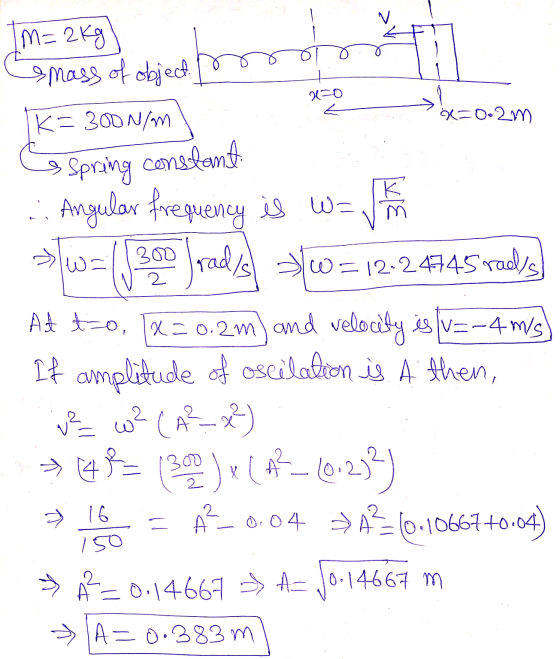
A 2.00-kg, frictionless block is attached to an ideal spring with force constant 300 N/m. At t=0 the block has velocity -4.00 m/s and displacement +0.200 m. Part A Find (a) the amplitude and (b) the phase angle. A A = nothing m SubmitRequest Answer Part B ϕ ϕ = nothing rad SubmitRequest Answer Part C Write an equation for the position as a function of time. Assume x(t) in meters and t in seconds. x(t) x(t) = nothing m
A 2.00-kg, frictionless block is attached to an ideal spring with force constant 300 . At the...
A 2.00-kg, frictionless block is attached to an ideal spring with force constant 300 . At the block has velocity -4.00 and displacement +0.200 .Part AFind (a) the amplitude and (b) the phase angle.=Part Bφ=Part CWrite an equation for the position as a function of time.Assume in meters and in seconds.=
Constants PartA A 2.00-kg, frictionless block is attached to an ideal spring with force constant 300...
 Constants PartA A 2.00-kg, frictionless block is attached to an ideal spring with force constant 300 N/m. Att0 the block has velocity -4.00 m/s and displacement +0.200 m Find (a) the amplitude and (b) the phase angle SubmitR Request Answer Part B rad Submit Request Answer Part C Write an equation for the position as a function of time. Assume (t) in meters and t in seconds. a (t)- Submit F Request Answer
A 2.00-kg, frictionless block is attached to an ideal spring with force constant 300 N/m Att-0...
 A 2.00-kg, frictionless block is attached to an ideal spring with force constant 300 N/m Att-0 the block has velocity -4.00 m/s and displacement +0.200 m. Correct Significant Figures Feedback: Your answer .382 m was either rounded differently or used a different number of significant figures than required for this part. ?: 1.02 rad Correct Significant Figures Feedback: Your answer 1.023 rad was either rounded differently or used a different number of significant figures than required for this part. Part...
A 2.50 kg frictionless block is attached to an ideal spring with force constant 312 N/m...
A 2.50 kg frictionless block is attached to an ideal spring with force constant 312 N/m . Initially the block has velocity -3.67 m/s and displacement 0.290 m . Find the amplitude of the motion. Find the maximum acceleration of the block. Find the maximum force the spring exerts on the block.
A 2.20 kg frictionless block is attached to an ideal spring with force constant 316 N/m...
A 2.20 kg frictionless block is attached to an ideal spring with force constant 316 N/m . Initially the block has velocity -3.80 m/s and displacement 0.240 m . A. Find the amplitude of the motion. B. Find the maximum acceleration of the block. C. Find the maximum force the spring exerts on the block.
A 2.40 kg frictionless block is attached to an ideal spring with force constant 317 N/m...
A 2.40 kg frictionless block is attached to an ideal spring with force constant 317 N/m . Initially the block has velocity -3.61 m/s and displacement 0.210 m . Part A Find the amplitude of the motion. Part B Find the maximum acceleration of the block. Part C Find the maximum force the spring exerts on the block.
A 2.5-kg, frictionless block is attached to an ideal spring with force constant 315N/m is undergoing...
A 2.5-kg, frictionless block is attached to an ideal spring with force constant 315N/m is undergoing simple harmonic motion. When the block has displacement 0.27 m, it is moving in the negative x-direction with a speed 4 m/s part a: find the amplitude of the motion ? (........m) part b: find the magnitude of the maximum force the spring exerts on the block? (..........N) (I have only 1 left try in mastering physics, please help me thanks)
A 2.00 kg frictionless block is attached to an ideal spring with force constant 350 N/m...
A 2.00 kg frictionless block is attached to an ideal spring with force constant 350 N/m . Initially the spring is neither stretched nor compressed, but the block is moving in the negative direction at 12.0 m/s . A. Find the amplitude of the motion. A = ____ m B. Find the maximum acceleration of the block. |amax| = ______ m/s2 C. Find the maximum force the spring exerts on the block. |Fmax| = ______ N
A 2.5-kg, frictionless block is attached to an ideal spring with force constant 315N/m is undergoing...
A 2.5-kg, frictionless block is attached to an ideal spring with force constant 315N/m is undergoing simple harmonic motion. When the block has displacement 0.27 m, it is moving in the negative x-direction with a speed 4 m/s part a: find the amplitude of the motion ? (........m) part b: find the magnitude of the maximum force the spring exerts on the block? (..........N)
 Constants PartA A 2.00-kg, frictionless block is attached to an ideal spring with force constant 300 N/m. Att0 the block has velocity -4.00 m/s and displacement +0.200 m Find (a) the amplitude and (b) the phase angle SubmitR Request Answer Part B rad Submit Request Answer Part C Write an equation for the position as a function of time. Assume (t) in meters and t in seconds. a (t)- Submit F Request Answer
 A 2.00-kg, frictionless block is attached to an ideal spring with force constant 300 N/m Att-0 the block has velocity -4.00 m/s and displacement +0.200 m. Correct Significant Figures Feedback: Your answer .382 m was either rounded differently or used a different number of significant figures than required for this part. ?: 1.02 rad Correct Significant Figures Feedback: Your answer 1.023 rad was either rounded differently or used a different number of significant figures than required for this part. Part...
Most questions answered within 3 hours.
-
Where is the error in this code sequence?
String s1 = "Hello";
String s2 = "ello";...
asked 11 months ago -
Financial data for Joel de Paris, Inc., for last year
follow:
Joel de Paris, Inc.
Balance...
asked 11 months ago -
Consider this reaction:
Al2(SO4)3 (aq)+ BaCl3
(aq) Al2Cl6 (aq)- +
3BaSO4(s) . What is the...
asked 11 months ago -
Suppose that Savneet is considering increasing her
recent random sample from 20 car rentals to 40...
asked 11 months ago -
Trucks arrive at an unloading terminal at an average rate of 120
per hour.
Trucks arrive...
asked 11 months ago -
Why are methanol and ethanol completely soluble in water while
octanol is not very little soluble....
asked 11 months ago -
A facilities manager at a university reads in a research report
that the mean amount of...
asked 11 months ago -
When the CuSO4 is rehydrated by adding water to the anhydrous
compound, is this an endothermic...
asked 11 months ago -
A ray of sunlight is passing from diamond into crown glass; the
angle of incidence is...
asked 11 months ago -
A block of mass 0.249 kg is placed on top of a light, vertical
spring of...
asked 11 months ago -
how do the kidneys compensate in the presences of acidosis
a) trigger hyperventilate
b) reserve acid...
asked 11 months ago -
Question 501 pts
The rental rate of capital to the firm increases. Which of the
following...
asked 11 months ago