
Homework Answers
You have not supplied the complete data for this question. I don't know what W and Wtotal refer to.
Neverthless, this question seems to apply the combinatorics so I am providing you the basic details about the number of possible distributions.
Assuming that all quantas are identical to each other and that all particles are also identical to each other:
If one particle can have at the most one quanta of energy only, then the possible number of distributions are:
7C4 = 7! / ( 4! * 3! ) = 35
Revert back with the missing information and I will edit and repost the answer.
Hope this helps !
Add Answer to:
Write out all of the distinct distributions of 4 quanta of energy among 7 particles. Calculate...
1-) Consider two systems A and B. Each system has 5 particles and allowed energy levels...
1-) Consider two systems A and B. Each system has 5 particles and allowed energy levels are ε=0, ε=1 , ε=2. Suppose total energy of the system is Utotal=UA+UB=4. For all possible distributions calculate the total multiplicity of the system. Which energy distribution maximizes multiplicity? 2) Suppose system A has 3, where as B has 7 particles. How does your answer change for 1)?
11 Consider an assembly of N-4 particles in a system which has equally spaced non degenerate...
 11 Consider an assembly of N-4 particles in a system which has equally spaced non degenerate energy levels, U-0.e,2e,3e, The total energy of the system is U 6. a) Assuming the particles are distinguishable, how many distributions of the particles over the energy levels are possible? List all of them in a table showing the number [7] of particles, n, in each energy level U b) To which particle statistics does this scenario correspond? c) How many microstates contribute to...
3. Derive the following relationship between the Helmholtz free energy F and the partition function Z for a system of N particles: (a) Starting with the thermodynamic definition F-U-TS, substitute th...
 3. Derive the following relationship between the Helmholtz free energy F and the partition function Z for a system of N particles: (a) Starting with the thermodynamic definition F-U-TS, substitute the statistical mechanics results which give U and S in terms of occupation numbers n, state energies e and the most probable number of microstates t* to find, (b) Write out texplicitly in terms of occupation numbers using Stirling's approxima- tion (check the Lagrange multiplier derivation of the Boltzmann distribution)...
Consider two Einstein solids A and B that can exchange energy (but not oscillators/particles) wit...
 Using matlab, evaluate the following system:Consider two Einstein solids \(A\) and \(B\) that can exchange energy (but not oscillators/particles) with one another but the combined composite system is isolated from the surroundings. Suppose systems \(A\) and \(B\) have \(N_{A}\) and \(N_{B}\) oscillators, and \(q_{A}\) and \(q_{B}\) units of energy respectively. The total number of microstates for this macrostate for the macrostate \(N_{A}, N_{B}, q, q_{A}\) is given by$$ \Omega\left(N_{A}, N_{B}, q, q_{A}\right)=\Omega\left(N_{A}, q_{A}\right) \Omega\left(N_{B}, q_{B}\right) $$where$$ \Omega\left(N_{i}, q_{i}\right)=\frac{\left(q_{i}+N_{i}-1\right) !}{q_{i} !\left(N_{i}-1\right)...
1. What form of energy do cells rely on most to carry out important processes? 2....
1. What form of energy do cells rely on most to carry out important processes? 2. At what point during fasting does the body start using ketones for fuel? When does it use amino acids? 3. What process occurs during swallowing that ensures food ends in the stomach? 4. How many calories would a person need to decrease in one week in order to lose one pound? 5. Can 2 people with the same body mass index have different body...
Consider a system consisting of three particles: m1 = 5 kg, v1 = <11, -8, 12>m/s
Consider a system consisting of three particles: m1 = 5 kg, v1 = <11, -8, 12>m/s m2 = 2 kg, v2 = < -13, 4, -5 > m/s m3 = 2 kg, v2 = < -22, 38, 20 > m/s (a) What is the total momentum of this system? (b) What is the velocity of the center of mass of this system? (c) What is the total kinetic energy of this system? (d) What is the translational kinetic energy of this system? (e) What is the kinetic energy...
Energy Relative energy from text (see chapter 4 of Smith text) RECORD DATA for each conformer...
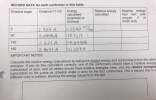 Energy Relative energy from text (see chapter 4 of Smith text) RECORD DATA for each conformer in this table: Dihedral angle Distance C1-C4 Relative energy calculated calculated (kcal/mol) or (KJ/mol) 2.907 A 10 5593 kJ moll 60 3.088A 17.7217 " 120 3.621A -4.6788 180 13.871A 721.2379 IMPORTANT NOTES: Calculate the relative energy (calculated) by taking the lowest energy and subtracting it from the other energies. If you do this calculation correctly, one of the conformers should have a "relative energy...
Please explain the answer to (7) using a minimum of 5-7 sentences, written out in words. YOU DO N...
 Please
explain the answer to (7) using a minimum of 5-7 sentences, written
out in words. YOU DO NOT NEED TO SOLVE CA10D. I only included it as
a reference to what is asked in (7).
7.丌1n your own words, give a clear, logical expla- nation for why the angles in a triangle must al- ways add to 180°. Do not use the "putting angles together" method of Class Activity 10D. 25 10.1 Lines and Angles CA-203 Class Activity 10D...
Please
explain the answer to (7) using a minimum of 5-7 sentences, written
out in words. YOU DO NOT NEED TO SOLVE CA10D. I only included it as
a reference to what is asked in (7).
7.丌1n your own words, give a clear, logical expla- nation for why the angles in a triangle must al- ways add to 180°. Do not use the "putting angles together" method of Class Activity 10D. 25 10.1 Lines and Angles CA-203 Class Activity 10D...
1. Write electron configuration for …. DO NOT use the core notation. Write out the last...
1. Write electron configuration for …. DO NOT use the core notation. Write out the last one so it would match the Box diagram. ( for example, write ….2p1,1,0 instead of 2p2). a) Sn b) Ba c)Nb d) Mg 2. Write electron configuration for …. Use the core notation. Write out the last one so it would match the Box diagram. ( for example, write ….2p1,1,0 instead of 2p2). a) Sn a) Zr Co Kr As 3. How many families...
Consider the following population: (4,7, 10, 13). Note that the population mean is the following. 4+7+10+'13...
 Consider the following population: (4,7, 10, 13). Note that the population mean is the following. 4+7+10+'13 -8.5 (a) Suppose that a random sample of sine 2 is to be selected without replacement from this population. There are 12 possible samples (provided that the order in which observations are selected is taken into account): 4,7 4,10 4,13 7.4 7.10 7.13 10,4 10,7 10, 13 13,4 13,7 13, 10 Compute the sample mean for each of the 12 possible samples Sample Sample...
 11 Consider an assembly of N-4 particles in a system which has equally spaced non degenerate energy levels, U-0.e,2e,3e, The total energy of the system is U 6. a) Assuming the particles are distinguishable, how many distributions of the particles over the energy levels are possible? List all of them in a table showing the number [7] of particles, n, in each energy level U b) To which particle statistics does this scenario correspond? c) How many microstates contribute to...
 3. Derive the following relationship between the Helmholtz free energy F and the partition function Z for a system of N particles: (a) Starting with the thermodynamic definition F-U-TS, substitute the statistical mechanics results which give U and S in terms of occupation numbers n, state energies e and the most probable number of microstates t* to find, (b) Write out texplicitly in terms of occupation numbers using Stirling's approxima- tion (check the Lagrange multiplier derivation of the Boltzmann distribution)...
 Using matlab, evaluate the following system:Consider two Einstein solids \(A\) and \(B\) that can exchange energy (but not oscillators/particles) with one another but the combined composite system is isolated from the surroundings. Suppose systems \(A\) and \(B\) have \(N_{A}\) and \(N_{B}\) oscillators, and \(q_{A}\) and \(q_{B}\) units of energy respectively. The total number of microstates for this macrostate for the macrostate \(N_{A}, N_{B}, q, q_{A}\) is given by$$ \Omega\left(N_{A}, N_{B}, q, q_{A}\right)=\Omega\left(N_{A}, q_{A}\right) \Omega\left(N_{B}, q_{B}\right) $$where$$ \Omega\left(N_{i}, q_{i}\right)=\frac{\left(q_{i}+N_{i}-1\right) !}{q_{i} !\left(N_{i}-1\right)...
 Energy Relative energy from text (see chapter 4 of Smith text) RECORD DATA for each conformer in this table: Dihedral angle Distance C1-C4 Relative energy calculated calculated (kcal/mol) or (KJ/mol) 2.907 A 10 5593 kJ moll 60 3.088A 17.7217 " 120 3.621A -4.6788 180 13.871A 721.2379 IMPORTANT NOTES: Calculate the relative energy (calculated) by taking the lowest energy and subtracting it from the other energies. If you do this calculation correctly, one of the conformers should have a "relative energy...
 Please
explain the answer to (7) using a minimum of 5-7 sentences, written
out in words. YOU DO NOT NEED TO SOLVE CA10D. I only included it as
a reference to what is asked in (7).
7.丌1n your own words, give a clear, logical expla- nation for why the angles in a triangle must al- ways add to 180°. Do not use the "putting angles together" method of Class Activity 10D. 25 10.1 Lines and Angles CA-203 Class Activity 10D...
Please
explain the answer to (7) using a minimum of 5-7 sentences, written
out in words. YOU DO NOT NEED TO SOLVE CA10D. I only included it as
a reference to what is asked in (7).
7.丌1n your own words, give a clear, logical expla- nation for why the angles in a triangle must al- ways add to 180°. Do not use the "putting angles together" method of Class Activity 10D. 25 10.1 Lines and Angles CA-203 Class Activity 10D...
 Consider the following population: (4,7, 10, 13). Note that the population mean is the following. 4+7+10+'13 -8.5 (a) Suppose that a random sample of sine 2 is to be selected without replacement from this population. There are 12 possible samples (provided that the order in which observations are selected is taken into account): 4,7 4,10 4,13 7.4 7.10 7.13 10,4 10,7 10, 13 13,4 13,7 13, 10 Compute the sample mean for each of the 12 possible samples Sample Sample...
Most questions answered within 3 hours.
-
Where is the error in this code sequence?
String s1 = "Hello";
String s2 = "ello";...
asked 11 months ago -
Financial data for Joel de Paris, Inc., for last year
follow:
Joel de Paris, Inc.
Balance...
asked 11 months ago -
Consider this reaction:
Al2(SO4)3 (aq)+ BaCl3
(aq) Al2Cl6 (aq)- +
3BaSO4(s) . What is the...
asked 11 months ago -
Suppose that Savneet is considering increasing her
recent random sample from 20 car rentals to 40...
asked 11 months ago -
Trucks arrive at an unloading terminal at an average rate of 120
per hour.
Trucks arrive...
asked 11 months ago -
Why are methanol and ethanol completely soluble in water while
octanol is not very little soluble....
asked 11 months ago -
A facilities manager at a university reads in a research report
that the mean amount of...
asked 11 months ago -
When the CuSO4 is rehydrated by adding water to the anhydrous
compound, is this an endothermic...
asked 11 months ago -
A ray of sunlight is passing from diamond into crown glass; the
angle of incidence is...
asked 11 months ago -
A block of mass 0.249 kg is placed on top of a light, vertical
spring of...
asked 11 months ago -
how do the kidneys compensate in the presences of acidosis
a) trigger hyperventilate
b) reserve acid...
asked 11 months ago -
Question 501 pts
The rental rate of capital to the firm increases. Which of the
following...
asked 11 months ago