A friend is having trouble with exponents and asks you to review her work. Look over...
A friend is having trouble with exponents and asks you to review her work. Look over the problem and correct any mistakes. Part a) Find the correct answer. Part b) Explain the error in her reasoning.
Prolem: (2x^2y)(3x^5)(y^2)
answer: 6x^10 y^2
Homework Answers

Add Answer to:
A friend is having trouble with exponents and asks you to review
her work. Look over...
An office administrator realizes that she is having trouble doing her work due to eyesight problems....
An office administrator realizes that she is having trouble doing her work due to eyesight problems. Her optometrist determines that without glasses she can focus clearly only on objects that lie at distances between 0.720 m and 4.40 m. The optometrist decides that the best way to handle her eyesight problems is to prescribe bifocals that will give her normal visual acuity from 25.0 cm out to infinity. After trying on several pairs of glasses frames, they agree that the...
having trouble finding y(t) NOT Correct (1 point) Consider the initial value problem y"+16y 48t, y(0)3,...
 having trouble finding y(t)
NOT Correct (1 point) Consider the initial value problem y"+16y 48t, y(0)3, /(0)-9. a. Take the Laplace transform of both sides of the given differential equation to create the corresponding algebraic equation. Denote the Laplace transform of y(t) by Y(s). Do not move any terms from one side of the equation to the other (until you get to part (b) below). (s 2Y(s)-3s-9)+16Y(s) help (formulas) 48/s 2 b. Solve your equation for Y(s). C{y(t))=48/(s 2(s2+ 16)...
having trouble finding y(t)
NOT Correct (1 point) Consider the initial value problem y"+16y 48t, y(0)3, /(0)-9. a. Take the Laplace transform of both sides of the given differential equation to create the corresponding algebraic equation. Denote the Laplace transform of y(t) by Y(s). Do not move any terms from one side of the equation to the other (until you get to part (b) below). (s 2Y(s)-3s-9)+16Y(s) help (formulas) 48/s 2 b. Solve your equation for Y(s). C{y(t))=48/(s 2(s2+ 16)...
I'm having trouble with this problem, I know to find the individual Field strengths but combining...
 I'm having trouble with this problem, I know to find the
individual Field strengths but combining them into a single vector
is causing me trouble. Any help is appreciated!
Review ▼ Part A What are the strength and direction of the electric field at the position indicated by the dot in (Figure 1)? Give your answer in component form. (Assume that x-axis is horizontal and points to the right, and y-axis points upward.) Express your answer in terms of the...
I'm having trouble with this problem, I know to find the
individual Field strengths but combining them into a single vector
is causing me trouble. Any help is appreciated!
Review ▼ Part A What are the strength and direction of the electric field at the position indicated by the dot in (Figure 1)? Give your answer in component form. (Assume that x-axis is horizontal and points to the right, and y-axis points upward.) Express your answer in terms of the...
can you please answer all of them please need it for a review F(x y, z)...
 can you please answer all of them please need it for a
review
F(x y, z) = 6x over the rectangular solid in the first octant bounded by the coordinate planes and the planes X-9, y-3, 2-S 27 1458 162 243 Find the center of mass of a thin triangular plate bounded by the coordinate axes and the line x + y = 4 if o(x, y) = x + y. 5 5 -3.73 . Oz Find the center of...
can you please answer all of them please need it for a
review
F(x y, z) = 6x over the rectangular solid in the first octant bounded by the coordinate planes and the planes X-9, y-3, 2-S 27 1458 162 243 Find the center of mass of a thin triangular plate bounded by the coordinate axes and the line x + y = 4 if o(x, y) = x + y. 5 5 -3.73 . Oz Find the center of...
Hello, I'm having some trouble computing the taxable income for this problem. Please describe how you...
 Hello,
I'm having some trouble computing the taxable income for this
problem. Please describe how you arrive at the correct answer.
The problem is referring to the 2018 tax code.
Problem 3-39 (LO. 1, 2, 3, 4, 5, 6) Charlotte (age 40) is a surviving spouse and provides all of the support of her four minor children who live with her (all are under age 16). She also maintains the household in which her parents live and furnished 60% of...
Hello,
I'm having some trouble computing the taxable income for this
problem. Please describe how you arrive at the correct answer.
The problem is referring to the 2018 tax code.
Problem 3-39 (LO. 1, 2, 3, 4, 5, 6) Charlotte (age 40) is a surviving spouse and provides all of the support of her four minor children who live with her (all are under age 16). She also maintains the household in which her parents live and furnished 60% of...
Hi I am having trouble with the last two questions. Please show work Two charges, Q1=...
 Hi I am having trouble with the last two questions. Please show
work
Two charges, Q1= 4.00 μС, and Q2= 5.40 pC are located at points (0,-4.00 cm ) and (0,+4.00 cm), as shown in the figure What is the magnitude of the electric field at point P, located at (5.50 cm, 0), due to Q1 alone? 7.78×10⁶ N/C You are correct. Previous Tries What is the x-component of the total electric field at P? 1.48x10⁷ N/C You are correct....
Hi I am having trouble with the last two questions. Please show
work
Two charges, Q1= 4.00 μС, and Q2= 5.40 pC are located at points (0,-4.00 cm ) and (0,+4.00 cm), as shown in the figure What is the magnitude of the electric field at point P, located at (5.50 cm, 0), due to Q1 alone? 7.78×10⁶ N/C You are correct. Previous Tries What is the x-component of the total electric field at P? 1.48x10⁷ N/C You are correct....
I've figured out part a and b but am having trouble on part c. Thanks! VU...
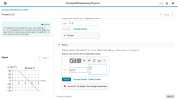 I've figured out part a and b
but am having trouble on part c. Thanks!
VU phys205 Engineering Physics l Kelly VU phys205 Worksheet MO3 Problem 2.37 2 of 3 Review Three particles move along the r-axis, each starting at to 0s. The graph for A is a position-versus-time graph; the graph for B is a velocity-versus-time graph; the graph for C is an acceleration-versus-time graph Correct Part C Find the velocity of the particle C at t 6.5 s....
I've figured out part a and b
but am having trouble on part c. Thanks!
VU phys205 Engineering Physics l Kelly VU phys205 Worksheet MO3 Problem 2.37 2 of 3 Review Three particles move along the r-axis, each starting at to 0s. The graph for A is a position-versus-time graph; the graph for B is a velocity-versus-time graph; the graph for C is an acceleration-versus-time graph Correct Part C Find the velocity of the particle C at t 6.5 s....
please show work, im having trouble to do it. Thank you Math 130 -Section 1.7 Solving...
 please show work, im having trouble to do it. Thank you
Math 130 -Section 1.7 Solving Inequalities 1. Let S-(-3,-1,0, v2.4), Determine which elements of S satisfy the inequality. (a) 3r + 1< 4 (b) r2-32 2 2. Solve the linear inequality. Express the solution using interval notation and graph the solution set. (a) 4 - 13 > 5 t13 (b) -2r +5 s 9 - -S +13 2x44 2,00) (o (c) 5 3x-4S 14 t> (P) 923x 418 32x26...
please show work, im having trouble to do it. Thank you
Math 130 -Section 1.7 Solving Inequalities 1. Let S-(-3,-1,0, v2.4), Determine which elements of S satisfy the inequality. (a) 3r + 1< 4 (b) r2-32 2 2. Solve the linear inequality. Express the solution using interval notation and graph the solution set. (a) 4 - 13 > 5 t13 (b) -2r +5 s 9 - -S +13 2x44 2,00) (o (c) 5 3x-4S 14 t> (P) 923x 418 32x26...
PLEASE ANSWER BOTH AND SHOW WORK FOR A RATING. THANK YOU! 15.2 Double integrals over general...
 PLEASE ANSWER BOTH AND SHOW WORK FOR A RATING. THANK YOU!
15.2 Double integrals over general regions: Problem 1 Previous Problem Problem List Next Problem (1 point) Calculate the Riemann sum for f(x, y) = 7x – 2y and domain D in Figure 2 with two choices of sample points, and o. Which do you think is a better approximation to the integral of fover D? Why? y 4 O o o 3 o 2 1 O 0 1 2...
PLEASE ANSWER BOTH AND SHOW WORK FOR A RATING. THANK YOU!
15.2 Double integrals over general regions: Problem 1 Previous Problem Problem List Next Problem (1 point) Calculate the Riemann sum for f(x, y) = 7x – 2y and domain D in Figure 2 with two choices of sample points, and o. Which do you think is a better approximation to the integral of fover D? Why? y 4 O o o 3 o 2 1 O 0 1 2...
Hello, I am having trouble with part c of this question. Here is my work so far: The solution for part c states that a...
 Hello, I am having trouble with part c of this question.
Here is my work so far:
The solution for part c states that a possible solution is (e^16
* 4^3) / 3!
I am having trouble understanding how they got e^16 or why they
decided to use e^(4^2) for M in the equation |f(x) - Tn(x)| <=
(M / (n + 1)!) * |x - 0|^(n + 1).
From my understanding, I have to maximize H^3(x) (i.e. 3rd
derivative...
Hello, I am having trouble with part c of this question.
Here is my work so far:
The solution for part c states that a possible solution is (e^16
* 4^3) / 3!
I am having trouble understanding how they got e^16 or why they
decided to use e^(4^2) for M in the equation |f(x) - Tn(x)| <=
(M / (n + 1)!) * |x - 0|^(n + 1).
From my understanding, I have to maximize H^3(x) (i.e. 3rd
derivative...
 having trouble finding y(t)
NOT Correct (1 point) Consider the initial value problem y"+16y 48t, y(0)3, /(0)-9. a. Take the Laplace transform of both sides of the given differential equation to create the corresponding algebraic equation. Denote the Laplace transform of y(t) by Y(s). Do not move any terms from one side of the equation to the other (until you get to part (b) below). (s 2Y(s)-3s-9)+16Y(s) help (formulas) 48/s 2 b. Solve your equation for Y(s). C{y(t))=48/(s 2(s2+ 16)...
having trouble finding y(t)
NOT Correct (1 point) Consider the initial value problem y"+16y 48t, y(0)3, /(0)-9. a. Take the Laplace transform of both sides of the given differential equation to create the corresponding algebraic equation. Denote the Laplace transform of y(t) by Y(s). Do not move any terms from one side of the equation to the other (until you get to part (b) below). (s 2Y(s)-3s-9)+16Y(s) help (formulas) 48/s 2 b. Solve your equation for Y(s). C{y(t))=48/(s 2(s2+ 16)...
 I'm having trouble with this problem, I know to find the
individual Field strengths but combining them into a single vector
is causing me trouble. Any help is appreciated!
Review ▼ Part A What are the strength and direction of the electric field at the position indicated by the dot in (Figure 1)? Give your answer in component form. (Assume that x-axis is horizontal and points to the right, and y-axis points upward.) Express your answer in terms of the...
I'm having trouble with this problem, I know to find the
individual Field strengths but combining them into a single vector
is causing me trouble. Any help is appreciated!
Review ▼ Part A What are the strength and direction of the electric field at the position indicated by the dot in (Figure 1)? Give your answer in component form. (Assume that x-axis is horizontal and points to the right, and y-axis points upward.) Express your answer in terms of the...
 can you please answer all of them please need it for a
review
F(x y, z) = 6x over the rectangular solid in the first octant bounded by the coordinate planes and the planes X-9, y-3, 2-S 27 1458 162 243 Find the center of mass of a thin triangular plate bounded by the coordinate axes and the line x + y = 4 if o(x, y) = x + y. 5 5 -3.73 . Oz Find the center of...
can you please answer all of them please need it for a
review
F(x y, z) = 6x over the rectangular solid in the first octant bounded by the coordinate planes and the planes X-9, y-3, 2-S 27 1458 162 243 Find the center of mass of a thin triangular plate bounded by the coordinate axes and the line x + y = 4 if o(x, y) = x + y. 5 5 -3.73 . Oz Find the center of...
 Hello,
I'm having some trouble computing the taxable income for this
problem. Please describe how you arrive at the correct answer.
The problem is referring to the 2018 tax code.
Problem 3-39 (LO. 1, 2, 3, 4, 5, 6) Charlotte (age 40) is a surviving spouse and provides all of the support of her four minor children who live with her (all are under age 16). She also maintains the household in which her parents live and furnished 60% of...
Hello,
I'm having some trouble computing the taxable income for this
problem. Please describe how you arrive at the correct answer.
The problem is referring to the 2018 tax code.
Problem 3-39 (LO. 1, 2, 3, 4, 5, 6) Charlotte (age 40) is a surviving spouse and provides all of the support of her four minor children who live with her (all are under age 16). She also maintains the household in which her parents live and furnished 60% of...
 Hi I am having trouble with the last two questions. Please show
work
Two charges, Q1= 4.00 μС, and Q2= 5.40 pC are located at points (0,-4.00 cm ) and (0,+4.00 cm), as shown in the figure What is the magnitude of the electric field at point P, located at (5.50 cm, 0), due to Q1 alone? 7.78×10⁶ N/C You are correct. Previous Tries What is the x-component of the total electric field at P? 1.48x10⁷ N/C You are correct....
Hi I am having trouble with the last two questions. Please show
work
Two charges, Q1= 4.00 μС, and Q2= 5.40 pC are located at points (0,-4.00 cm ) and (0,+4.00 cm), as shown in the figure What is the magnitude of the electric field at point P, located at (5.50 cm, 0), due to Q1 alone? 7.78×10⁶ N/C You are correct. Previous Tries What is the x-component of the total electric field at P? 1.48x10⁷ N/C You are correct....
 I've figured out part a and b
but am having trouble on part c. Thanks!
VU phys205 Engineering Physics l Kelly VU phys205 Worksheet MO3 Problem 2.37 2 of 3 Review Three particles move along the r-axis, each starting at to 0s. The graph for A is a position-versus-time graph; the graph for B is a velocity-versus-time graph; the graph for C is an acceleration-versus-time graph Correct Part C Find the velocity of the particle C at t 6.5 s....
I've figured out part a and b
but am having trouble on part c. Thanks!
VU phys205 Engineering Physics l Kelly VU phys205 Worksheet MO3 Problem 2.37 2 of 3 Review Three particles move along the r-axis, each starting at to 0s. The graph for A is a position-versus-time graph; the graph for B is a velocity-versus-time graph; the graph for C is an acceleration-versus-time graph Correct Part C Find the velocity of the particle C at t 6.5 s....
 please show work, im having trouble to do it. Thank you
Math 130 -Section 1.7 Solving Inequalities 1. Let S-(-3,-1,0, v2.4), Determine which elements of S satisfy the inequality. (a) 3r + 1< 4 (b) r2-32 2 2. Solve the linear inequality. Express the solution using interval notation and graph the solution set. (a) 4 - 13 > 5 t13 (b) -2r +5 s 9 - -S +13 2x44 2,00) (o (c) 5 3x-4S 14 t> (P) 923x 418 32x26...
please show work, im having trouble to do it. Thank you
Math 130 -Section 1.7 Solving Inequalities 1. Let S-(-3,-1,0, v2.4), Determine which elements of S satisfy the inequality. (a) 3r + 1< 4 (b) r2-32 2 2. Solve the linear inequality. Express the solution using interval notation and graph the solution set. (a) 4 - 13 > 5 t13 (b) -2r +5 s 9 - -S +13 2x44 2,00) (o (c) 5 3x-4S 14 t> (P) 923x 418 32x26...
 PLEASE ANSWER BOTH AND SHOW WORK FOR A RATING. THANK YOU!
15.2 Double integrals over general regions: Problem 1 Previous Problem Problem List Next Problem (1 point) Calculate the Riemann sum for f(x, y) = 7x – 2y and domain D in Figure 2 with two choices of sample points, and o. Which do you think is a better approximation to the integral of fover D? Why? y 4 O o o 3 o 2 1 O 0 1 2...
PLEASE ANSWER BOTH AND SHOW WORK FOR A RATING. THANK YOU!
15.2 Double integrals over general regions: Problem 1 Previous Problem Problem List Next Problem (1 point) Calculate the Riemann sum for f(x, y) = 7x – 2y and domain D in Figure 2 with two choices of sample points, and o. Which do you think is a better approximation to the integral of fover D? Why? y 4 O o o 3 o 2 1 O 0 1 2...
 Hello, I am having trouble with part c of this question.
Here is my work so far:
The solution for part c states that a possible solution is (e^16
* 4^3) / 3!
I am having trouble understanding how they got e^16 or why they
decided to use e^(4^2) for M in the equation |f(x) - Tn(x)| <=
(M / (n + 1)!) * |x - 0|^(n + 1).
From my understanding, I have to maximize H^3(x) (i.e. 3rd
derivative...
Hello, I am having trouble with part c of this question.
Here is my work so far:
The solution for part c states that a possible solution is (e^16
* 4^3) / 3!
I am having trouble understanding how they got e^16 or why they
decided to use e^(4^2) for M in the equation |f(x) - Tn(x)| <=
(M / (n + 1)!) * |x - 0|^(n + 1).
From my understanding, I have to maximize H^3(x) (i.e. 3rd
derivative...
Most questions answered within 3 hours.
-
Where is the error in this code sequence?
String s1 = "Hello";
String s2 = "ello";...
asked 10 months ago -
Financial data for Joel de Paris, Inc., for last year
follow:
Joel de Paris, Inc.
Balance...
asked 10 months ago -
Consider this reaction:
Al2(SO4)3 (aq)+ BaCl3
(aq) Al2Cl6 (aq)- +
3BaSO4(s) . What is the...
asked 10 months ago -
Suppose that Savneet is considering increasing her
recent random sample from 20 car rentals to 40...
asked 10 months ago -
Trucks arrive at an unloading terminal at an average rate of 120
per hour.
Trucks arrive...
asked 10 months ago -
Why are methanol and ethanol completely soluble in water while
octanol is not very little soluble....
asked 10 months ago -
A facilities manager at a university reads in a research report
that the mean amount of...
asked 10 months ago -
When the CuSO4 is rehydrated by adding water to the anhydrous
compound, is this an endothermic...
asked 10 months ago -
A ray of sunlight is passing from diamond into crown glass; the
angle of incidence is...
asked 10 months ago -
A block of mass 0.249 kg is placed on top of a light, vertical
spring of...
asked 10 months ago -
how do the kidneys compensate in the presences of acidosis
a) trigger hyperventilate
b) reserve acid...
asked 10 months ago -
Question 501 pts
The rental rate of capital to the firm increases. Which of the
following...
asked 10 months ago