derive an expression for the entropy of mixing as a function of Xi
derive an expression for the entropy of mixing as a
function of Xi

Homework Answers


3. Consider the entropy as a function of temperature and pressure. Derive an expression for the change in entropy in te...
 3. Consider the entropy as a function of temperature and pressure. Derive an expression for the change in entropy in terms of parameters such as Cp, a, K, T, and V.
9.3.C Derive an expression for the molar excess enthalpy of mixing of a mixture described by...
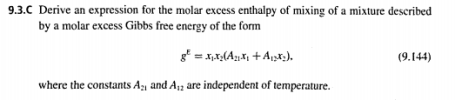 9.3.C Derive an expression for the molar excess enthalpy of mixing of a mixture described by a molar excess Gibbs free energy of the form (9.144) where the constants Azi and A1 are independent of temperature.
c. Derive the following expression Using the expression in part c, derive an expression for terms...
 c. Derive the following expression Using the expression in part c, derive an expression for terms of only Rand P. d. ASof an ideal gas in How does the molar entropy change with increasing pressure for an ideal gas? Justify you answer using the result in part d e.
2. Take the entropy to be a function of the independent variables T and V. For...
 2. Take the entropy to be a function of the independent variables T and V. For the van der Waals gas, derive an expression for the entropy as a function of volume at a given (fixed) temperature. Hint: You will want to take advantage of Maxwell's relations. Your answer will contain an undetermined constant of integration.
(20 pts) Derive the expression for the necessary magnetic flux ( function of am, for as...
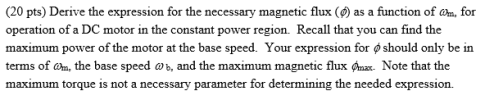 (20 pts) Derive the expression for the necessary magnetic flux ( function of am, for as a operation of a DC motor in the constant power region. Recall that you can find the maximum power of the motor at the base speed. Your expression for ø should only be in terms of am, the base speed ob, and the maximum magnetic flux dmax. Note that the maximum torque is not a necessary parameter for determining the needed expression
(20 pts)...
(20 pts) Derive the expression for the necessary magnetic flux ( function of am, for as a operation of a DC motor in the constant power region. Recall that you can find the maximum power of the motor at the base speed. Your expression for ø should only be in terms of am, the base speed ob, and the maximum magnetic flux dmax. Note that the maximum torque is not a necessary parameter for determining the needed expression
(20 pts)...
Using the partition function , where , derive an expression for the magnetization M of a...
Using the partition function , where , derive an expression for the magnetization M of a paramagnet consisting of N atoms, each with total angular momentum J. Use the formula,
2.26 Derive the simplest POS expression for the function of f = (Ti + T3 +...
 2.26 Derive the simplest POS expression for the function of f = (Ti + T3 + 14) T2 + T3 + x4) 11 + 12 +13)
Qc) Consider the following function F. х Y F N a) Derive the expression for the...
 Qc) Consider the following function F. х Y F N a) Derive the expression for the function F (Do not simplify F). b) Construct the truth table of F. c) Find expression for complement of F, F'.
For the general case, derive an expression to calculate the fraction dissociated, fd, as a function...
For the general case, derive an expression to calculate the fraction dissociated, fd, as a function of pH and pKa, with fd defined as: fd = [A-] / [A-] + [AH] Hint: First use the Henderson-Hasselbalch equation to write an expression for [AH] in terms of [A-]. Use this expression to replace [AH] in the equation above and simplify. Henderson-Hasselbalch: pH - pKa = log [A-]/[AH]
Compressible aerodynamics. Derive an expression for Cp that is a function of gamma and R only....
Compressible aerodynamics. Derive an expression for Cp that is a function of gamma and R only. Where gamma is the specific heat ratio, R is the gas constant, and Cp is the pressure coefficient.
 3. Consider the entropy as a function of temperature and pressure. Derive an expression for the change in entropy in terms of parameters such as Cp, a, K, T, and V.
 9.3.C Derive an expression for the molar excess enthalpy of mixing of a mixture described by a molar excess Gibbs free energy of the form (9.144) where the constants Azi and A1 are independent of temperature.
 c. Derive the following expression Using the expression in part c, derive an expression for terms of only Rand P. d. ASof an ideal gas in How does the molar entropy change with increasing pressure for an ideal gas? Justify you answer using the result in part d e.
 2. Take the entropy to be a function of the independent variables T and V. For the van der Waals gas, derive an expression for the entropy as a function of volume at a given (fixed) temperature. Hint: You will want to take advantage of Maxwell's relations. Your answer will contain an undetermined constant of integration.
 (20 pts) Derive the expression for the necessary magnetic flux ( function of am, for as a operation of a DC motor in the constant power region. Recall that you can find the maximum power of the motor at the base speed. Your expression for ø should only be in terms of am, the base speed ob, and the maximum magnetic flux dmax. Note that the maximum torque is not a necessary parameter for determining the needed expression
(20 pts)...
(20 pts) Derive the expression for the necessary magnetic flux ( function of am, for as a operation of a DC motor in the constant power region. Recall that you can find the maximum power of the motor at the base speed. Your expression for ø should only be in terms of am, the base speed ob, and the maximum magnetic flux dmax. Note that the maximum torque is not a necessary parameter for determining the needed expression
(20 pts)...
 2.26 Derive the simplest POS expression for the function of f = (Ti + T3 + 14) T2 + T3 + x4) 11 + 12 +13)
 Qc) Consider the following function F. х Y F N a) Derive the expression for the function F (Do not simplify F). b) Construct the truth table of F. c) Find expression for complement of F, F'.
Most questions answered within 3 hours.
-
Where is the error in this code sequence?
String s1 = "Hello";
String s2 = "ello";...
asked 10 months ago -
Financial data for Joel de Paris, Inc., for last year
follow:
Joel de Paris, Inc.
Balance...
asked 10 months ago -
Consider this reaction:
Al2(SO4)3 (aq)+ BaCl3
(aq) Al2Cl6 (aq)- +
3BaSO4(s) . What is the...
asked 10 months ago -
Suppose that Savneet is considering increasing her
recent random sample from 20 car rentals to 40...
asked 11 months ago -
Trucks arrive at an unloading terminal at an average rate of 120
per hour.
Trucks arrive...
asked 11 months ago -
Why are methanol and ethanol completely soluble in water while
octanol is not very little soluble....
asked 11 months ago -
A facilities manager at a university reads in a research report
that the mean amount of...
asked 11 months ago -
When the CuSO4 is rehydrated by adding water to the anhydrous
compound, is this an endothermic...
asked 11 months ago -
A ray of sunlight is passing from diamond into crown glass; the
angle of incidence is...
asked 11 months ago -
A block of mass 0.249 kg is placed on top of a light, vertical
spring of...
asked 11 months ago -
how do the kidneys compensate in the presences of acidosis
a) trigger hyperventilate
b) reserve acid...
asked 11 months ago -
Question 501 pts
The rental rate of capital to the firm increases. Which of the
following...
asked 11 months ago