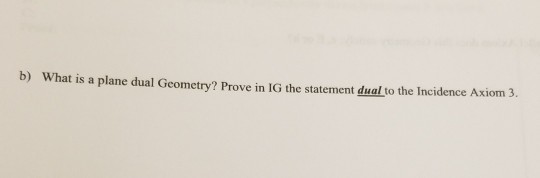
what is a plane dual Geometry? Prove in IG the statement dual to Incidence Axiom 3.
Homework Answers
 Thanks
Add Answer to:
what is a plane dual Geometry? Prove in IG the
statement dual to Incidence Axiom 3....
3) Let us build a geometry, S, using the three axioms of incidence geometry with one additional a...
 3) Let us build a geometry, S, using the three axioms of incidence geometry with one additional axiom added: Incidence Axiom l: For every point P and every point Q (P and Q not equal), there exists a unique line, I, incident with P and Q. Incidence Axiom 2: For every line / there exist at least two distinct points incident with Incidence Axiom3: There exist (at least) three distinct points with the property that no line is incident with...
3) Let us build a geometry, S, using the three axioms of incidence geometry with one...
 3) Let us build a geometry, S, using the three axioms of incidence geometry with one additional axiom added: Incidence Axiom l: For every point P and every point Q (P and Q not equal), there exists a unique line, I, incident with P and Q. Incidence Axiom 2: For every line / there exist at least two distinct points incident with Incidence Axiom3: There exist (at least) three distinct points with the property that no line is incident with...
3 Remember that for projective geometry, the dual of a statement is found by exchanging "point...
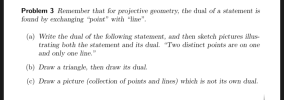 3 Remember that for projective geometry, the dual of a statement is found by exchanging "point with "ie" (a) Write the dual of the following statement, and then sketch picturess- trating both the statement and its dual. "Two distinct points are on one and only one line." (b) Draw a triangle, then draw its dual. (c) Draw a picture (collection of points and lines) which is not its own dual.
3. Determine which of the following are models of Incidence Geometry. For those th are models,...
 3. Determine which of the following are models of Incidence Geometry. For those th are models, indicate which parallel property holds for the model. For those that a not a model, list at least one axiom that fails and illustrate why. a. Points are points in the Euclidean plane and lines are circles with positive radius. b. Points are in {(x, y) = R2 22 + y2 <9} and lines are open chords of the circle. c. Points are points...
2) (i) State the converse of the Alternate Interior Angle Theorem in Neutral Geometry. (ii) Prove...
2) (i) State the converse of the Alternate Interior Angle Theorem in Neutral Geometry. (ii) Prove that if the converse of the Alternate Interior Angle Theorem is true, then all triangles have zero defect. [Hint: For an arbitrary triangle, ABC, draw a line through C parallel to side AB. Justify why you can do this.] 5) Consider the following statements: I: If two triangles are congruent, then they have equal defect. II: If two triangles are similar, then they have...
Part II. (4 pts) Given the axiom set for the Incidence Geometry as below: Undefined terms: point, line, on Definitions: 1. Two lines are intersecting if there is a point on both. 2. Two lines are...
 Part II. (4 pts) Given the axiom set for the Incidence Geometry as below: Undefined terms: point, line, on Definitions: 1. Two lines are intersecting if there is a point on both. 2. Two lines are parallel if they have no point in common. Axioms: I. Given any two distinct points, there is a unique line on both. II. Each line has at least two distinct points on it. III. There exist at least three points. IV. Not all points...
Duality Axiom 1. There exist exactly 4 distinct points. Axiom 2. There exist exactly 5 distinct...
 Duality
Axiom 1. There exist exactly 4 distinct points. Axiom 2. There exist exactly 5 distinct lines. Axiom 3. There is exactly 1 line with exactly 3 distinct points on it. Axiom 4. Given any 2 distinct points, there exists at least 1 line passing through the 2 points. Which of the following is the dual of Axiom 4? O a. Every line has at least 2 points on it. b. There exists at least 1 point with at least...
Duality
Axiom 1. There exist exactly 4 distinct points. Axiom 2. There exist exactly 5 distinct lines. Axiom 3. There is exactly 1 line with exactly 3 distinct points on it. Axiom 4. Given any 2 distinct points, there exists at least 1 line passing through the 2 points. Which of the following is the dual of Axiom 4? O a. Every line has at least 2 points on it. b. There exists at least 1 point with at least...
Prove that an affine plane extended by ideal points and ideal line will satisfy projective Axiom ...
prove that an affine plane extended by ideal points and ideal line will satisfy projective Axiom 3. (Use cases: 1) when two lines are affine lines with an ideal point added 2) when of one the two lines is an ideal line)
Show that every model of incidence geometry which consists of precisely 3 points is isomorphic to...
 Show that every model of incidence geometry which consists of precisely 3 points is isomorphic to the 3-point plane. (8 points)
1. a) Prove that the axiom "OSz and 0 3 y implies 0 tion is equivalent...
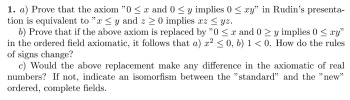 1. a) Prove that the axiom "OSz and 0 3 y implies 0 tion is equivalent to "r 3 y and z 2 0 implies xz ya. ry" in Rudin's presenta- b) Prove that if the above axiom is replaced by "O < x and 0 2y implies 0 ry" in the ordered field axiomatic, it follows that 0, b) 1 <0. How do the rules of signs change? c) Would the above replacement make any difference in the axiomatic...
 3) Let us build a geometry, S, using the three axioms of incidence geometry with one additional axiom added: Incidence Axiom l: For every point P and every point Q (P and Q not equal), there exists a unique line, I, incident with P and Q. Incidence Axiom 2: For every line / there exist at least two distinct points incident with Incidence Axiom3: There exist (at least) three distinct points with the property that no line is incident with...
 3) Let us build a geometry, S, using the three axioms of incidence geometry with one additional axiom added: Incidence Axiom l: For every point P and every point Q (P and Q not equal), there exists a unique line, I, incident with P and Q. Incidence Axiom 2: For every line / there exist at least two distinct points incident with Incidence Axiom3: There exist (at least) three distinct points with the property that no line is incident with...
 3 Remember that for projective geometry, the dual of a statement is found by exchanging "point with "ie" (a) Write the dual of the following statement, and then sketch picturess- trating both the statement and its dual. "Two distinct points are on one and only one line." (b) Draw a triangle, then draw its dual. (c) Draw a picture (collection of points and lines) which is not its own dual.
 3. Determine which of the following are models of Incidence Geometry. For those th are models, indicate which parallel property holds for the model. For those that a not a model, list at least one axiom that fails and illustrate why. a. Points are points in the Euclidean plane and lines are circles with positive radius. b. Points are in {(x, y) = R2 22 + y2 <9} and lines are open chords of the circle. c. Points are points...
 Part II. (4 pts) Given the axiom set for the Incidence Geometry as below: Undefined terms: point, line, on Definitions: 1. Two lines are intersecting if there is a point on both. 2. Two lines are parallel if they have no point in common. Axioms: I. Given any two distinct points, there is a unique line on both. II. Each line has at least two distinct points on it. III. There exist at least three points. IV. Not all points...
 Duality
Axiom 1. There exist exactly 4 distinct points. Axiom 2. There exist exactly 5 distinct lines. Axiom 3. There is exactly 1 line with exactly 3 distinct points on it. Axiom 4. Given any 2 distinct points, there exists at least 1 line passing through the 2 points. Which of the following is the dual of Axiom 4? O a. Every line has at least 2 points on it. b. There exists at least 1 point with at least...
Duality
Axiom 1. There exist exactly 4 distinct points. Axiom 2. There exist exactly 5 distinct lines. Axiom 3. There is exactly 1 line with exactly 3 distinct points on it. Axiom 4. Given any 2 distinct points, there exists at least 1 line passing through the 2 points. Which of the following is the dual of Axiom 4? O a. Every line has at least 2 points on it. b. There exists at least 1 point with at least...
 Show that every model of incidence geometry which consists of precisely 3 points is isomorphic to the 3-point plane. (8 points)
 1. a) Prove that the axiom "OSz and 0 3 y implies 0 tion is equivalent to "r 3 y and z 2 0 implies xz ya. ry" in Rudin's presenta- b) Prove that if the above axiom is replaced by "O < x and 0 2y implies 0 ry" in the ordered field axiomatic, it follows that 0, b) 1 <0. How do the rules of signs change? c) Would the above replacement make any difference in the axiomatic...
Most questions answered within 3 hours.
-
Where is the error in this code sequence?
String s1 = "Hello";
String s2 = "ello";...
asked 11 months ago -
Financial data for Joel de Paris, Inc., for last year
follow:
Joel de Paris, Inc.
Balance...
asked 11 months ago -
Consider this reaction:
Al2(SO4)3 (aq)+ BaCl3
(aq) Al2Cl6 (aq)- +
3BaSO4(s) . What is the...
asked 11 months ago -
Suppose that Savneet is considering increasing her
recent random sample from 20 car rentals to 40...
asked 11 months ago -
Trucks arrive at an unloading terminal at an average rate of 120
per hour.
Trucks arrive...
asked 11 months ago -
Why are methanol and ethanol completely soluble in water while
octanol is not very little soluble....
asked 11 months ago -
A facilities manager at a university reads in a research report
that the mean amount of...
asked 11 months ago -
When the CuSO4 is rehydrated by adding water to the anhydrous
compound, is this an endothermic...
asked 11 months ago -
A ray of sunlight is passing from diamond into crown glass; the
angle of incidence is...
asked 11 months ago -
A block of mass 0.249 kg is placed on top of a light, vertical
spring of...
asked 11 months ago -
how do the kidneys compensate in the presences of acidosis
a) trigger hyperventilate
b) reserve acid...
asked 11 months ago -
Question 501 pts
The rental rate of capital to the firm increases. Which of the
following...
asked 11 months ago