How can you use electromagnetic waves within the visible spectrum to identify unknown gases?
How can you use electromagnetic waves within the visible spectrum to identify unknown gases?
Homework Answers
when an unknown gas is passed through visible electromagnetic waves region it absorbs some colors at particular frequency which is unique for evergy gas .spectrum which is left behind is called emission spectra. we can see some dark bands in it this happens because
When an atoms are passed throgh visible spectrum they absorbs energy, their electrons jump to higher energy levels. Then they jump back down again. Each jump corresponds to a particular wavelength of light.
There are many possible electron transitions for each atom. Each transition has a specific energy difference. This collection of transitions makes up an emission spectrum. These emission spectra are distinctive to each element
Thus we can use atomic spectra to identify the unknown gas .
Add Answer to:
How can you use electromagnetic waves within the visible
spectrum to identify unknown gases?
The electromagnetic spectrum arranged by increasing wavelength is O radio waves, gamma rays, x-rays, visible light,...
 The electromagnetic spectrum arranged by increasing wavelength is O radio waves, gamma rays, x-rays, visible light, infrared, microwave, ultra violet. O x-rays, gamma rays, ultraviolet, visible light, infrared, microwave, radio waves. O infrared, gamma rays, x-rays, ultraviolet, visible light, microwave, radio waves. O gamma rays, x-rays, ultraviolet, visible light, infrared, microwave, radio waves.
Within the electromagnetic spectrum, visible light provides the energy for photosynthesis and Click the answer you...
 Within the electromagnetic spectrum, visible light provides the energy for photosynthesis and Click the answer you think is right. long wavelength and low amount of energy. middle-range wavelength and medium amount of energy. short wavelength and high amount of energy. I know it No Idea
Where do radio waves fall on the electromagnetic spectrum? a. Radio waves have the same wavelengths...
Where do radio waves fall on the electromagnetic spectrum? a. Radio waves have the same wavelengths as visible light. b. Radio waves falls on the high-frequency side of visible light. c. Radio waves fall on the short-wavelength side of visible light. d. Radio waves fall on the low-frequency side of visible light.
The diagram shows the electromagnetic spectrum.
 1.The diagram shows the electromagnetic spectrum. Identify the types of electromagnetic radiation (EMR) with the following characteristics. (a) highest frequency radio waves microwaves infrared visible ultraviolet X rays gamma rays (b) highest energy radio waves microwaves infrared visible ultraviolet X rays gamma rays (c) longest wavelength radio waves microwaves infrared visible ultraviolet X rays gamma rays2. Calculate the energy (in joules) of a photon with a wavelength of 2.93x10 nm.
Chapter 6 Waves and Electromagnetic Radiation Identify everyday examples of waves that travel through solids, liquids...
Chapter 6 Waves and Electromagnetic Radiation Identify everyday examples of waves that travel through solids, liquids and gases. What are transverse and longitudinal waves?What happens when two different waves overlap? A vat of molten iron is heated until white hot, then poured into a mold. As it cools, its color changes to yellow and then red. Explain why this occurs. Identify three common uses of microwaves. What are some uses of gamma rays? What is the Doppler effect? Give an...
11) Considering the electromagnetic spectrum, identify likely mutagens from the following list: radio waves, microwaves, infrared,...
 11) Considering the electromagnetic spectrum, identify likely mutagens from the following list: radio waves, microwaves, infrared, ultraviolet, X-rays, gamma rays, and cosmic rays. (4 pts)
can you answer all questions please 26. Describe how you could use IR spectroscopy to distinguish between the follo...
 can you answer all questions please
26. Describe how you could use IR spectroscopy to distinguish between the following two isomers. 27. Match each compound below to its IR spectrum based on the intensity of the alkane C-H stretch absorption band. Spectrum 2 Spectrum 3 28. Nuclear magnetic resonance spectroscopy is generated using which type of electromagnetic radiation? a. microwaves b. radio waves c. visible light d. gamma rays e. No electromagnetic radiation is used.
can you answer all questions please
26. Describe how you could use IR spectroscopy to distinguish between the following two isomers. 27. Match each compound below to its IR spectrum based on the intensity of the alkane C-H stretch absorption band. Spectrum 2 Spectrum 3 28. Nuclear magnetic resonance spectroscopy is generated using which type of electromagnetic radiation? a. microwaves b. radio waves c. visible light d. gamma rays e. No electromagnetic radiation is used.
Question5 micro infra visible waves -red gamma X-rays rays B C D The diagram represents the...
 Question5 micro infra visible waves -red gamma X-rays rays B C D The diagram represents the range of waves in the electromagnetic spectrum. a) What are the waves in section D called? b Give one important use for these waves. c) State one hazard of exposure to these waves. d) Explain one precaution that can be taken to minimize this hazard (Total: 4 marks) (Total marks for TMA-36)
Which of the following is the portion of the electromagnetic spectrum that is adjacent to visible...
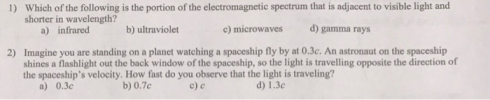 Which of the following is the portion of the electromagnetic spectrum that is adjacent to visible light and shorter in wavelength? 1) a) infrared b) ultraviolet c) microwaves d) gamma rays Imagine you are standing on a planet watching a spaceship fly by at 0.3c. An astronaut on the spaceship shines a flashlight out the back window of the spaceship, so the light is travelling opposite the direction of the spaceship's velocity. How fast do you observe that the light...
When you consider the electromagnetic spectrum containing visible light and X-rays, both are emitted from the...
 When you consider the electromagnetic spectrum containing visible light and X-rays, both are emitted from the positive atomic nucleus electrons around the atom different energy sources
 The electromagnetic spectrum arranged by increasing wavelength is O radio waves, gamma rays, x-rays, visible light, infrared, microwave, ultra violet. O x-rays, gamma rays, ultraviolet, visible light, infrared, microwave, radio waves. O infrared, gamma rays, x-rays, ultraviolet, visible light, microwave, radio waves. O gamma rays, x-rays, ultraviolet, visible light, infrared, microwave, radio waves.
 Within the electromagnetic spectrum, visible light provides the energy for photosynthesis and Click the answer you think is right. long wavelength and low amount of energy. middle-range wavelength and medium amount of energy. short wavelength and high amount of energy. I know it No Idea
 11) Considering the electromagnetic spectrum, identify likely mutagens from the following list: radio waves, microwaves, infrared, ultraviolet, X-rays, gamma rays, and cosmic rays. (4 pts)
 can you answer all questions please
26. Describe how you could use IR spectroscopy to distinguish between the following two isomers. 27. Match each compound below to its IR spectrum based on the intensity of the alkane C-H stretch absorption band. Spectrum 2 Spectrum 3 28. Nuclear magnetic resonance spectroscopy is generated using which type of electromagnetic radiation? a. microwaves b. radio waves c. visible light d. gamma rays e. No electromagnetic radiation is used.
can you answer all questions please
26. Describe how you could use IR spectroscopy to distinguish between the following two isomers. 27. Match each compound below to its IR spectrum based on the intensity of the alkane C-H stretch absorption band. Spectrum 2 Spectrum 3 28. Nuclear magnetic resonance spectroscopy is generated using which type of electromagnetic radiation? a. microwaves b. radio waves c. visible light d. gamma rays e. No electromagnetic radiation is used.
 Question5 micro infra visible waves -red gamma X-rays rays B C D The diagram represents the range of waves in the electromagnetic spectrum. a) What are the waves in section D called? b Give one important use for these waves. c) State one hazard of exposure to these waves. d) Explain one precaution that can be taken to minimize this hazard (Total: 4 marks) (Total marks for TMA-36)
 Which of the following is the portion of the electromagnetic spectrum that is adjacent to visible light and shorter in wavelength? 1) a) infrared b) ultraviolet c) microwaves d) gamma rays Imagine you are standing on a planet watching a spaceship fly by at 0.3c. An astronaut on the spaceship shines a flashlight out the back window of the spaceship, so the light is travelling opposite the direction of the spaceship's velocity. How fast do you observe that the light...
 When you consider the electromagnetic spectrum containing visible light and X-rays, both are emitted from the positive atomic nucleus electrons around the atom different energy sources
Most questions answered within 3 hours.
-
Where is the error in this code sequence?
String s1 = "Hello";
String s2 = "ello";...
asked 10 months ago -
Financial data for Joel de Paris, Inc., for last year
follow:
Joel de Paris, Inc.
Balance...
asked 10 months ago -
Consider this reaction:
Al2(SO4)3 (aq)+ BaCl3
(aq) Al2Cl6 (aq)- +
3BaSO4(s) . What is the...
asked 10 months ago -
Suppose that Savneet is considering increasing her
recent random sample from 20 car rentals to 40...
asked 10 months ago -
Trucks arrive at an unloading terminal at an average rate of 120
per hour.
Trucks arrive...
asked 10 months ago -
Why are methanol and ethanol completely soluble in water while
octanol is not very little soluble....
asked 10 months ago -
A facilities manager at a university reads in a research report
that the mean amount of...
asked 10 months ago -
When the CuSO4 is rehydrated by adding water to the anhydrous
compound, is this an endothermic...
asked 10 months ago -
A ray of sunlight is passing from diamond into crown glass; the
angle of incidence is...
asked 10 months ago -
A block of mass 0.249 kg is placed on top of a light, vertical
spring of...
asked 10 months ago -
how do the kidneys compensate in the presences of acidosis
a) trigger hyperventilate
b) reserve acid...
asked 10 months ago -
Question 501 pts
The rental rate of capital to the firm increases. Which of the
following...
asked 10 months ago