Multiple Choice: Let A =  . Let x be the solution of the following initial value problem:
x' = Ax, x(0) =  .
.
What is the value of ln(x( ))?
))?
(a)  (b)
(b)  (c)
(c)  (d)
(d)  (e)
(e) 
Homework Answers
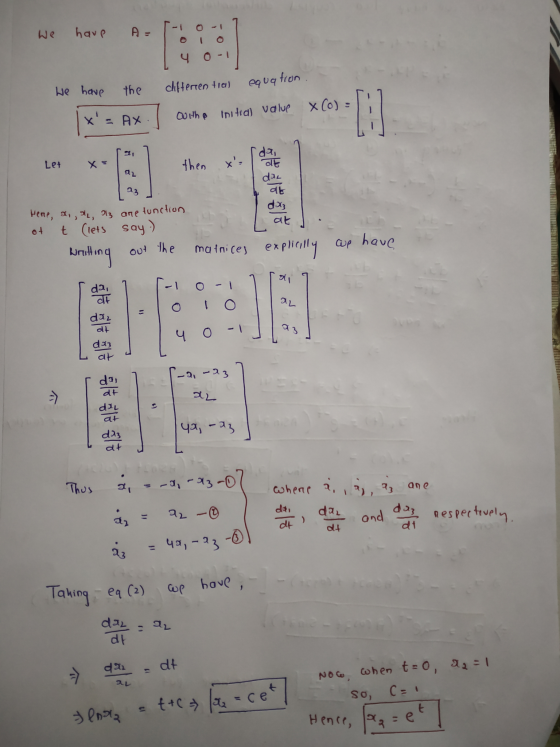
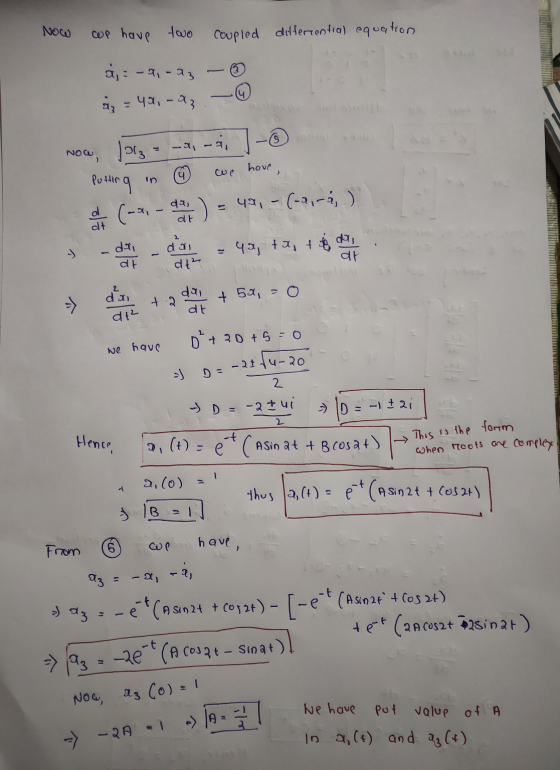
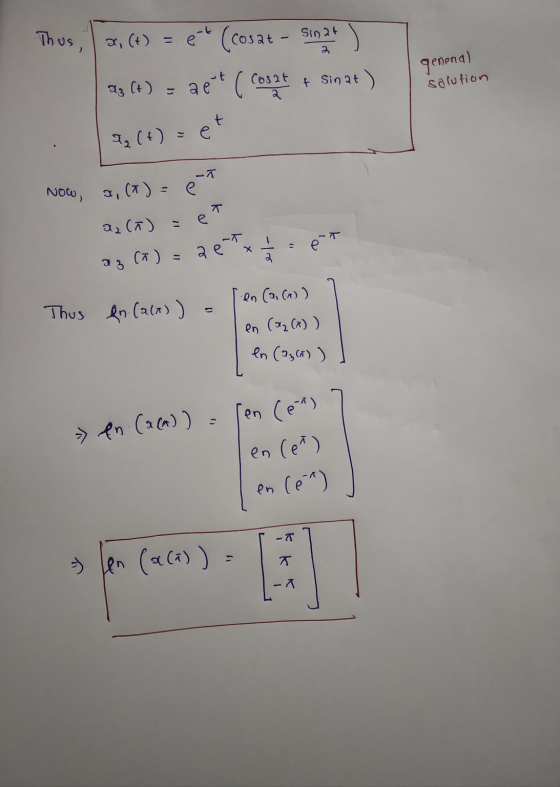
The answer is option(d). Look at the handwritten detailed solution.
Few Points:
1. If Roots of complimentary equation is of the form (a
 i*b) (i.e complex), then the solution is of the form
x(t) =  . This is used in finding the solution.
Add Answer to:
Multiple Choice: Let A =
. Let x be the solution of the following initial value...
Consider the initial value problem below has a series solution centered at zero of y =...
 Consider the initial value problem below has a series solution
centered at zero of y =
(x). Determine
'(0),
''(0) and
4(0).
y''+ x2y'+ cos(x)y = 0, y(0) = 2, y'(0) = 3.
We were unable to transcribe this imageWe were unable to transcribe this imageWe were unable to transcribe this imageWe were unable to transcribe this image
Consider the initial value problem below has a series solution
centered at zero of y =
(x). Determine
'(0),
''(0) and
4(0).
y''+ x2y'+ cos(x)y = 0, y(0) = 2, y'(0) = 3.
We were unable to transcribe this imageWe were unable to transcribe this imageWe were unable to transcribe this imageWe were unable to transcribe this image
Exact Differential Equations. Let y(x) be the solution of the following initial value problem: (cos z...
 Exact Differential Equations. Let y(x) be the solution of the following initial value problem: (cos z ln(2y = 8) + 2) + (x+4)=0, x(1) -- What is the value of y(+/2)? (a) 37 + 1. (b) 1/7- 2. (c) /3+ V. (d) 4+1/. (e) None.
(A) Find the largest x-interval where the initial value problem has a unique solution: Where A,...
 (A) Find the largest x-interval where the initial value problem
has a unique solution:
Where A, B, C, D, E, F are some known constants.
(B) Determine whether the set of functions
could form a fundamental set of solution of a linear differential
equation
Thank you
We were unable to transcribe this image5, sinx, cos2.c
(A) Find the largest x-interval where the initial value problem
has a unique solution:
Where A, B, C, D, E, F are some known constants.
(B) Determine whether the set of functions
could form a fundamental set of solution of a linear differential
equation
Thank you
We were unable to transcribe this image5, sinx, cos2.c
Does there exist a unique solution to the following IVP (initial-value-problem) in the neighborhood of the...
 Does there exist a unique solution to the following IVP
(initial-value-problem) in the neighborhood of the original
condition? find all constant solutions. Justify your answers.
I am having trouble understanding my professors solution where
and
. I
understand that pi is between 3 and 4 and e is between 2 and 3 but
how to you justify that. Also what good does taking the partial
derivative of Y have to do with anything, as that also consists of
the solution....
Does there exist a unique solution to the following IVP
(initial-value-problem) in the neighborhood of the original
condition? find all constant solutions. Justify your answers.
I am having trouble understanding my professors solution where
and
. I
understand that pi is between 3 and 4 and e is between 2 and 3 but
how to you justify that. Also what good does taking the partial
derivative of Y have to do with anything, as that also consists of
the solution....
Which of the following is the solution to the differential equation with the initial condition y(1)...
 Which of the following is the solution to the differential
equation
with the initial condition y(1) = -1/2
A.
B.
C.
D.
We were unable to transcribe this imageWe were unable to transcribe this imageWe were unable to transcribe this imageWe were unable to transcribe this imageWe were unable to transcribe this image
Which of the following is the solution to the differential
equation
with the initial condition y(1) = -1/2
A.
B.
C.
D.
We were unable to transcribe this imageWe were unable to transcribe this imageWe were unable to transcribe this imageWe were unable to transcribe this imageWe were unable to transcribe this image
Let Z be a random variable where P(X<0) = 0: a) If , what is ?...
 Let Z be a random variable where P(X<0) = 0:
a) If
, what is
?
b) If
, what is P = [Z = E(Z)] ?
c) If
, what is
?
6,(W) = jw We were unable to transcribe this imageD() = *(1 + exp(2jw) We were unable to transcribe this imageWe were unable to transcribe this image
Let Z be a random variable where P(X<0) = 0:
a) If
, what is
?
b) If
, what is P = [Z = E(Z)] ?
c) If
, what is
?
6,(W) = jw We were unable to transcribe this imageD() = *(1 + exp(2jw) We were unable to transcribe this imageWe were unable to transcribe this image
Let a and be be in . Show the following. If gcd(a,b)=1, then for every n...
 Let a and be be in . Show
the following. If gcd(a,b)=1, then for every n in there
exist x and y in such
that n=ax+by.
We were unable to transcribe this imageWe were unable to transcribe this imageWe were unable to transcribe this image
Let a and be be in . Show
the following. If gcd(a,b)=1, then for every n in there
exist x and y in such
that n=ax+by.
We were unable to transcribe this imageWe were unable to transcribe this imageWe were unable to transcribe this image
I found the general solution: But I need to answer this: Determine all initial conditions for...
 I found the general solution:
But I need to answer this: Determine all initial conditions for
which solutions to x'=Ax are bounded. Describe the surface in which
these solutions live.
We were unable to transcribe this imageWe were unable to transcribe this image
I found the general solution:
But I need to answer this: Determine all initial conditions for
which solutions to x'=Ax are bounded. Describe the surface in which
these solutions live.
We were unable to transcribe this imageWe were unable to transcribe this image
Let . (a) Find the singular value decomposition of A. (b) Find the least squares solution...
 Let
.
(a) Find the singular value decomposition of A.
(b) Find the least squares solution to the linear system
We were unable to transcribe this imageWe were unable to transcribe this image
Let
.
(a) Find the singular value decomposition of A.
(b) Find the least squares solution to the linear system
We were unable to transcribe this imageWe were unable to transcribe this image
let , 1)Find the initial value problem 2)Find the integral equation. We were unable to transcribe...
 let
,
1)Find the initial value problem
2)Find the integral equation.
We were unable to transcribe this imageuec2[0, 1], gec[0, 1], ze(0, 1)
let
,
1)Find the initial value problem
2)Find the integral equation.
We were unable to transcribe this imageuec2[0, 1], gec[0, 1], ze(0, 1)
 Consider the initial value problem below has a series solution
centered at zero of y =
(x). Determine
'(0),
''(0) and
4(0).
y''+ x2y'+ cos(x)y = 0, y(0) = 2, y'(0) = 3.
We were unable to transcribe this imageWe were unable to transcribe this imageWe were unable to transcribe this imageWe were unable to transcribe this image
Consider the initial value problem below has a series solution
centered at zero of y =
(x). Determine
'(0),
''(0) and
4(0).
y''+ x2y'+ cos(x)y = 0, y(0) = 2, y'(0) = 3.
We were unable to transcribe this imageWe were unable to transcribe this imageWe were unable to transcribe this imageWe were unable to transcribe this image
 Exact Differential Equations. Let y(x) be the solution of the following initial value problem: (cos z ln(2y = 8) + 2) + (x+4)=0, x(1) -- What is the value of y(+/2)? (a) 37 + 1. (b) 1/7- 2. (c) /3+ V. (d) 4+1/. (e) None.
 (A) Find the largest x-interval where the initial value problem
has a unique solution:
Where A, B, C, D, E, F are some known constants.
(B) Determine whether the set of functions
could form a fundamental set of solution of a linear differential
equation
Thank you
We were unable to transcribe this image5, sinx, cos2.c
(A) Find the largest x-interval where the initial value problem
has a unique solution:
Where A, B, C, D, E, F are some known constants.
(B) Determine whether the set of functions
could form a fundamental set of solution of a linear differential
equation
Thank you
We were unable to transcribe this image5, sinx, cos2.c
 Does there exist a unique solution to the following IVP
(initial-value-problem) in the neighborhood of the original
condition? find all constant solutions. Justify your answers.
I am having trouble understanding my professors solution where
and
. I
understand that pi is between 3 and 4 and e is between 2 and 3 but
how to you justify that. Also what good does taking the partial
derivative of Y have to do with anything, as that also consists of
the solution....
Does there exist a unique solution to the following IVP
(initial-value-problem) in the neighborhood of the original
condition? find all constant solutions. Justify your answers.
I am having trouble understanding my professors solution where
and
. I
understand that pi is between 3 and 4 and e is between 2 and 3 but
how to you justify that. Also what good does taking the partial
derivative of Y have to do with anything, as that also consists of
the solution....
 Which of the following is the solution to the differential
equation
with the initial condition y(1) = -1/2
A.
B.
C.
D.
We were unable to transcribe this imageWe were unable to transcribe this imageWe were unable to transcribe this imageWe were unable to transcribe this imageWe were unable to transcribe this image
Which of the following is the solution to the differential
equation
with the initial condition y(1) = -1/2
A.
B.
C.
D.
We were unable to transcribe this imageWe were unable to transcribe this imageWe were unable to transcribe this imageWe were unable to transcribe this imageWe were unable to transcribe this image
 Let Z be a random variable where P(X<0) = 0:
a) If
, what is
?
b) If
, what is P = [Z = E(Z)] ?
c) If
, what is
?
6,(W) = jw We were unable to transcribe this imageD() = *(1 + exp(2jw) We were unable to transcribe this imageWe were unable to transcribe this image
Let Z be a random variable where P(X<0) = 0:
a) If
, what is
?
b) If
, what is P = [Z = E(Z)] ?
c) If
, what is
?
6,(W) = jw We were unable to transcribe this imageD() = *(1 + exp(2jw) We were unable to transcribe this imageWe were unable to transcribe this image
 Let a and be be in . Show
the following. If gcd(a,b)=1, then for every n in there
exist x and y in such
that n=ax+by.
We were unable to transcribe this imageWe were unable to transcribe this imageWe were unable to transcribe this image
Let a and be be in . Show
the following. If gcd(a,b)=1, then for every n in there
exist x and y in such
that n=ax+by.
We were unable to transcribe this imageWe were unable to transcribe this imageWe were unable to transcribe this image
 I found the general solution:
But I need to answer this: Determine all initial conditions for
which solutions to x'=Ax are bounded. Describe the surface in which
these solutions live.
We were unable to transcribe this imageWe were unable to transcribe this image
I found the general solution:
But I need to answer this: Determine all initial conditions for
which solutions to x'=Ax are bounded. Describe the surface in which
these solutions live.
We were unable to transcribe this imageWe were unable to transcribe this image
 Let
.
(a) Find the singular value decomposition of A.
(b) Find the least squares solution to the linear system
We were unable to transcribe this imageWe were unable to transcribe this image
Let
.
(a) Find the singular value decomposition of A.
(b) Find the least squares solution to the linear system
We were unable to transcribe this imageWe were unable to transcribe this image
 let
,
1)Find the initial value problem
2)Find the integral equation.
We were unable to transcribe this imageuec2[0, 1], gec[0, 1], ze(0, 1)
let
,
1)Find the initial value problem
2)Find the integral equation.
We were unable to transcribe this imageuec2[0, 1], gec[0, 1], ze(0, 1)
Most questions answered within 3 hours.
-
Where is the error in this code sequence?
String s1 = "Hello";
String s2 = "ello";...
asked 10 months ago -
Financial data for Joel de Paris, Inc., for last year
follow:
Joel de Paris, Inc.
Balance...
asked 10 months ago -
Consider this reaction:
Al2(SO4)3 (aq)+ BaCl3
(aq) Al2Cl6 (aq)- +
3BaSO4(s) . What is the...
asked 10 months ago -
Suppose that Savneet is considering increasing her
recent random sample from 20 car rentals to 40...
asked 10 months ago -
Trucks arrive at an unloading terminal at an average rate of 120
per hour.
Trucks arrive...
asked 10 months ago -
Why are methanol and ethanol completely soluble in water while
octanol is not very little soluble....
asked 10 months ago -
A facilities manager at a university reads in a research report
that the mean amount of...
asked 10 months ago -
When the CuSO4 is rehydrated by adding water to the anhydrous
compound, is this an endothermic...
asked 10 months ago -
A ray of sunlight is passing from diamond into crown glass; the
angle of incidence is...
asked 10 months ago -
A block of mass 0.249 kg is placed on top of a light, vertical
spring of...
asked 10 months ago -
how do the kidneys compensate in the presences of acidosis
a) trigger hyperventilate
b) reserve acid...
asked 10 months ago -
Question 501 pts
The rental rate of capital to the firm increases. Which of the
following...
asked 10 months ago