For a solution equilibrium, a change in concentration of a reactant or product does not change...
For a solution equilibrium, a change in concentration of a reactant or product does not change Kc.
True/False?
Homework Answers

Add Answer to:
For a solution equilibrium, a change in concentration of a
reactant or product does not change...
xplanation For homogeneous equilibria, Kc is the ratio of product to reactant concentration aised to their...
 xplanation For homogeneous equilibria, Kc is the ratio of product to reactant concentration aised to their respective stoichiometric coefficients. Answered - Correct! 2 attempts left . Change your responses to resubmit QB 14.14 Level 2 Homework . Unanswered At 300 K the reaction 2 BrCl(g) =Br2(g) + Cl2(g) has Kc = 377. What is the value of Ke for the reaction Br2(g) + Cl2(g) = 2 BrCl(g)? Numeric Answer: Unanswered 3 attempts left Submit HQ14.06 Homework . Unanswered aparatuare the...
Indicate how the concentration of each species in the chemical equation will change to reestablish equilibrium...
 Indicate how the concentration of each species in the chemical equation will change to reestablish equilibrium after reactant or product is added. Click in each box to toggle in the relative change in concentration (up = increases, down = decreases, leave the box blank for no charge). 2CO(g) + O_2(g) rlhar 2CO_2(g) a) after increasing the concentration of CO b) after increasing the concentration of CO_2
Calculate the equilibrium concentration of H3O+ in the solution if the initial concentration of C6H5COOH is 6.0×10^-2
Calculate the equilibrium concentration of H3O+ in the solution if the initial concentration of C6H5COOH is 6.0×10^-2. Kc=6.3 *10^-5
Calculation the concentration of (H+] in a solution in which (OH) = 4*[+]? 5*10-8 4 0.5*10-14...
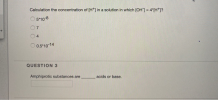 Calculation the concentration of (H+] in a solution in which (OH) = 4*[+]? 5*10-8 4 0.5*10-14 QUESTION 3 Amphiprotic substances are acids or base. QUESTION 12 For the following equilibrium reaction, 2A + 3B <---->D. Complete the equilibrium-constant expression, Kc =D (A QUESTION 13 True or False. The stoichiometry is not needed to calculate the changes in concentration for all species within the equilibrium-constant expression. True False
If the equilibrium concentration of each product is [0.035 M], and the equilibrium concentration of [HNO2]...
If the equilibrium concentration of each product is [0.035 M], and the equilibrium concentration of [HNO2] is 0.15, what is the equilibrium constant (K)? (please do not input answer using scientific notation). Based on the information given in the previous question, what is the pH of the solution?
4. (4 points) The free energy change of the reaction A(g) → B (g) is zero...
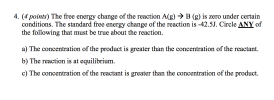 4. (4 points) The free energy change of the reaction A(g) → B (g) is zero under certain conditions. The standard free energy change of the reaction is -42.53. Circle ANY of the following that must be true about the reaction. a) The concentration of the product is greater than the concentration of the reactant. b) The reaction is at equilibrium. c) The concentration of the reactant is greater than the concentration of the product.
True or false? & What is the product? The elution order does not change when the...
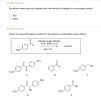 True or false? & What is the product?
The elution order does not change when the solvent is changed to a more polar solvent. True False Chose the expected organic product for the benzoic condensation shown below.
True or false? & What is the product?
The elution order does not change when the solvent is changed to a more polar solvent. True False Chose the expected organic product for the benzoic condensation shown below.
Question 15 You have an unknown concentration of reactant A to form products B in a...
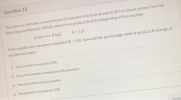 Question 15 You have an unknown concentration of reactant A to form products B in a closed system (see the following equilibrium). Initially there is no product B at the beginning of the reaction. A (aq) — B(aq) K = 1.0 If the equilibrium constant is doubled (K = 2.0), how will the percentage yield of product B change at equilibrium state? The yield will increase by 33%. More information is needed for this question The yield will increase a...
The rate of the reaction in terms of the "disappearance of reactant" includes the change in...
The rate of the reaction in terms of the "disappearance of reactant" includes the change in the concentration of the reactant, the time interval, and the coefficient of the reactant. Consider the following reaction: 2A+3B→3C+2D The concentrations of reactant A at three different time intervals are given. Use the following data to determine the average rate of reaction in terms of the disappearance of reactant A between time = 0 s and time = 20 s. Time (s) 0 20 40...
2A + 3B ----> 3D Assuming that doubling the concentration of reactant A causes no change...
2A + 3B ----> 3D Assuming that doubling the concentration of reactant A causes no change in rate and doubling the concentration of reactant B causes the rate to double, what is the rate law? a. Rate = k[B]2 b. Rate = k[A]2[B] c. Rate = k[A][B]2 d. Rate = k[B] e. Rate = k[A]
 xplanation For homogeneous equilibria, Kc is the ratio of product to reactant concentration aised to their respective stoichiometric coefficients. Answered - Correct! 2 attempts left . Change your responses to resubmit QB 14.14 Level 2 Homework . Unanswered At 300 K the reaction 2 BrCl(g) =Br2(g) + Cl2(g) has Kc = 377. What is the value of Ke for the reaction Br2(g) + Cl2(g) = 2 BrCl(g)? Numeric Answer: Unanswered 3 attempts left Submit HQ14.06 Homework . Unanswered aparatuare the...
 Indicate how the concentration of each species in the chemical equation will change to reestablish equilibrium after reactant or product is added. Click in each box to toggle in the relative change in concentration (up = increases, down = decreases, leave the box blank for no charge). 2CO(g) + O_2(g) rlhar 2CO_2(g) a) after increasing the concentration of CO b) after increasing the concentration of CO_2
 Calculation the concentration of (H+] in a solution in which (OH) = 4*[+]? 5*10-8 4 0.5*10-14 QUESTION 3 Amphiprotic substances are acids or base. QUESTION 12 For the following equilibrium reaction, 2A + 3B <---->D. Complete the equilibrium-constant expression, Kc =D (A QUESTION 13 True or False. The stoichiometry is not needed to calculate the changes in concentration for all species within the equilibrium-constant expression. True False
 4. (4 points) The free energy change of the reaction A(g) → B (g) is zero under certain conditions. The standard free energy change of the reaction is -42.53. Circle ANY of the following that must be true about the reaction. a) The concentration of the product is greater than the concentration of the reactant. b) The reaction is at equilibrium. c) The concentration of the reactant is greater than the concentration of the product.
 True or false? & What is the product?
The elution order does not change when the solvent is changed to a more polar solvent. True False Chose the expected organic product for the benzoic condensation shown below.
True or false? & What is the product?
The elution order does not change when the solvent is changed to a more polar solvent. True False Chose the expected organic product for the benzoic condensation shown below.
 Question 15 You have an unknown concentration of reactant A to form products B in a closed system (see the following equilibrium). Initially there is no product B at the beginning of the reaction. A (aq) — B(aq) K = 1.0 If the equilibrium constant is doubled (K = 2.0), how will the percentage yield of product B change at equilibrium state? The yield will increase by 33%. More information is needed for this question The yield will increase a...
Most questions answered within 3 hours.
-
Where is the error in this code sequence?
String s1 = "Hello";
String s2 = "ello";...
asked 11 months ago -
Financial data for Joel de Paris, Inc., for last year
follow:
Joel de Paris, Inc.
Balance...
asked 11 months ago -
Consider this reaction:
Al2(SO4)3 (aq)+ BaCl3
(aq) Al2Cl6 (aq)- +
3BaSO4(s) . What is the...
asked 11 months ago -
Suppose that Savneet is considering increasing her
recent random sample from 20 car rentals to 40...
asked 11 months ago -
Trucks arrive at an unloading terminal at an average rate of 120
per hour.
Trucks arrive...
asked 11 months ago -
Why are methanol and ethanol completely soluble in water while
octanol is not very little soluble....
asked 11 months ago -
A facilities manager at a university reads in a research report
that the mean amount of...
asked 11 months ago -
When the CuSO4 is rehydrated by adding water to the anhydrous
compound, is this an endothermic...
asked 11 months ago -
A ray of sunlight is passing from diamond into crown glass; the
angle of incidence is...
asked 11 months ago -
A block of mass 0.249 kg is placed on top of a light, vertical
spring of...
asked 11 months ago -
how do the kidneys compensate in the presences of acidosis
a) trigger hyperventilate
b) reserve acid...
asked 11 months ago -
Question 501 pts
The rental rate of capital to the firm increases. Which of the
following...
asked 11 months ago