
Homework Answers
Van der Waals equation-
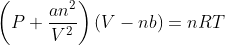
substituting the values, we get:


or, (P + 2.785 atm)(1.088 L) = 20.43 L.atm
(P + 2.785 atm) = 18.78 atm
P = 15.99 atm
Therefore, Van der Waals pressure = 15.99 atm
Ideal gas pressure = 17.99 atm
Pideal - PVanderWaals = 17.99 - 15.99 = 2.00 atm
% difference = (2.00/17.99)x100 =11.11 %
Add Answer to:
According to the ideal gas law, a 0.9249 mol sample of xenon gas in a 1.135...
According to the ideal gas law, a 10.01 mol sample of xenon gas in a 0.8137...
According to the ideal gas law, a 10.01 mol sample of xenon gas in a 0.8137 L container at 500.4 K should exert a pressure if 505.1 atm. What is the percent difference between the pressure calculated using the van der Waals' equation and the ideal pressure? For Xe gas, a = 4.194 L^2atm/mol^2 and b = 5.105 x 10^-2 L/mol.
According to the ideal gas law, a 0.9988 mol sample of xenon gas in a 1.401...
According to the ideal gas law, a 0.9988 mol sample of xenon gas in a 1.401 L container at 267.4 K should exert a pressure of 15.64 atm. What is the percent difference between the pressure calculated using the van der Waals' equation and the ideal pressure? For Xe gas, a = 4.194 L2atm/mol2 and b = 5.105×10⁻² L/mol. %
According to the ideal gas law, a 0.9188 mol sample of xenon gas in a 1.004...
According to the ideal gas law, a 0.9188 mol sample of xenon gas in a 1.004 L container at 268.5 K should exert a pressure of 20.16 atm. What is the percent difference between the pressure calculated using the van der Waals' equation and the ideal pressure? For Xe gas, a = 4.194 L2atm/mol2 and b = 5.105×10⁻² L/mol.
A 9.594 mol sample of xenon gas is maintained in a 0.7694 L container at 300.4...
A 9.594 mol sample of xenon gas is maintained in a 0.7694 L container at 300.4 K. What is the pressure in atm calculated using the van der Waals' equation for Xe gas under these conditions? For Xe, a = 4.194 L2atm/mol2 and b = 5.105×10⁻² L/mol. atm According to the ideal gas law, a 1.013 mol sample of methane gas in a 1.996 L container at 267.7 K should exert a pressure of 11.15 atm. What is the percent...
1. A 10.80 mol sample of oxygen gas is maintained in a 0.8395 L container at...
1. A 10.80 mol sample of oxygen gas is maintained in a 0.8395 L container at 304.6 K. What is the pressure in atm calculated using the van der Waals' equation for O2 gas under these conditions? For O2, a = 1.360 L2atm/mol2 and b = 3.183×10⁻²L/mol. ______atm 2. According to the ideal gas law, a 1.093 mol sample of nitrogen gas in a 1.390 L container at 266.8 K should exert a pressure of 17.22 atm. What is the...
A 9.262 mol sample of xenon gas is maintained in a 0.8496 L container at 299.3...
A 9.262 mol sample of xenon gas is maintained in a 0.8496 L container at 299.3 K. What is the pressure in atm calculated using the van der Waals' equation for Xe gas under these conditions? For Xe, a = 4.194 L2atm/mol2 and b = 5.105×10⁻² L/mol.
According to the ideal gas law, a 0.9469 mol sample of argon gas in a 1.474...
According to the ideal gas law, a 0.9469 mol sample of argon gas in a 1.474 L container at 273.1 K should exert a pressure of 14.40 atm. What is the percent difference between the pressure calculated using the van der Waals' equation and the ideal pressure? For Ar gas, a = 1.345 L^2atm/mol^2 and b = 3.219 x 10^-2 L/mol.
According to the ideal gas law, a 0.9832 mol sample of carbon dioxide gas in a...
 According to the ideal gas law, a 0.9832 mol sample of carbon dioxide gas in a 1.975 L container at 271.4 K should exert a pressure of 11.09 atm. By what percent does the pressure calculated using the van der Waals' equation differ from the ideal pressure? For CO2 gas, a = 3.592 L'atm/mol and b=4.267x10² L/mol. Hint: % difference = 100*(P ideal - Pvan der Waals)/P ideal
According to the ideal gas law, a 0.9935 mol sample of krypton gas in a 1.258...
 According to the ideal gas law, a 0.9935 mol sample of krypton gas in a 1.258 L container at 265.4 K should exert a pressure of 17.20 atm. By what percent does the pressure calculated using the van der Waals' equation differ from the ideal pressure? For Kr gas, a - 2.318 L'atm/mol- and b= 3.978*10-2 L/mol. Hint: % difference = 100*(P ideal - Pvan der Waals) /P ideal
Use the References to access important values if needed for this question. According to the ideal...
 Use the References to access important values if needed for this question. According to the ideal gas law, a 0.9428 mol sample of xenon gas in a 1.859 L container at 272.4 K should exert a pressure of 11.34 atm. What is the percent difference between the pressure calculated using the van der Waals' equation and the ideal pressure? For Xe gas, a= 4.194 L’atm/mol2 and b = 5.105x10⁻² L/mol. Percent difference = 14 Pideal – Pvan der Waals x...
 According to the ideal gas law, a 0.9832 mol sample of carbon dioxide gas in a 1.975 L container at 271.4 K should exert a pressure of 11.09 atm. By what percent does the pressure calculated using the van der Waals' equation differ from the ideal pressure? For CO2 gas, a = 3.592 L'atm/mol and b=4.267x10² L/mol. Hint: % difference = 100*(P ideal - Pvan der Waals)/P ideal
 According to the ideal gas law, a 0.9935 mol sample of krypton gas in a 1.258 L container at 265.4 K should exert a pressure of 17.20 atm. By what percent does the pressure calculated using the van der Waals' equation differ from the ideal pressure? For Kr gas, a - 2.318 L'atm/mol- and b= 3.978*10-2 L/mol. Hint: % difference = 100*(P ideal - Pvan der Waals) /P ideal
 Use the References to access important values if needed for this question. According to the ideal gas law, a 0.9428 mol sample of xenon gas in a 1.859 L container at 272.4 K should exert a pressure of 11.34 atm. What is the percent difference between the pressure calculated using the van der Waals' equation and the ideal pressure? For Xe gas, a= 4.194 L’atm/mol2 and b = 5.105x10⁻² L/mol. Percent difference = 14 Pideal – Pvan der Waals x...
Most questions answered within 3 hours.
-
Where is the error in this code sequence?
String s1 = "Hello";
String s2 = "ello";...
asked 11 months ago -
Financial data for Joel de Paris, Inc., for last year
follow:
Joel de Paris, Inc.
Balance...
asked 11 months ago -
Consider this reaction:
Al2(SO4)3 (aq)+ BaCl3
(aq) Al2Cl6 (aq)- +
3BaSO4(s) . What is the...
asked 11 months ago -
Suppose that Savneet is considering increasing her
recent random sample from 20 car rentals to 40...
asked 11 months ago -
Trucks arrive at an unloading terminal at an average rate of 120
per hour.
Trucks arrive...
asked 11 months ago -
Why are methanol and ethanol completely soluble in water while
octanol is not very little soluble....
asked 11 months ago -
A facilities manager at a university reads in a research report
that the mean amount of...
asked 11 months ago -
When the CuSO4 is rehydrated by adding water to the anhydrous
compound, is this an endothermic...
asked 11 months ago -
A ray of sunlight is passing from diamond into crown glass; the
angle of incidence is...
asked 11 months ago -
A block of mass 0.249 kg is placed on top of a light, vertical
spring of...
asked 11 months ago -
how do the kidneys compensate in the presences of acidosis
a) trigger hyperventilate
b) reserve acid...
asked 11 months ago -
Question 501 pts
The rental rate of capital to the firm increases. Which of the
following...
asked 11 months ago