
Homework Answers
Add Answer to:
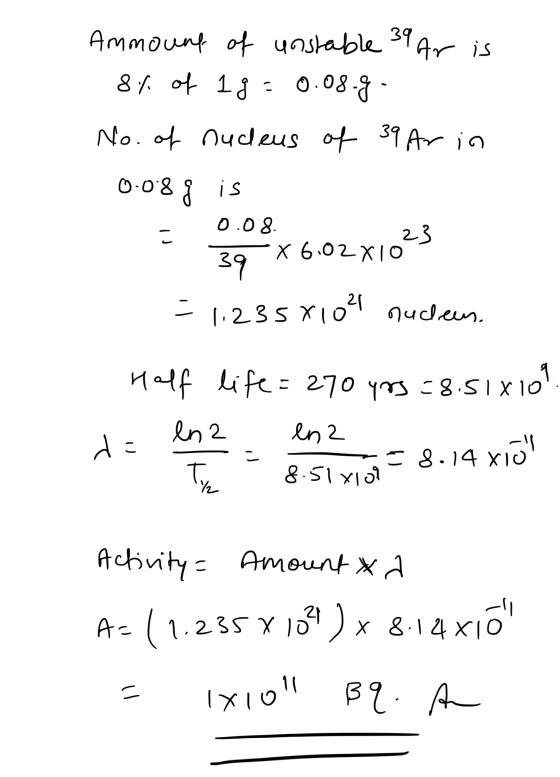
A sample contains 92% stable 40 Ar and 8 % unstable 39 Ar. The half life...
Question 27: A sample contains 98% stable 1271(lodine) and 2 % unstable 1311. The half life...
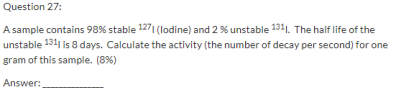 Question 27: A sample contains 98% stable 1271(lodine) and 2 % unstable 1311. The half life of the unstable 1311 is 8 days. Calculate the activity (the number of decay per second) for one gram of this sample. (8%) Answer: -
Suppose a radioactive sample initially contains N0 unstable nuclei. These nuclei will decay into stable nuclei,...
Suppose a radioactive sample initially contains N0 unstable nuclei. These nuclei will decay into stable nuclei, and as they do, the number of unstable nuclei that remain, N(t), will decrease with time. Although there is no way for us to predict exactly when any one nucleus will decay, we can write down an expression for the total number of unstable nuclei that remain after a time t: N(t)=N0e−λt, where λ is known as the decay constant. Note that at t=0,...
The average banana contains about half a gram of potassium. Of that, 0.012% is radioactive K-40,...
The average banana contains about half a gram of potassium. Of that, 0.012% is radioactive K-40, with a half-life of 1.251×10⁹ years. Calculate the number of atoms that decay in one hour from a banana.
The half-life of Potassium-40 (K-40) decaying to Argon-40 (Ar-40) is 1.3 billion years. Suppose an igneous...
 The half-life of Potassium-40 (K-40) decaying to Argon-40 (Ar-40) is 1.3 billion years. Suppose an igneous rock contains 105 million atoms of Ar-40 and 15 million atoms of K-40. (Assume here that no Ar-40 was present in the mineral when it formed and that no Ar-40 has escaped since formation). Using the number of half-lives from the previous question, how old is this rock? 2.6 billion years old 5.2 billion years old 3.9 billion years old 1.3 billion years old
Only problem 8 please. 8. Consider the three component decay in Problem 7. The half-life of...
 Only problem 8 please.
8. Consider the three component decay in Problem 7. The
half-life of the orig- inal nucleus is one day. The half-life of
the second nuclide is two days, while the third nuclide is stable.
The initial number of particles for nuclide A is 10,000, while
nuclides B and C have no initial particles. Plot the number of
particles from 0 to 10 days using ODE45 in MATLAB.
Problem 7 Consider the case where we have the...
Only problem 8 please.
8. Consider the three component decay in Problem 7. The
half-life of the orig- inal nucleus is one day. The half-life of
the second nuclide is two days, while the third nuclide is stable.
The initial number of particles for nuclide A is 10,000, while
nuclides B and C have no initial particles. Plot the number of
particles from 0 to 10 days using ODE45 in MATLAB.
Problem 7 Consider the case where we have the...
4. The half-life of a sample has been defined as the time it takes for half...
 4. The half-life of a sample has been defined as the time it takes for half of a sample to decay. The fifth-life can be defined as the time it takes for one-fifth of a sample to decay. Given these definitions, calculate the fifth-life of a sample that has a half-life of 29 years.
4. The half-life of a sample has been defined as the time it takes for half...
 4. The half-life of a sample has been defined as the time it takes for half of a sample to decay. The fifth-life can be defined as the time it takes for one-fifth of a sample to decay. Given these definitions, calculate the fifth-life of a sample that has a half-life of 29 years.
The half-life of 131I is 8.04 days. (a) Convert the half-life to seconds. (b) Calculate the...
The half-life of 131I is 8.04 days. (a) Convert the half-life to seconds. (b) Calculate the decay constant for this isotope. (c) Convert 0.350 μCi to the SI unit the becquerel. (d) Find the number of 131I nuclei necessary to produce a sample with an activity of 0.350 μCi. (e) Suppose the activity of a certain 131I sample is 6.10 mCi at a given time. Find the number of half-lives the sample goes through in 40.2 d and the activity...
The half-life of 131I is 8.04 days. (a) Convert the half-life to seconds. s (b) Calculate...
The half-life of 131I is 8.04 days. (a) Convert the half-life to seconds. s (b) Calculate the decay constant for this isotope. s−1 (c) Convert 0.650 μCi to the SI unit the becquerel. Bq (d) Find the number of 131I nuclei necessary to produce a sample with an activity of 0.650 μCi. 131I nuclei (e) Suppose the activity of a certain 131I sample is 7.10 mCi at a given time. Find the number of half-lives the sample goes through in...
The unstable isotope 40K is used for dating rock samples. Its half-life is 1.28×10⁹y. How many...
The unstable isotope 40K is used for dating rock samples. Its half-life is 1.28×10⁹y. How many decays occur per second in a sample containing 1.61×10⁻⁶ g of 40K? What is the activity of the sample in curies?
 Question 27: A sample contains 98% stable 1271(lodine) and 2 % unstable 1311. The half life of the unstable 1311 is 8 days. Calculate the activity (the number of decay per second) for one gram of this sample. (8%) Answer: -
 The half-life of Potassium-40 (K-40) decaying to Argon-40 (Ar-40) is 1.3 billion years. Suppose an igneous rock contains 105 million atoms of Ar-40 and 15 million atoms of K-40. (Assume here that no Ar-40 was present in the mineral when it formed and that no Ar-40 has escaped since formation). Using the number of half-lives from the previous question, how old is this rock? 2.6 billion years old 5.2 billion years old 3.9 billion years old 1.3 billion years old
 Only problem 8 please.
8. Consider the three component decay in Problem 7. The
half-life of the orig- inal nucleus is one day. The half-life of
the second nuclide is two days, while the third nuclide is stable.
The initial number of particles for nuclide A is 10,000, while
nuclides B and C have no initial particles. Plot the number of
particles from 0 to 10 days using ODE45 in MATLAB.
Problem 7 Consider the case where we have the...
Only problem 8 please.
8. Consider the three component decay in Problem 7. The
half-life of the orig- inal nucleus is one day. The half-life of
the second nuclide is two days, while the third nuclide is stable.
The initial number of particles for nuclide A is 10,000, while
nuclides B and C have no initial particles. Plot the number of
particles from 0 to 10 days using ODE45 in MATLAB.
Problem 7 Consider the case where we have the...
 4. The half-life of a sample has been defined as the time it takes for half of a sample to decay. The fifth-life can be defined as the time it takes for one-fifth of a sample to decay. Given these definitions, calculate the fifth-life of a sample that has a half-life of 29 years.
 4. The half-life of a sample has been defined as the time it takes for half of a sample to decay. The fifth-life can be defined as the time it takes for one-fifth of a sample to decay. Given these definitions, calculate the fifth-life of a sample that has a half-life of 29 years.
Most questions answered within 3 hours.
-
Where is the error in this code sequence?
String s1 = "Hello";
String s2 = "ello";...
asked 10 months ago -
Financial data for Joel de Paris, Inc., for last year
follow:
Joel de Paris, Inc.
Balance...
asked 10 months ago -
Consider this reaction:
Al2(SO4)3 (aq)+ BaCl3
(aq) Al2Cl6 (aq)- +
3BaSO4(s) . What is the...
asked 10 months ago -
Suppose that Savneet is considering increasing her
recent random sample from 20 car rentals to 40...
asked 10 months ago -
Trucks arrive at an unloading terminal at an average rate of 120
per hour.
Trucks arrive...
asked 10 months ago -
Why are methanol and ethanol completely soluble in water while
octanol is not very little soluble....
asked 10 months ago -
A facilities manager at a university reads in a research report
that the mean amount of...
asked 10 months ago -
When the CuSO4 is rehydrated by adding water to the anhydrous
compound, is this an endothermic...
asked 10 months ago -
A ray of sunlight is passing from diamond into crown glass; the
angle of incidence is...
asked 10 months ago -
A block of mass 0.249 kg is placed on top of a light, vertical
spring of...
asked 10 months ago -
how do the kidneys compensate in the presences of acidosis
a) trigger hyperventilate
b) reserve acid...
asked 10 months ago -
Question 501 pts
The rental rate of capital to the firm increases. Which of the
following...
asked 10 months ago