Static Equilibrium A rod of uniform density that has a mass of 50 grams and is...
Static Equilibrium A rod of uniform density that has a mass of 50 grams and is 80cm long has two masses hanging from either end. Mass 1 is 500grams and the fulcrum is placed 10cm from this mass. Find the other mass.
Homework Answers
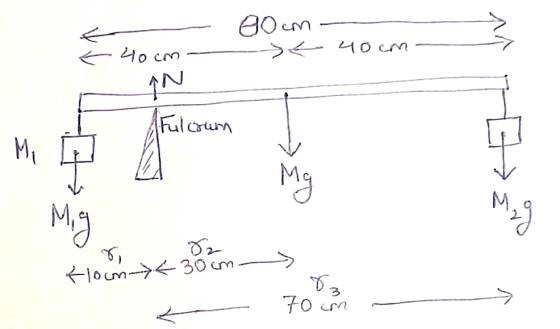
In static equilibrium the net Torque of the system about any point must be zero. To solve the problem easily, we take the reference point as the point of contact of fulcrum and the rod.
There are four forces acting: forces of gravity on mass
 ,
,
 and the rod; the contact force (N) by fulcrum on the rod.
In static equilibrium, the net Torque about the fulcrum due to these forces must be zero.


where g is the gravitational acceleration;  ,
,  and
and  are distances
between fulcrum and mass , center of mass of
the rod, and mass respectively. The
positive sign is for torque pointing out of the page, and negative
signs indicates torques pointing into of the page.
are distances
between fulcrum and mass , center of mass of
the rod, and mass respectively. The
positive sign is for torque pointing out of the page, and negative
signs indicates torques pointing into of the page.
Solving for

Using  ,
,
 ,
,  ,
,
 and
and

We get 
Add Answer to:
Static Equilibrium A rod of uniform density
that has a mass of 50 grams and is...
A 5 m long uniform rod having a mass M of 9.70 kg making an angle...
 A 5 m long uniform rod having a mass M of 9.70 kg making an
angle of 30? with the horizontal is kept in equilibrium by a 2.5 kg
mass, m on its other end and a massless rope as shown in the figure
below. a. Find the normal force at the base of the rod, b. the
tension in the rope that keeps it in equilibrium, and c. the
coefficient of static friction at the base of the rod....
A 5 m long uniform rod having a mass M of 9.70 kg making an
angle of 30? with the horizontal is kept in equilibrium by a 2.5 kg
mass, m on its other end and a massless rope as shown in the figure
below. a. Find the normal force at the base of the rod, b. the
tension in the rope that keeps it in equilibrium, and c. the
coefficient of static friction at the base of the rod....
A uniform rod of length 67.5 cm and mass 0.234 kg is placed on a fulcrum...
A uniform rod of length 67.5 cm and mass 0.234 kg is placed on a fulcrum at a distance of 47.7 cm from the left end of the rod. At what distance (in cm) from the left end of the rod should a 0.805 kg mass be hung to balance the rod?
In lecture we found that the center of mass of a rod with a non-uniform density...
In lecture we found that the center of mass of a rod with a non-uniform density profile (where the density changes linearly from one end to the other, doubling in density from one end to the next) was 5/9L when measured from the less-dense end. We also found that the rotational inertia around the less-dense end came out to be 7/18ML2. Use these facts and the parallel-axis theorem to find the rotational inertia of this rod around its center of...
A 5 m long uniform rod having a mass M of 9.70 kg making an angle...
A 5 m long uniform rod having a mass M of 9.70 kg making an angle of 30? with the horizontal is kept in equilibrium by a 2.5 kg mass, m on its other end and a massless rope as shown in the figure below. a. Find the normal force at the base of the rod, b. the tension in the rope that keeps it in equilibrium, and c. the coefficient of static friction at the base of the rod.
1.)In the static equilibrium experiment, a student placed the 107 g mass (including the hanger mass)...
1.)In the static equilibrium experiment, a student placed the 107 g mass (including the hanger mass) at position of 6.6 cm from the fulcrum. Then, placed a 52 g mass (including the hanger mass) on the right side of the fulcrum and adjusted the position until balance is achieved. Calculate the torque (magnitude only) caused by the 107 g mass. (g = 9.80 m/s2) 2.)In the static equilibrium experiment, a student placed the 105 g mass (including the hanger mass)...
A thin, uniform rod has length L and the linear density a (i.e. total mass M=al)....
 A thin, uniform rod has length L and the linear density a (i.e. total mass M=al). A point mass m is placed at distance x from one end of the rod, along the axis of the rod. Calculate the gravitational force of the rod on the point mass m. (Hint: element of the mass is dM = adx) -GmM/x? O-GmM/(L2-x2) -GmM/(x+.5L) -GmM/(x2+Lx)
A uniform, 241-N rod that is 2.12 m long carries a 225-N weight at its right...
 A uniform, 241-N rod that is 2.12 m long carries a 225-N weight
at its right end and an unknown weight W toward the left end (see
the figure (Figure 1)). When W is placed 54.3 cm from the left end
of the rod, the system just balances horizontally when the fulcrum
is located 76.2 cm from the right end.
A. Find W.
B. If W is now moved 21.1 cm to the right, how far must the
fulcrum be...
A uniform, 241-N rod that is 2.12 m long carries a 225-N weight
at its right end and an unknown weight W toward the left end (see
the figure (Figure 1)). When W is placed 54.3 cm from the left end
of the rod, the system just balances horizontally when the fulcrum
is located 76.2 cm from the right end.
A. Find W.
B. If W is now moved 21.1 cm to the right, how far must the
fulcrum be...
1. A rod is in static equilibrium as in the drawing below. Sketch the forces on...
 1. A rod is in static equilibrium as in the drawing below. Sketch the forces on the rod. The rope is parallel to the adjacent wall. The rod is 4 meters long. It has mass m and uniform mass distribution. Find the magnitude of the tension T. Use the g for the gravitational acceleration. rope earth frictionless 2. Janet is tightening a wheel bolt with a wrench 0 She applies force at the point 0.2 n from the bolt axis....
A 0.110-kg, 51.8-cm-long uniform bar has a small 0.080-kg mass glued to its left end and...
A 0.110-kg, 51.8-cm-long uniform bar has a small 0.080-kg mass glued to its left end and a small 0.135-kg mass glued to the other end. You want to balance this system horizontally on a fulcrum placed just under its center of gravity. How far from the left end should the fulcrum be placed?
A 0.115-kg, 53.6-cm-long uniform bar has a small 0.045-kg mass glued to its left end and...
A 0.115-kg, 53.6-cm-long uniform bar has a small 0.045-kg mass glued to its left end and a small 0.150-kg mass glued to the other end. You want to balance this system horizontally on a fulcrum placed just under its center of gravity. How far from the left end should the fulcrum be placed?
 A 5 m long uniform rod having a mass M of 9.70 kg making an
angle of 30? with the horizontal is kept in equilibrium by a 2.5 kg
mass, m on its other end and a massless rope as shown in the figure
below. a. Find the normal force at the base of the rod, b. the
tension in the rope that keeps it in equilibrium, and c. the
coefficient of static friction at the base of the rod....
A 5 m long uniform rod having a mass M of 9.70 kg making an
angle of 30? with the horizontal is kept in equilibrium by a 2.5 kg
mass, m on its other end and a massless rope as shown in the figure
below. a. Find the normal force at the base of the rod, b. the
tension in the rope that keeps it in equilibrium, and c. the
coefficient of static friction at the base of the rod....
 A thin, uniform rod has length L and the linear density a (i.e. total mass M=al). A point mass m is placed at distance x from one end of the rod, along the axis of the rod. Calculate the gravitational force of the rod on the point mass m. (Hint: element of the mass is dM = adx) -GmM/x? O-GmM/(L2-x2) -GmM/(x+.5L) -GmM/(x2+Lx)
 A uniform, 241-N rod that is 2.12 m long carries a 225-N weight
at its right end and an unknown weight W toward the left end (see
the figure (Figure 1)). When W is placed 54.3 cm from the left end
of the rod, the system just balances horizontally when the fulcrum
is located 76.2 cm from the right end.
A. Find W.
B. If W is now moved 21.1 cm to the right, how far must the
fulcrum be...
A uniform, 241-N rod that is 2.12 m long carries a 225-N weight
at its right end and an unknown weight W toward the left end (see
the figure (Figure 1)). When W is placed 54.3 cm from the left end
of the rod, the system just balances horizontally when the fulcrum
is located 76.2 cm from the right end.
A. Find W.
B. If W is now moved 21.1 cm to the right, how far must the
fulcrum be...
 1. A rod is in static equilibrium as in the drawing below. Sketch the forces on the rod. The rope is parallel to the adjacent wall. The rod is 4 meters long. It has mass m and uniform mass distribution. Find the magnitude of the tension T. Use the g for the gravitational acceleration. rope earth frictionless 2. Janet is tightening a wheel bolt with a wrench 0 She applies force at the point 0.2 n from the bolt axis....
Most questions answered within 3 hours.
-
Where is the error in this code sequence?
String s1 = "Hello";
String s2 = "ello";...
asked 10 months ago -
Financial data for Joel de Paris, Inc., for last year
follow:
Joel de Paris, Inc.
Balance...
asked 10 months ago -
Consider this reaction:
Al2(SO4)3 (aq)+ BaCl3
(aq) Al2Cl6 (aq)- +
3BaSO4(s) . What is the...
asked 10 months ago -
Suppose that Savneet is considering increasing her
recent random sample from 20 car rentals to 40...
asked 10 months ago -
Trucks arrive at an unloading terminal at an average rate of 120
per hour.
Trucks arrive...
asked 10 months ago -
Why are methanol and ethanol completely soluble in water while
octanol is not very little soluble....
asked 10 months ago -
A facilities manager at a university reads in a research report
that the mean amount of...
asked 10 months ago -
When the CuSO4 is rehydrated by adding water to the anhydrous
compound, is this an endothermic...
asked 10 months ago -
A ray of sunlight is passing from diamond into crown glass; the
angle of incidence is...
asked 10 months ago -
A block of mass 0.249 kg is placed on top of a light, vertical
spring of...
asked 10 months ago -
how do the kidneys compensate in the presences of acidosis
a) trigger hyperventilate
b) reserve acid...
asked 10 months ago -
Question 501 pts
The rental rate of capital to the firm increases. Which of the
following...
asked 10 months ago