
Homework Answers
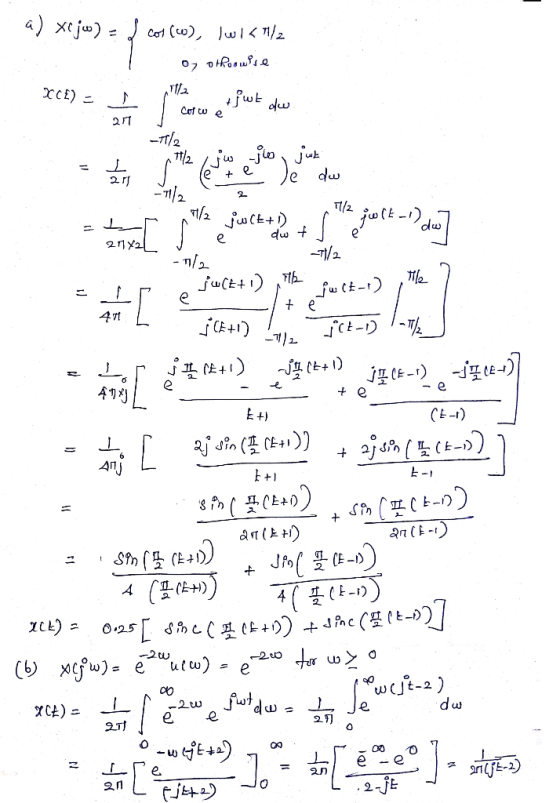
![(c) xejus) = é twl - Se w for wao o le for w so xi) = h I jewelotteda] [ 1° e 5o. 140 do +5 2001- *** [ 2100910 La 1 + + [](http://img.homeworklib.com/questions/01c75280-9763-11ec-b580-cf3a83767ef9.png?x-oss-process=image/resize,w_560)
Add Answer to:
1x(jw) 2 Use the equation describing the FT representa- tion to determine the time-domain signals cor-...
3.53 Use the equation describing the DTFT representa- tion to determine the time-domain signals corre- sponding...
 3.53 Use the equation describing the DTFT representa- tion to determine the time-domain signals corre- sponding to the following DTFTS: (f) X(ein) as depicted in Figure P3.53(c). |X(ethy 1 * .. Ω -2π -π -π2 π/2 π 2π O arg{XeA) -2π -π -π2 π2 2π - Ω ο T FIGURE P3.53
Determine the time-domain signals corresponding ti each of the following FT using an expression of FT expression. X(jw) shown in figure P3.55 (a) X(jw) shown in figure P3.55 (c) arg(X(jo)) 4 -2 0...
 Determine the time-domain signals corresponding ti
each of the following FT using an expression of FT expression.
X(jw) shown in figure P3.55 (a)
X(jw) shown in figure P3.55 (c)
arg(X(jo)) 4 -2 0 4 X(jo) 2j |X(ja) argfX(ja)) TT/2 ㅠ12 그림 P3.55
arg(X(jo)) 4 -2 0 4 X(jo) 2j |X(ja) argfX(ja)) TT/2 ㅠ12 그림 P3.55
Determine the time-domain signals corresponding ti
each of the following FT using an expression of FT expression.
X(jw) shown in figure P3.55 (a)
X(jw) shown in figure P3.55 (c)
arg(X(jo)) 4 -2 0 4 X(jo) 2j |X(ja) argfX(ja)) TT/2 ㅠ12 그림 P3.55
arg(X(jo)) 4 -2 0 4 X(jo) 2j |X(ja) argfX(ja)) TT/2 ㅠ12 그림 P3.55
Problem 3.12 Find the DTFT of the following time-domain signals: (b) x[n] = alu. lal <...
 Problem 3.12 Find the DTFT of the following time-domain signals: (b) x[n] = alu. lal < 1 11:32 AM Wed 25 Mar '< ! Q 0 O Untitled Notebook (12) 5 * Untitled Notebook (12) W X hw3A_s2020.pdf Untitled Problem 3.14 Find the FT of the following signals: continuous la aperiodic (b) X(t) = e te n(jw) t 120
(c) Determine whether the corresponding time-domain signal is (i) rea imaginary, or neither and(i...
 (c) Determine whether the corresponding time-domain signal is (i) rea imaginary, or neither and(i) even, odd, or neither, without evaluating the inverse of the signal iii . X (ju) = u(w)-u(w-2) d) For the following signal t<-1/2 0, t + 1/2, -1/2 t 1 /2 1,t>1/2 Hint use the differntiation and integration x(t) = i. Determine X(jw). properties and the Fourier transform pair for the rectangular pulse. ii. Calculate the Fourier transfom of the even part of x(t). Is it...
solve 2.40 a,b,c, e using Fourier series. 2.40 part a,b,c,e 2.40 Consider the continuous-time signals depicted in Fig. P2.40. Evaluate the following convolution integrals: (a) m(t) x(t) y(t) (...
 solve 2.40 a,b,c, e using Fourier series.
2.40 part a,b,c,e 2.40 Consider the continuous-time signals depicted in Fig. P2.40. Evaluate the following convolution integrals: (a) m(t) x(t) y(t) (b) m(t)x(t)z(t) (c) m(t) x(t) ft) (d) m(t) x(t) a(t) (e) m(t)y(t) z(t) (f) m(t) -y(t) w(t) (g) m(t) y(t)g(t) (h) m(t)y(t) c(t) (i) m(t) z(t) f(t) (j) m(t) z(t) g(t) (k) m(t) z(t)b(t) (1) m(t) w(t) g(t) (m) m(t) w(t) a(t) (n) m(t) f(t) g(t (o) m(t) fo) . do) (p)...
solve 2.40 a,b,c, e using Fourier series.
2.40 part a,b,c,e 2.40 Consider the continuous-time signals depicted in Fig. P2.40. Evaluate the following convolution integrals: (a) m(t) x(t) y(t) (b) m(t)x(t)z(t) (c) m(t) x(t) ft) (d) m(t) x(t) a(t) (e) m(t)y(t) z(t) (f) m(t) -y(t) w(t) (g) m(t) y(t)g(t) (h) m(t)y(t) c(t) (i) m(t) z(t) f(t) (j) m(t) z(t) g(t) (k) m(t) z(t)b(t) (1) m(t) w(t) g(t) (m) m(t) w(t) a(t) (n) m(t) f(t) g(t (o) m(t) fo) . do) (p)...
Suppose that r(l) is a band-limited signal with the bandwidth W. Suppose that we sampled this...
 Suppose that r(l) is a band-limited signal with the bandwidth W. Suppose that we sampled this signal with the sainpling interval T, to generate the sample sequence 1 TLI suppose that 2n/T is larger than the Nyquist rate 2W Given rn, we reconstructed a conius time signal ( using the zero-order-hold method. In other words, rr(l) n for L E [nT, (n +1)T;). In the last lecture, we derived that where s(), as usual, denotes the continuous time representation of...
(a) Determine the Fourier transform of x(t) 26(t-1)-6(t-3) (b) Compute the convolution sum of the following signals, (6%) [696] (c) The Fourier transform of a continuous-time signal a(t) is given bel...
 (a) Determine the Fourier transform of x(t) 26(t-1)-6(t-3) (b) Compute the convolution sum of the following signals, (6%) [696] (c) The Fourier transform of a continuous-time signal a(t) is given below. Determine the [696] total energy of (t) 4 sin w (d) Determine the DC value and the average power of the following periodic signal. (6%) 0.5 0.5 (e) Determine the Nyquist rate for the following signal. (6%) x(t) = [1-0.78 cos(50nt + π/4)]2. (f) Sketch the frequency spectrum of...
 3.53 Use the equation describing the DTFT representa- tion to determine the time-domain signals corre- sponding to the following DTFTS: (f) X(ein) as depicted in Figure P3.53(c). |X(ethy 1 * .. Ω -2π -π -π2 π/2 π 2π O arg{XeA) -2π -π -π2 π2 2π - Ω ο T FIGURE P3.53
 Determine the time-domain signals corresponding ti
each of the following FT using an expression of FT expression.
X(jw) shown in figure P3.55 (a)
X(jw) shown in figure P3.55 (c)
arg(X(jo)) 4 -2 0 4 X(jo) 2j |X(ja) argfX(ja)) TT/2 ㅠ12 그림 P3.55
arg(X(jo)) 4 -2 0 4 X(jo) 2j |X(ja) argfX(ja)) TT/2 ㅠ12 그림 P3.55
Determine the time-domain signals corresponding ti
each of the following FT using an expression of FT expression.
X(jw) shown in figure P3.55 (a)
X(jw) shown in figure P3.55 (c)
arg(X(jo)) 4 -2 0 4 X(jo) 2j |X(ja) argfX(ja)) TT/2 ㅠ12 그림 P3.55
arg(X(jo)) 4 -2 0 4 X(jo) 2j |X(ja) argfX(ja)) TT/2 ㅠ12 그림 P3.55
 Problem 3.12 Find the DTFT of the following time-domain signals: (b) x[n] = alu. lal < 1 11:32 AM Wed 25 Mar '< ! Q 0 O Untitled Notebook (12) 5 * Untitled Notebook (12) W X hw3A_s2020.pdf Untitled Problem 3.14 Find the FT of the following signals: continuous la aperiodic (b) X(t) = e te n(jw) t 120
 (c) Determine whether the corresponding time-domain signal is (i) rea imaginary, or neither and(i) even, odd, or neither, without evaluating the inverse of the signal iii . X (ju) = u(w)-u(w-2) d) For the following signal t<-1/2 0, t + 1/2, -1/2 t 1 /2 1,t>1/2 Hint use the differntiation and integration x(t) = i. Determine X(jw). properties and the Fourier transform pair for the rectangular pulse. ii. Calculate the Fourier transfom of the even part of x(t). Is it...
 solve 2.40 a,b,c, e using Fourier series.
2.40 part a,b,c,e 2.40 Consider the continuous-time signals depicted in Fig. P2.40. Evaluate the following convolution integrals: (a) m(t) x(t) y(t) (b) m(t)x(t)z(t) (c) m(t) x(t) ft) (d) m(t) x(t) a(t) (e) m(t)y(t) z(t) (f) m(t) -y(t) w(t) (g) m(t) y(t)g(t) (h) m(t)y(t) c(t) (i) m(t) z(t) f(t) (j) m(t) z(t) g(t) (k) m(t) z(t)b(t) (1) m(t) w(t) g(t) (m) m(t) w(t) a(t) (n) m(t) f(t) g(t (o) m(t) fo) . do) (p)...
solve 2.40 a,b,c, e using Fourier series.
2.40 part a,b,c,e 2.40 Consider the continuous-time signals depicted in Fig. P2.40. Evaluate the following convolution integrals: (a) m(t) x(t) y(t) (b) m(t)x(t)z(t) (c) m(t) x(t) ft) (d) m(t) x(t) a(t) (e) m(t)y(t) z(t) (f) m(t) -y(t) w(t) (g) m(t) y(t)g(t) (h) m(t)y(t) c(t) (i) m(t) z(t) f(t) (j) m(t) z(t) g(t) (k) m(t) z(t)b(t) (1) m(t) w(t) g(t) (m) m(t) w(t) a(t) (n) m(t) f(t) g(t (o) m(t) fo) . do) (p)...
 Suppose that r(l) is a band-limited signal with the bandwidth W. Suppose that we sampled this signal with the sainpling interval T, to generate the sample sequence 1 TLI suppose that 2n/T is larger than the Nyquist rate 2W Given rn, we reconstructed a conius time signal ( using the zero-order-hold method. In other words, rr(l) n for L E [nT, (n +1)T;). In the last lecture, we derived that where s(), as usual, denotes the continuous time representation of...
 (a) Determine the Fourier transform of x(t) 26(t-1)-6(t-3) (b) Compute the convolution sum of the following signals, (6%) [696] (c) The Fourier transform of a continuous-time signal a(t) is given below. Determine the [696] total energy of (t) 4 sin w (d) Determine the DC value and the average power of the following periodic signal. (6%) 0.5 0.5 (e) Determine the Nyquist rate for the following signal. (6%) x(t) = [1-0.78 cos(50nt + π/4)]2. (f) Sketch the frequency spectrum of...
Most questions answered within 3 hours.
-
Where is the error in this code sequence?
String s1 = "Hello";
String s2 = "ello";...
asked 10 months ago -
Financial data for Joel de Paris, Inc., for last year
follow:
Joel de Paris, Inc.
Balance...
asked 10 months ago -
Consider this reaction:
Al2(SO4)3 (aq)+ BaCl3
(aq) Al2Cl6 (aq)- +
3BaSO4(s) . What is the...
asked 10 months ago -
Suppose that Savneet is considering increasing her
recent random sample from 20 car rentals to 40...
asked 10 months ago -
Trucks arrive at an unloading terminal at an average rate of 120
per hour.
Trucks arrive...
asked 10 months ago -
Why are methanol and ethanol completely soluble in water while
octanol is not very little soluble....
asked 10 months ago -
A facilities manager at a university reads in a research report
that the mean amount of...
asked 10 months ago -
When the CuSO4 is rehydrated by adding water to the anhydrous
compound, is this an endothermic...
asked 10 months ago -
A ray of sunlight is passing from diamond into crown glass; the
angle of incidence is...
asked 10 months ago -
A block of mass 0.249 kg is placed on top of a light, vertical
spring of...
asked 10 months ago -
how do the kidneys compensate in the presences of acidosis
a) trigger hyperventilate
b) reserve acid...
asked 10 months ago -
Question 501 pts
The rental rate of capital to the firm increases. Which of the
following...
asked 10 months ago