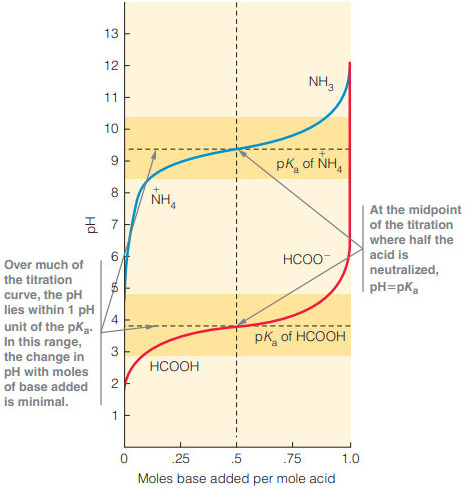
In regard to the picture:
1)
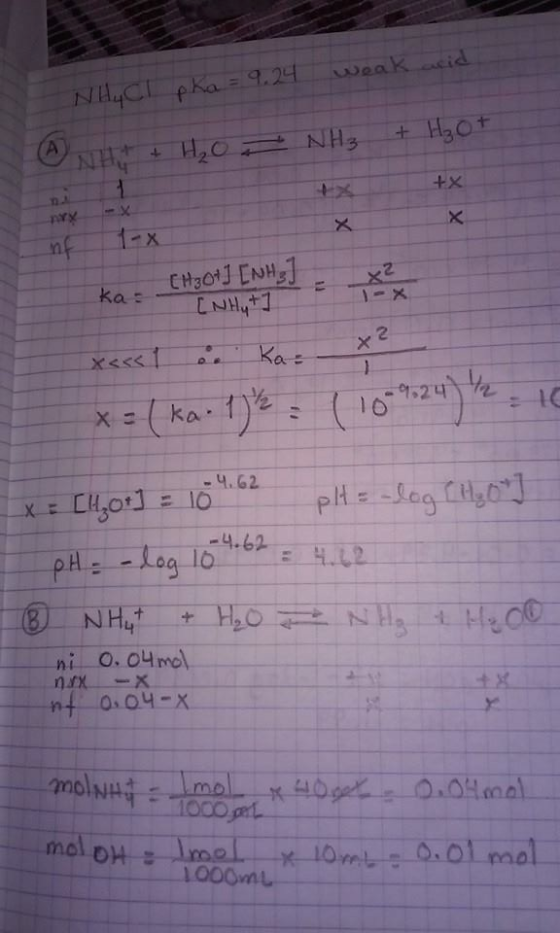
A) Calculate the pH of a 1 MNH4Cl solution.
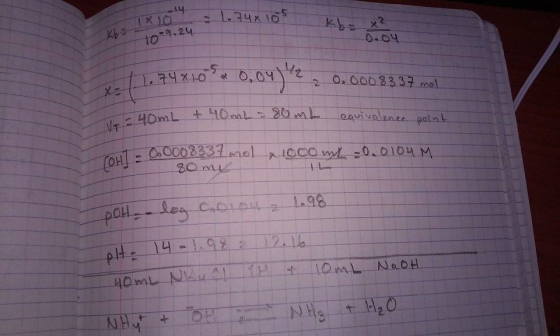
B) Calculate the pH of the solution that results following addition of 10 mLof 1 MNaOH to 40 mL of 1 MNH4Cl.
C) Calculate the pH of the solution that results following addition of 30 mLof 1 MNaOH to 40 mL of 1 MNH4Cl.
Please explain too! Thanks!
Homework Answers
Hi, thanks for asking.
These are more than one question but we are glad to help you with two of them.
If you need more help we will glad to help you.
Have a nice day.



Add Answer to:
In regard to the picture:
1)
A) Calculate the pH of a 1 MNH4Cl solution.
B)...
a) Calculate the pH of a 0.8M solution of HCOOH (Ka = 1.8 x 10⁻⁴) in...
a) Calculate the pH of a 0.8M solution of HCOOH (Ka = 1.8 x 10⁻⁴) in 0.4M Li+ HCOO-. b) Calculate the pH of a solution of 0.4M NH4Cl and 0.5M NH3 (pKa NH4+ = 9.2). c) Calculate the pH of a titration of 100 mL 1.5M HCl when 75 mL 1.25M NaOH has been added. d) What volume of 1.25M NaOH must be added to 100 mL of 1.5M HCl to reach equivalence?
a) . Calculate the pH of a titration of 100 mL 1.5M HCOOH with 1.25M NaOH...
a) . Calculate the pH of a titration of 100 mL 1.5M HCOOH with 1.25M NaOH at equivalence. WHY is the pH what it is (if it’s 7, why is the solution neutral? If not 7, why?) b) . If it takes 50 mL of 2.5M NaOH to titrate 60 mL HF to equivalence, what is the concentration of the HF? c) What is true at the half-equivalence point of a titration of acid with base in terms of moles...
1. if 15.27 mL of 0.250 M solution of barium hydroxide is required to reach the...
1. if 15.27 mL of 0.250 M solution of barium hydroxide is required to reach the equivalence point in a titration of 20.00 mL of nitric acid, what is the concentration of the acid? The equation for the reaction is 2 HNO3 + Ba(OH)2 --> 2 H2O + 2 NO3- + Ba2+ 2. For the reaction: HCOOH + OH- --> HCOO- + H2O If 24.60 mL of base is required to reach the equivalence point of this titration, what volume...
Answer all assigned questions and problems, and show all work. Determine the pH of (a) a...
Answer all assigned questions and problems, and show all work. Determine the pH of (a) a 0.40 MCH3CO2H solution, (b) a solution that is 0.40 MCH3CO2H and 0.20 MNaCH3CO2. (8 points) (Reference: Chang 16.5) Which of the following solutions can act as a buffer? (a) KCl/HCl, (b) KHSO4/H2SO4, (c) KNO2/HNO2.(5 points) (Reference: Chang 16.9) Calculate the pH of the buffer system made up of 0.15 MNH3/0.35 MNH4Cl. (5 points) (Reference: Chang 16.11) The pH of a bicarbonate-carbonic acid buffer is...
1. Calculate the pH of a 0.405 M aqueous solution of acetylsalicylic acid (aspirin) (HC9H7O4, Ka...
1. Calculate the pH of a 0.405 M aqueous solution of acetylsalicylic acid (aspirin) (HC9H7O4, Ka = 3.0×10⁻⁴) and the equilibrium concentrations of the weak acid and its conjugate base. pH = [HC9H7O4 ]equilibrium = M [C9H7O4- ]equilibrium = M 2. Calculate the pH of a 0.0149 M aqueous solution of formic acid (HCOOH, Ka = 1.8×10⁻⁴) and the equilibrium concentrations of the weak acid and its conjugate base. pH = [HCOOH]equilibrium = M [HCOO- ]equilibrium = M
Calculate the hypothetical pH BEFORE acid is added for the titration of 50.00 mL of 0.0800...
 Calculate the hypothetical pH BEFORE acid is added for the titration of 50.00 mL of 0.0800 M Formic Acid (HCOOH, Ka= 1.80x10⁴) with 0.1000 M NaOH at 25°C. Calculate the hypothetical pH AFTER addition of 15.00 mL of reagent for the titration of 50.00 mL of 0.0800 M Formic Acid (HCOOH, Ka= 1.80x10⁻⁴) with 0.1000 M NaOH at 25°C. Calculate the hypothetical pH AFTER addition of 40.50 mL of reagent for the titration of 50.00 mL of 0.0800 M Formic...
Calculate the pH of a 0.0167 M aqueous solution of formic acid (HCOOH, K, = 1.8x10⁻⁴)...
 Calculate the pH of a 0.0167 M aqueous solution of formic acid (HCOOH, K, = 1.8x10⁻⁴) and the equilibrium concentrations of the weak acid and its conjugate base. pH [HCOOH)equilibrium [HCOO equilibrium
Calculate the hypothetical pH AFTER addition of 15.00 mL of reagent for the titration of 50.00...
 Calculate the hypothetical pH AFTER addition of 15.00 mL of reagent for the titration of 50.00 mL of 0.0800 M NaOH with 0.1000 M HCl at 25°C. QUESTION 7 10 poir Calculate the hypothetical pH AFTER addition of 40.00 mL of reagent for the titration of 50.00 mL of 0.0800 M NaOH with 0.1000 M HCl at 25°C. Calculate the hypothetical pH AFTER addition of 46.00 mL of reagent for the titration of 50.00 mL of 0.0800 M NaOH with...
please help!! calculate pH of solutions on second page a-c!! 1. (4 points) A buffer solution...
 please help!! calculate pH of solutions on second page a-c!!
1. (4 points) A buffer solution is created with C;H,NH, and 0.012 M C;HsNH2. The K, for C,H,NH2 is 4.7 х 104. What is the concentration of C,HNH, in the buffer solution that has a pH of 11.50? а. What is the concentration of the buffer solution if 0.0011 M HC is added to the buffer in part a.? b. Why is the buffer a basic solution? Could this weak...
please help!! calculate pH of solutions on second page a-c!!
1. (4 points) A buffer solution is created with C;H,NH, and 0.012 M C;HsNH2. The K, for C,H,NH2 is 4.7 х 104. What is the concentration of C,HNH, in the buffer solution that has a pH of 11.50? а. What is the concentration of the buffer solution if 0.0011 M HC is added to the buffer in part a.? b. Why is the buffer a basic solution? Could this weak...
To calculate the concentration of a solution using acid–base titration data. In an acid–base titration, an...
To calculate the concentration of a solution using acid–base titration data. In an acid–base titration, an acid (or base) of known concentration is added to a base (or acid) of unknown concentration until the number of moles of H+ and OH- are equal, a condition called the equivalence point. Since you know the number of moles of H+ (or OH- ) that you added, you can determine the number of moles of OH- (or H+) in the unknown solution. For...
 Calculate the hypothetical pH BEFORE acid is added for the titration of 50.00 mL of 0.0800 M Formic Acid (HCOOH, Ka= 1.80x10⁴) with 0.1000 M NaOH at 25°C. Calculate the hypothetical pH AFTER addition of 15.00 mL of reagent for the titration of 50.00 mL of 0.0800 M Formic Acid (HCOOH, Ka= 1.80x10⁻⁴) with 0.1000 M NaOH at 25°C. Calculate the hypothetical pH AFTER addition of 40.50 mL of reagent for the titration of 50.00 mL of 0.0800 M Formic...
 Calculate the pH of a 0.0167 M aqueous solution of formic acid (HCOOH, K, = 1.8x10⁻⁴) and the equilibrium concentrations of the weak acid and its conjugate base. pH [HCOOH)equilibrium [HCOO equilibrium
 Calculate the hypothetical pH AFTER addition of 15.00 mL of reagent for the titration of 50.00 mL of 0.0800 M NaOH with 0.1000 M HCl at 25°C. QUESTION 7 10 poir Calculate the hypothetical pH AFTER addition of 40.00 mL of reagent for the titration of 50.00 mL of 0.0800 M NaOH with 0.1000 M HCl at 25°C. Calculate the hypothetical pH AFTER addition of 46.00 mL of reagent for the titration of 50.00 mL of 0.0800 M NaOH with...
 please help!! calculate pH of solutions on second page a-c!!
1. (4 points) A buffer solution is created with C;H,NH, and 0.012 M C;HsNH2. The K, for C,H,NH2 is 4.7 х 104. What is the concentration of C,HNH, in the buffer solution that has a pH of 11.50? а. What is the concentration of the buffer solution if 0.0011 M HC is added to the buffer in part a.? b. Why is the buffer a basic solution? Could this weak...
please help!! calculate pH of solutions on second page a-c!!
1. (4 points) A buffer solution is created with C;H,NH, and 0.012 M C;HsNH2. The K, for C,H,NH2 is 4.7 х 104. What is the concentration of C,HNH, in the buffer solution that has a pH of 11.50? а. What is the concentration of the buffer solution if 0.0011 M HC is added to the buffer in part a.? b. Why is the buffer a basic solution? Could this weak...
Most questions answered within 3 hours.
-
Where is the error in this code sequence?
String s1 = "Hello";
String s2 = "ello";...
asked 11 months ago -
Financial data for Joel de Paris, Inc., for last year
follow:
Joel de Paris, Inc.
Balance...
asked 11 months ago -
Consider this reaction:
Al2(SO4)3 (aq)+ BaCl3
(aq) Al2Cl6 (aq)- +
3BaSO4(s) . What is the...
asked 11 months ago -
Suppose that Savneet is considering increasing her
recent random sample from 20 car rentals to 40...
asked 11 months ago -
Trucks arrive at an unloading terminal at an average rate of 120
per hour.
Trucks arrive...
asked 11 months ago -
Why are methanol and ethanol completely soluble in water while
octanol is not very little soluble....
asked 11 months ago -
A facilities manager at a university reads in a research report
that the mean amount of...
asked 11 months ago -
When the CuSO4 is rehydrated by adding water to the anhydrous
compound, is this an endothermic...
asked 11 months ago -
A ray of sunlight is passing from diamond into crown glass; the
angle of incidence is...
asked 11 months ago -
A block of mass 0.249 kg is placed on top of a light, vertical
spring of...
asked 11 months ago -
how do the kidneys compensate in the presences of acidosis
a) trigger hyperventilate
b) reserve acid...
asked 11 months ago -
Question 501 pts
The rental rate of capital to the firm increases. Which of the
following...
asked 11 months ago