

Homework Answers

Add Answer to:
consider two thin conducting spherical shells as shown in the
figure
9 Consider two thin, conducting,...
Consider two thin conductive spherical shells in Figure. Radius of inner conductive shell r1 = 15cm...
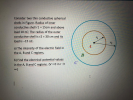 Consider two thin conductive spherical shells in Figure. Radius of inner conductive shell r1 = 15cm and above load 10 nC; The radius of the outer conductive shell is r2 = 30 cm and its load is -15 nC. 11 12 A a) The intensity of the electric field in the A, B and C regions, B С b) Find the electrical potential values in the A, B and C regions. (V = 0 in r → -) 1 -
Question 1 (5 points) We consider two uniformly-charged thin spherical conducting shells as shown in Figure...
 Question 1 (5 points) We consider two uniformly-charged thin spherical conducting shells as shown in Figure 1. The inner and outer shells have total charges of -Q and +Q, respectively. Figure 1: Charged spherical shells. [S1, S2 and S; and the fictive Gauss surfaces to be considered]. 1°/Determine the electric field in all regions. 2°/We insert a point charge of magnitude +Q at the center of the two shells. Determine the electric field in all regions.
Status and follow-up Participants 5 More - B Consider two thin, conducting spherical shells as shown...
 Status and follow-up Participants 5 More - B Consider two thin, conducting spherical shells as shown in figure above. The inner shell has a radius /7 = 15 cm and a charge of 10.0 PC. The outer shell has a radius ry - 30cm and a charge of -15.0 pC. Which of the following is the electric field E at region A(0) ? Carefull:takek, -9x10⁹ Your answer: rx 10-12 A) (0.15) x 4x .//m B) O V/m x 10-12 C)...
A spherical capacitor is formed from two concentric spherical conducting shells separated by vacuum. The inner...
A spherical capacitor is formed from two concentric spherical conducting shells separated by vacuum. The inner sphere has a radius of ra = 12.3 cm , and the outer sphere has a radius of rb = 15.0 cm . A potential difference of 120 V is applied to the capacitor. a) What is the capacitance of the capacitor? Use ϵ0 = 8.85×10⁻¹² F/m for the permittivity of free space. b)What is the magnitude E1 of the electric field E⃗ at radius...
A spherical capacitor is formed from two concentric, spherical conducting shells separated by a vacuum.
A spherical capacitor is formed from two concentric, spherical conducting shells separated by a vacuum. The inner sphere has a radius of 15.0 cm and the capacitance of the device is 116 pF. a) What is the radius of the outer sphere? b) If the potential difference between the two spheres is 220 V, how much energy is stored in this capacitor?
The space between two concentric conducting spherical shells of radii b = 2.20 cm and a...
The space between two concentric conducting spherical shells of radii b = 2.20 cm and a = 1.20 cm is filled with a substance of dielectric constant κ = 24.2. A potential difference V = 50.0 V is applied across the inner and outer shells. Determine (a) the capacitance of the device, (b) the free charge q on the inner shell, and (c) the charge q induced along the surface of the inner shell.
The space between two concentric conducting spherical shells of radii b = 1.70 cm and a...
The space between two concentric conducting spherical shells of radii b = 1.70 cm and a = 1.20 cm is filled with a substance of dielectric constant κ = 20.5. A potential difference V = 62.0 V is applied across the inner and outer shells. (a) Determine the capacitance of the device. (b) Determine the free charge q on the inner shell. (c) Determine the charge q' induced along the surface of the inner shell.
A conducting spherical shell of inner radius a= 50.0 cm and outer radius b= 60.0 cm...
 A conducting spherical shell of inner radius a= 50.0 cm and
outer radius b= 60.0 cm has a net charge Q1= -7.00 μC. A second
larger conducting shell of inner radius c= 70.0 cm and outer radius
d= 80.0 cm has a net charge of Q2= +3.00 μC, and it is concentric
with the first shell as shown in the figure to the left. What is
the magnitude and direction of the electric field as a function of
distance from...
A conducting spherical shell of inner radius a= 50.0 cm and
outer radius b= 60.0 cm has a net charge Q1= -7.00 μC. A second
larger conducting shell of inner radius c= 70.0 cm and outer radius
d= 80.0 cm has a net charge of Q2= +3.00 μC, and it is concentric
with the first shell as shown in the figure to the left. What is
the magnitude and direction of the electric field as a function of
distance from...
Concentric Cylindrical Conducting Shells 1 An infiinitely long solid conducting cylindrical shell of radius a =...
 Concentric Cylindrical Conducting Shells
1
An infiinitely long solid conducting cylindrical shell of radius
a = 4.8 cm and negligible thickness is positioned with its symmetry
axis along the z-axis as shown. The shell is charged, having a
linear charge density ?inner = -0.35 ?C/m. Concentric
with the shell is another cylindrical conducting shell of inner
radius b = 17.1 cm, and outer radius c = 21.1 cm. This conducting
shell has a linear charge density ? outer =
0.35?C/m....
Concentric Cylindrical Conducting Shells
1
An infiinitely long solid conducting cylindrical shell of radius
a = 4.8 cm and negligible thickness is positioned with its symmetry
axis along the z-axis as shown. The shell is charged, having a
linear charge density ?inner = -0.35 ?C/m. Concentric
with the shell is another cylindrical conducting shell of inner
radius b = 17.1 cm, and outer radius c = 21.1 cm. This conducting
shell has a linear charge density ? outer =
0.35?C/m....
Four thin spherical shells with radii Ry = 3.00 cm, R2 = 5.00 cm, R3 =...
 Four thin spherical shells with radii Ry = 3.00 cm, R2 = 5.00 cm, R3 = 7.00 cm, and R4 = 9.00 cm are all concentric. All shells are made of insulating material with their net charge distributed uniformly over the surface. Shell R, has net charge q = +2.00 nC, shell R2 has net charge 42 = -5.00 nC, shell Rhas net charge +4.00 nC, and shell Rd has net charge 44 = -7.00 nC. Take the electric potential...
 Consider two thin conductive spherical shells in Figure. Radius of inner conductive shell r1 = 15cm and above load 10 nC; The radius of the outer conductive shell is r2 = 30 cm and its load is -15 nC. 11 12 A a) The intensity of the electric field in the A, B and C regions, B С b) Find the electrical potential values in the A, B and C regions. (V = 0 in r → -) 1 -
 Question 1 (5 points) We consider two uniformly-charged thin spherical conducting shells as shown in Figure 1. The inner and outer shells have total charges of -Q and +Q, respectively. Figure 1: Charged spherical shells. [S1, S2 and S; and the fictive Gauss surfaces to be considered]. 1°/Determine the electric field in all regions. 2°/We insert a point charge of magnitude +Q at the center of the two shells. Determine the electric field in all regions.
 Status and follow-up Participants 5 More - B Consider two thin, conducting spherical shells as shown in figure above. The inner shell has a radius /7 = 15 cm and a charge of 10.0 PC. The outer shell has a radius ry - 30cm and a charge of -15.0 pC. Which of the following is the electric field E at region A(0) ? Carefull:takek, -9x10⁹ Your answer: rx 10-12 A) (0.15) x 4x .//m B) O V/m x 10-12 C)...
 A conducting spherical shell of inner radius a= 50.0 cm and
outer radius b= 60.0 cm has a net charge Q1= -7.00 μC. A second
larger conducting shell of inner radius c= 70.0 cm and outer radius
d= 80.0 cm has a net charge of Q2= +3.00 μC, and it is concentric
with the first shell as shown in the figure to the left. What is
the magnitude and direction of the electric field as a function of
distance from...
A conducting spherical shell of inner radius a= 50.0 cm and
outer radius b= 60.0 cm has a net charge Q1= -7.00 μC. A second
larger conducting shell of inner radius c= 70.0 cm and outer radius
d= 80.0 cm has a net charge of Q2= +3.00 μC, and it is concentric
with the first shell as shown in the figure to the left. What is
the magnitude and direction of the electric field as a function of
distance from...
 Concentric Cylindrical Conducting Shells
1
An infiinitely long solid conducting cylindrical shell of radius
a = 4.8 cm and negligible thickness is positioned with its symmetry
axis along the z-axis as shown. The shell is charged, having a
linear charge density ?inner = -0.35 ?C/m. Concentric
with the shell is another cylindrical conducting shell of inner
radius b = 17.1 cm, and outer radius c = 21.1 cm. This conducting
shell has a linear charge density ? outer =
0.35?C/m....
Concentric Cylindrical Conducting Shells
1
An infiinitely long solid conducting cylindrical shell of radius
a = 4.8 cm and negligible thickness is positioned with its symmetry
axis along the z-axis as shown. The shell is charged, having a
linear charge density ?inner = -0.35 ?C/m. Concentric
with the shell is another cylindrical conducting shell of inner
radius b = 17.1 cm, and outer radius c = 21.1 cm. This conducting
shell has a linear charge density ? outer =
0.35?C/m....
 Four thin spherical shells with radii Ry = 3.00 cm, R2 = 5.00 cm, R3 = 7.00 cm, and R4 = 9.00 cm are all concentric. All shells are made of insulating material with their net charge distributed uniformly over the surface. Shell R, has net charge q = +2.00 nC, shell R2 has net charge 42 = -5.00 nC, shell Rhas net charge +4.00 nC, and shell Rd has net charge 44 = -7.00 nC. Take the electric potential...
Most questions answered within 3 hours.
-
Where is the error in this code sequence?
String s1 = "Hello";
String s2 = "ello";...
asked 11 months ago -
Financial data for Joel de Paris, Inc., for last year
follow:
Joel de Paris, Inc.
Balance...
asked 11 months ago -
Consider this reaction:
Al2(SO4)3 (aq)+ BaCl3
(aq) Al2Cl6 (aq)- +
3BaSO4(s) . What is the...
asked 11 months ago -
Suppose that Savneet is considering increasing her
recent random sample from 20 car rentals to 40...
asked 11 months ago -
Trucks arrive at an unloading terminal at an average rate of 120
per hour.
Trucks arrive...
asked 11 months ago -
Why are methanol and ethanol completely soluble in water while
octanol is not very little soluble....
asked 11 months ago -
A facilities manager at a university reads in a research report
that the mean amount of...
asked 11 months ago -
When the CuSO4 is rehydrated by adding water to the anhydrous
compound, is this an endothermic...
asked 11 months ago -
A ray of sunlight is passing from diamond into crown glass; the
angle of incidence is...
asked 11 months ago -
A block of mass 0.249 kg is placed on top of a light, vertical
spring of...
asked 11 months ago -
how do the kidneys compensate in the presences of acidosis
a) trigger hyperventilate
b) reserve acid...
asked 11 months ago -
Question 501 pts
The rental rate of capital to the firm increases. Which of the
following...
asked 11 months ago