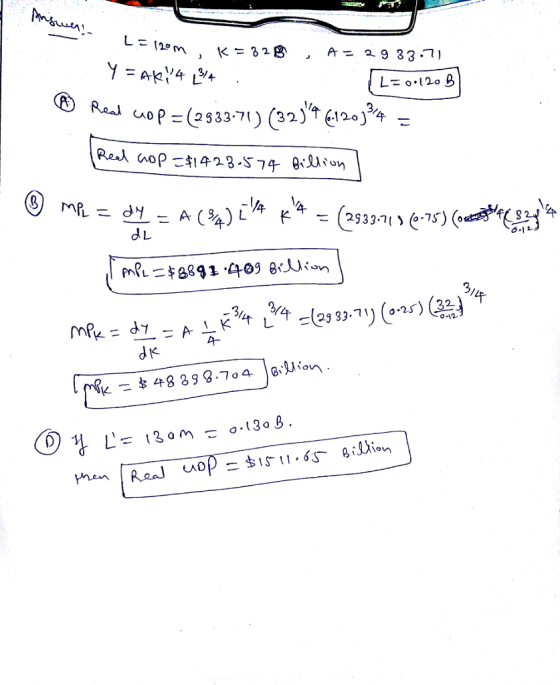
Given that Labor Force is 120M workers, the capital stock is 32 B, and total productivity...
Given that Labor Force is 120M workers, the capital stock is 32 B, and total productivity is 2933.71 A. If production function is Y=AK1/4L3/4, What is real GDP b. What is MPL c. What is MPK d. If labor force increase 130 M workoers, what will happen to real GDP c. Graph the production function, with capital on the horizontal axis, and use your graph to explain the different effect of doubling force and doubling total factor productivity.
Homework Answers
Add Answer to:
Given that Labor Force is 120M workers, the capital stock is 32
B, and total productivity...
Assume a society that has a labor force of 200 million (0.2 billion) workers, a capital...
Assume a society that has a labor force of 200 million (0.2 billion) workers, a capital stock of $55,000 billion, and a real gdp that is $6,500 billion Given the production function Q = A(K0.5 L0.5) determine the value for productivity.
1. Marginal productivity of capital in a given economy is described by the following function: MPK...
 1. Marginal productivity of capital in a given economy is described by the following function: MPK = 48/J(K), where K stands for aggregate capital and MPK for marginal productivity of capital. (a) Use words to explain what MPK measures. (b) Calculate MPK when K = 16 and when K = 64. How does MPK change as K increases? What property does this MPK function capture? (c) Write down the two assumptions of the classical environment and explain what they imply....
#1 (2 points) What are the relationships that the aggregate production function repre- sents? As a...
 #1 (2 points) What are the relationships that the aggregate production function repre- sents? As a hypothetical example, describe each part of the function as if the variables represent data from the United States. #2 (2 points) In economics, what is the difference between the short run and long run? Is the aggregate production function a short run or long run model? #3 For this question use this aggregate production function: Y = AK1/4 [3/4 Part A) (2 points) Does...
Consider the following production functions Y = AK1/2L1/2 Y=AK+3L a. Fixing total factor productivity (A) at...
Consider the following production functions Y = AK1/2L1/2 Y=AK+3L a. Fixing total factor productivity (A) at 2 and labor employment (L) at 16 units, what is the marginal product of capital when capital employment (K) is 25, 35, and 45 for each production function? Do these production functions exhibit diminishing returns to capital employment? Explain. b. Are labor and capital complements under these production functions? Explain. c. Is either production function a “Cobb-Douglas” function? Explain. 3. Describe the difference between...
19. Computing labor productivity and its relationship to the demand for labor
 19. Computing labor productivity and its relationship to the demand for labor Gopher Excavators produces shovels in a small factory and sells the shovels in a competitive market. The following table shows the company's production function: Labor (Number of workers)Output (Shovels)001952185326043205355Use the blue points (circle symbol) to plot the production function for Gopher Excavators on the following graph, Calculate the marginal product of labor (MPL) of each worker, and then plot the MPL curve on the following graph using the blue points (circle...
Suppose a firm’s production function is given by Q = L1/2*K1/2. The Marginal Product of Labor...
Suppose a firm’s production function is given by Q = L1/2*K1/2. The Marginal Product of Labor and the Marginal Product of Capital are given by: MPL = ½ L-1/2K1/2and MPK = ½ L1/2K-1/2 a) Suppose the price of labor is w = 18, and the price of capital is r = 2. Derive the firm’s total cost function. b) What is the firm’s marginal cost? c) For this problem, you will sketch the graph of the firm’s isoquant for Q...
Econ 202 Problems Chapter 12 – Long-run economic growth 1. The production function of an economy...
 Econ 202 Problems Chapter 12 – Long-run economic growth 1. The production function of an economy is: Y= A * K0,3 * H0.7 a. What is real output when K = 10, H = 40 and A = 5? (2 point) b. Does this production function exhibit diminishing marginal productivity of capital? Calculate MPK if K increases from 10 to 20 and from 20 to 30, keeping H and A constant. Assume H = 70, A = 4. (5 points)...
Canvas > x C @ B. Average Labor Productivity "Share of Population employed Total Labor Productivity...
 Canvas > x C @ B. Average Labor Productivity "Share of Population employed Total Labor Productivity Population Average Labor Productivity/Share of Population Employed Question 7 A country has these statistics: Population = 31 million Number of employed workers * 21 million Real GDP 15,401 million What is Real GDP per capita for this country? Give your answer to 2 decimal places. That is, if your calculator says 23.3577970897, write 23.36 Question 8 A country has these statistics: Population31 million Question...
Question 3: Productivity, Output, and Employment (20 marks) Assume that the aggregate production is given by...
 Question 3: Productivity, Output, and Employment (20 marks) Assume that the aggregate production is given by the following: Y stands for output, K stands for the capital stock, N stands for the number of the people employed, L stands for the quantity of land used in production, and A stands for a measure of labour efficiency. α and β are parameters whose values are between 0 and 1. a) Derive an analytical expression for the marginal product of capital (MPK),...
Question 3: Productivity, Output, and Employment (20 marks) Assume that the aggregate production is given by...
 Question 3: Productivity, Output, and Employment (20 marks) Assume that the aggregate production is given by the following: Y stands for output, K stands for the capital stock, N stands for the number of the people employed, L stands for the quantity of land used in production, and A stands for a measure of labour efficiency. a and B are parameters whose values are between O and I a) Derive an analytical expression for the marginal product of capital (MPK),...
 1. Marginal productivity of capital in a given economy is described by the following function: MPK = 48/J(K), where K stands for aggregate capital and MPK for marginal productivity of capital. (a) Use words to explain what MPK measures. (b) Calculate MPK when K = 16 and when K = 64. How does MPK change as K increases? What property does this MPK function capture? (c) Write down the two assumptions of the classical environment and explain what they imply....
 #1 (2 points) What are the relationships that the aggregate production function repre- sents? As a hypothetical example, describe each part of the function as if the variables represent data from the United States. #2 (2 points) In economics, what is the difference between the short run and long run? Is the aggregate production function a short run or long run model? #3 For this question use this aggregate production function: Y = AK1/4 [3/4 Part A) (2 points) Does...
 Econ 202 Problems Chapter 12 – Long-run economic growth 1. The production function of an economy is: Y= A * K0,3 * H0.7 a. What is real output when K = 10, H = 40 and A = 5? (2 point) b. Does this production function exhibit diminishing marginal productivity of capital? Calculate MPK if K increases from 10 to 20 and from 20 to 30, keeping H and A constant. Assume H = 70, A = 4. (5 points)...
 Canvas > x C @ B. Average Labor Productivity "Share of Population employed Total Labor Productivity Population Average Labor Productivity/Share of Population Employed Question 7 A country has these statistics: Population = 31 million Number of employed workers * 21 million Real GDP 15,401 million What is Real GDP per capita for this country? Give your answer to 2 decimal places. That is, if your calculator says 23.3577970897, write 23.36 Question 8 A country has these statistics: Population31 million Question...
 Question 3: Productivity, Output, and Employment (20 marks) Assume that the aggregate production is given by the following: Y stands for output, K stands for the capital stock, N stands for the number of the people employed, L stands for the quantity of land used in production, and A stands for a measure of labour efficiency. α and β are parameters whose values are between 0 and 1. a) Derive an analytical expression for the marginal product of capital (MPK),...
 Question 3: Productivity, Output, and Employment (20 marks) Assume that the aggregate production is given by the following: Y stands for output, K stands for the capital stock, N stands for the number of the people employed, L stands for the quantity of land used in production, and A stands for a measure of labour efficiency. a and B are parameters whose values are between O and I a) Derive an analytical expression for the marginal product of capital (MPK),...
Most questions answered within 3 hours.
-
Where is the error in this code sequence?
String s1 = "Hello";
String s2 = "ello";...
asked 10 months ago -
Financial data for Joel de Paris, Inc., for last year
follow:
Joel de Paris, Inc.
Balance...
asked 10 months ago -
Consider this reaction:
Al2(SO4)3 (aq)+ BaCl3
(aq) Al2Cl6 (aq)- +
3BaSO4(s) . What is the...
asked 10 months ago -
Suppose that Savneet is considering increasing her
recent random sample from 20 car rentals to 40...
asked 10 months ago -
Trucks arrive at an unloading terminal at an average rate of 120
per hour.
Trucks arrive...
asked 10 months ago -
Why are methanol and ethanol completely soluble in water while
octanol is not very little soluble....
asked 10 months ago -
A facilities manager at a university reads in a research report
that the mean amount of...
asked 10 months ago -
When the CuSO4 is rehydrated by adding water to the anhydrous
compound, is this an endothermic...
asked 10 months ago -
A ray of sunlight is passing from diamond into crown glass; the
angle of incidence is...
asked 10 months ago -
A block of mass 0.249 kg is placed on top of a light, vertical
spring of...
asked 10 months ago -
how do the kidneys compensate in the presences of acidosis
a) trigger hyperventilate
b) reserve acid...
asked 10 months ago -
Question 501 pts
The rental rate of capital to the firm increases. Which of the
following...
asked 10 months ago